ESPN’s 2024 College Football Coverage Takes to the Cloud for Super Slo-Mo Replay
Chris Calcinari: 'We believe that cloud is the next iteration of our REMI operations, adding tremendous efficiency and flexibility'
Story Highlights
ESPN’s coverage of the Aer Lingus College Football Classic this past weekend in Dublin, Ireland saw the network take its REMI operations to the next level as it was the first time ever that ESPN — working alongside AWS and other vendors — used the cloud for super slo-mo operations (SSMO) traversing two AWS regions and overseas. The plan is now to deploy cloud-based SuperMo for the ACC and SEC Prime CFB games on Saturdays this fall, which is a valuable production enhancement to both of those broadcasts, according to ESPN’s REMI Technical Operations Manager Marissa Bonertz.

Ben Whitmire, ESPN, Senior Media Replay Operator, REMI, working in the cloud for the Aer Lingus College Football Classic.
Bonertz laid out the full workflow for the Dublin game, which began with the deployment of two 1080p four-phase SuperMo cameras on site in Dublin. The individual phases from each camera were encoded to SRT via a Riedel Venue Gateway encoder and then sent to AWS Elemental MediaConnect in the Dublin AWS region. The AWS Elemental MediaConnect in Dublin then connected to AWS Elemental MediaConnect in the U.S.-East region and the individual phases were decoded in two Riedel ViBox servers.
“Simplylive operators located in Bristol connected to the Riedel ViBox servers to control and operate SuperMo replay, with two outputs coming down to Bristol’s transmission department for integration into the REMI production,” she says. “By utilizing AWS resources in both Dublin and Virginia, video transport latency is reduced from site to the AWS data centers and control latency is reduced for the operators in Bristol.”
ESPN started testing cloud-based production proof of concepts two years ago with an offline test alongside the US Open. The past year has been focused on working closely with AWS and individual vendors to build out infrastructure-as code to support scalable deployments of SuperMo, All-in-One, and Discrete Cloud-based productions. Bonertz says that in addition to writing the code for automated deployments, AWS and ESPN have been focusing on training DEET Engineering and ESPN Operations teams to support cloud-based workflow development and day-to-day productions without the assistance of AWS personnel.
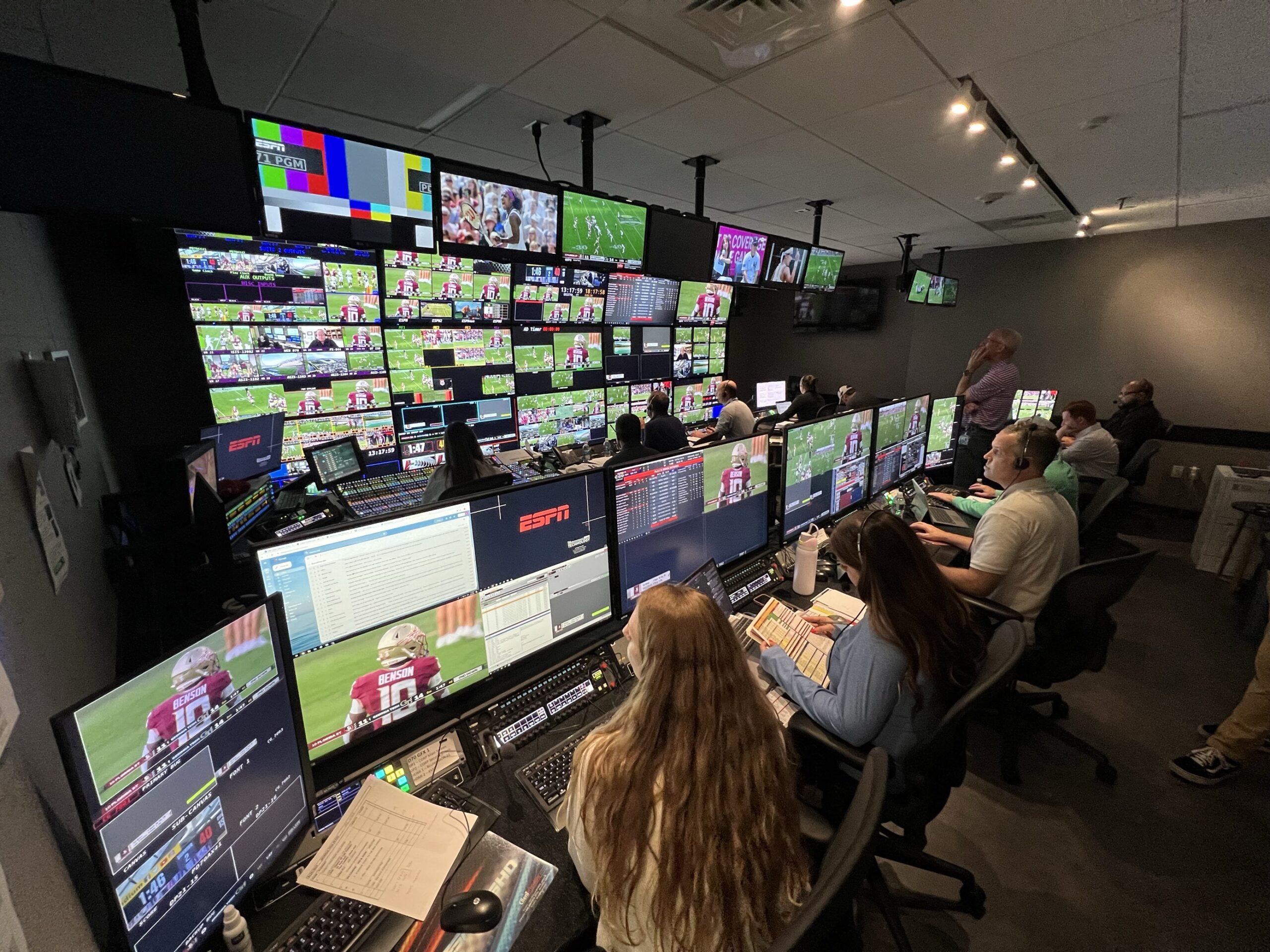
ESPN’s REMI production control room in Bristol was used to produce the Aer Lingus College Football Classic.
ESPN’s VP, Production Operations, Chris Calcinari, says the work with AWS is laying the foundation for a future where ESPN’s toolsets will be accessible anywhere, allowing the team to spin up resources as needed and at any time.
“We believe that cloud is the next iteration of our REMI operations, adding tremendous efficiency and flexibility,” he explains. “We have come a long way in a short amount of time thanks to the dedication and collaboration of so many teams behind the scenes.”
ESPN’s REMI Technical Operations Manager, Ben Neiger, says that with the success of this past weekend the team is now looking to roll out the same cloud-based workflows on two college football games every Saturday and ESPN is now implementing processes and workflows that will allow cloud-based resources to be deployed on a scalable and consistent basis.
“They will become part of our standard operating workflows instead of only being utilized on a one-off event with dedicated and specialized support teams in place,” adds Neiger.
ESPN’s Director, REMI Operations, Dan Lannon, says the network spent a significant amount of time creating automated deployment of software and systems and developing operational workflows to support full cloud-based productions as well as partial production deployments such as cloud-based replay.
“Thus far, we have created an operational model for Super SloMo replay that we have deployed for nine regular season WNBA games, multiple college baseball super-regional games, and six NBA Summer League games,” he says.
Lannon adds that cloud-based Super SloMo replay adds a production enhancement that wasn’t previously available due to a variety of technical and operational limitations. ESPN has deployed a cloud-based All-in-One production model to support full productions, including 40 Little League World Series games for both the Softball and Baseball Regionals.
“Those productions rely on several cloud-based software systems including Simplylive ViBox for video switching and replay, Solid State Logic for audio mixing, Vizrt for graphics, and several other software systems to achieve music playback, video and audio monitoring and signal conversion,” he says.
Bonertz says that Zoom rooms were utilized in the cloud for talent video contribution, providing individual NDI ISO feeds of each talent.
“Operators were in the Bristol facility, utilizing ESPN’s Direct Connect to AWS for control connectivity,” she says. “The final program feed was transmitted to Bristol’s Transmission Operations Center over the Direct Connect connection and distributed to ESPN+ and ESPN Linear networks.”
Lannon says that when it comes to high-profile games like the game in Dublin, fans expect certain production elements such as Super SloMo replay.
“We knew it was a must-have and when we looked at the different options to fit Super SloMo replay into the production plan, a simple and efficient model was necessary and cloud-based SSMO replay started to make a lot of sense,” he says. “Some of the benefits of a cloud-based model include minimal onsite equipment that is relatively simple to deploy, minimal bandwidth required, and the replay operator can work remotely in the facility with the rest of the production and operations team.”
Lannon adds that with so many things for the onsite operations team to manage and the director and producer to think about, the production team wanted to be as minimally impactful as possible with the setup.
“To production, it should look and operate like every other replay device they are used to,” he says. “The last thing we want to do is to deploy a science experiment that everyone is questioning how it works and will it work.”
Bonertz says that cloud-based productions will allow ESPN to deploy production enhancements on events where they would be otherwise unavailable in a cost-effective and efficient way.
ESPN worked closely with AWS during the entire run of POCs and now, the real-world projects. AWS’s Global Head of Sports, Julie Souza, says that over the past two years the two companies worked together to build a cloud REMI production architecture that not only supported ESPN technically, but also ensured their operators’ comfort and used their existing knowledge base.
“Through these PoCs, ESPN was able to programmatically iterate and build out a fully operationalized cloud REMI virtual Production Control Room (vPCR) environment, showcasing a successful transition to cloud-based workflows that meet their production values,” she explains.
Souza says to operationalize ESPN’s REMI Live Cloud Production architecture, AWS ProServe developed AWS CloudFormation templates for both all-in-one and super slow motion (Slomo) replay vPCR environments (creation of a third template is in-progress).
“The templates allow ESPN to quickly deploy and decommission REMI Production environments as needed, improving agility and optimizing resource management,” she adds. “This approach enables ESPN to scale and adapt their REMI productions as required, showcasing the growing sophistication of their cloud-based productions.”
DE&E Technology’s Director, Media Systems Engineering, Michael Kidd, says that the team has demonstrated some real and meaningful benefits to moving to the cloud.
“This has primarily been accomplished with a lift-and-shift approach, replicating the systems we’d normally deploy on-prem, as virtualized systems in a public cloud,” he says. “As more cloud-native solutions come to market and mature, we may also start talking about how we are extending the cloud into our production facilities. The result is that we’re likely to always have a production model that combines the benefits of public cloud resources and dedicated broadcast infrastructure, in increasingly new and useful ways.”
Souza says the AWS cloud-based REMI Live Production model represents a long-term, sustainable solution in several ways, including improved innovation, distributed production teams being able to work together from afar, and standardization across multiple productions.
“The model achieves scalability, allowing broadcasters to easily scale resources up or down based on production needs, ensuring an efficient use of resources and cost-effectiveness,” she explains. “Finally, cloud-based production facilitates easier management of international events and collaborations, supporting the increasingly global nature of sports broadcasting. This model not only addresses current production needs, but also provides a flexible foundation for future growth and technological advancements in the broadcasting industry.”