Live From Super Bowl LIX: Verizon’s Joe Russo on How 5G Can Get to the Next Level for Broadcasters, Fans
Standalone 5G turned on throughout New Orleans enables 5G advanced features
Story Highlights
Verizon EVP, Global Networks and Technology, Joe Russo is onsite at Super Bowl LIX making sure that the large Verizon team and the even larger Verizon 5G and wireless network are running properly. That network is particularly important because the coaching staffs of both the Kansas City Chiefs and the Philadelphia Eagles rely on a Verizon 5G network for their communications and, of course, tens of thousands of fans in the stadium will rely on it for their connectivity. Russo discussed the week’s efforts and the future of 5G as a tool for broadcast production with SVG.
What does Super Bowl Week mean for Verizon, given your role working with the NFL and also supporting the wireless needs of fans?
We leverage this event to showcase all our latest and greatest technology. It’s not only for the venue itself, the back office of the NFL, or the city around it. We’re trying to put all the technology we’ve been developing into the Super Bowl Weekend so that we can demonstrate all the new stuff. Several years ago, we started deploying 5G millimeter wave, and we just keep building on that.
We have the coach-to-coach communication for the second year. We have a private network for the broadcasters to communicate. And we turned on standalone 5G throughout New Orleans, which allows us to do 5G advanced features this year: slicing for first responders or creators, [for example,] can guarantee certain capabilities that they need for what they’re trying to do on our networks.

Verizon’s Joe Russo: “We leverage [the Super Bowl] to showcase all our latest and greatest technology. Several years ago, we started deploying 5G millimeter wave, and we just keep building on that.”
I meet with the NFL’s CIO every month, and we talk about lots of different things. I thought year one was exceptional: the performance of the network, the clarity of the communication is what they were looking for. And we over-delivered on that.
Two things have happened since then. First, we are doing it for all their international games via our private 5G portable network that we take with us, and they keep expanding the international games, which makes it challenging for us as we have to work with local carriers. The other thing is, we’re now working with the NFL on expanding the private network used for coach-to-coach to other things that they want to do, like back-office support or sideline communications. The referees now have watches that are connected to the private network. We have proved how a private network can give them end-to-end communication in a venue.
Obviously, broadcasters have shown they believe in bonded-cellular technologies from companies like LiveU or TVU Networks. They are hugely important for broadcasters everywhere. [We talked about] slicing. One of the dreams for broadcasters is the ability to roll out their broadcast cameras for an event and tap into a 5G wireless network.
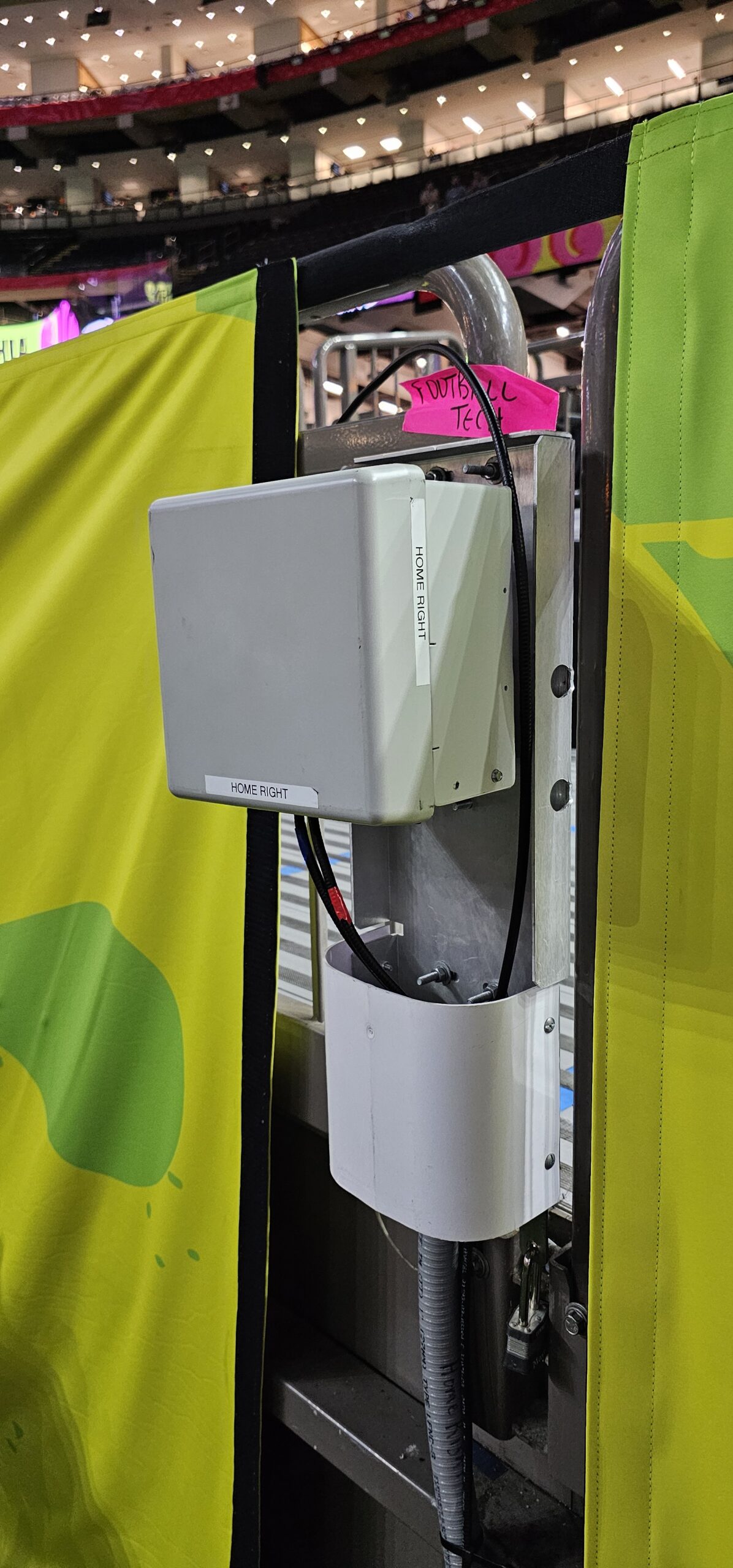
One of four 5G transmission nodes on the field of Super Bowl LIX that will support coaches communications. Only two are active at any one time, leaving the other two available as backups.
Where are we on the roadmap to making that a reality? We’re in the early innings, and there are three things that have to come together. The first is, you have to have the 5G core to support it. We launched that nationwide last year, so the core now has all the capabilities necessary to support 5G advanced features.
The second thing is, you have to have the radio access network to support the 5G advanced features. We’ve taken a bit of a different approach than some of our competitors in that. Our view is, if we’re going to offer these 5G advanced features, we need to do them on our mid-band or high-band spectrum because, if it’s on the low-band spectrum, you might as well use 4G LTE. Our view was, let’s build out the mid-band spectrum across the nation, get as much of the population covered as we can, and turn that spectrum on with standalone services. That’s kind of our strategy: make our standalone network a true differentiated experience that I could support with the great mid-band spectrum. We have the C-band spectrum or millimeter wave for certain applications, such as venues.
And then there is the third layer: the devices that support it. Today, I think, Samsung S21 and Apple 14 or newer cellphones have SA capability. But what we have to work on with the ecosystems of backpacks that may have a 5G chip is to get them to support standalone networks. I think that is where the industry is probably the furthest behind: having devices that support standalone networks.
What can be done to speed that along?
There are things we can do, like RedCap (or reduced-capacity) 5G, which means the core doesn’t need to support the kind of complex functions on a smartphone. We could reduce the form factor and reduce the cost. Our core now supports RedCap, and we’re working with all the device manufacturers to bring the price and form factors down for those 5G SA-capable devices so they can be put into backpacks and other things.
And the challenge there is that someone needs to manufacture devices with those capabilities but won’t do it unless there is a solid potential customer base who can support the manufacture of those devices.
Exactly. Look at the tablets that are used on the sidelines by the coaches and players at NFL games as an example. It’s a Microsoft tablet today, but it doesn’t support 5G millimeter wave. We and the NFL need to work with Microsoft to get those devices to support these new capabilities if we want to put them on the private network. That’s just one example of what has to happen.
Let’s discuss Sunday, when there will be around 83,000 people in the stadium and there will be a lot of outbound and inbound traffic. How are you setting up the network?
Part of what we do in the lead-up to a Super Bowl is to have lots of dry runs as we build out the platform and to watch how it is used during an NFL game or when the Sugar Bowl was here. The real test of what you’re talking about was when Taylor Swift [performed] here: you literally had 80,000 people live-streaming the whole concert. I don’t know who they’re streaming it to exactly, but it was the first time in my career — and I’ve been doing this for 30 years — when the uplink during the event was larger than the downlink. Our view is, the future of 5G and beyond is the uplink and we need to continue to figure out how to make that more and more robust because more and more people will be streaming these events. We’ll be sharing these things.
I’ve been using Meta glasses, and I absolutely envision that, in the next couple of years, this will be my personal assistant and, as a result, will be streaming what I’m seeing all the time so that it can help me see what I see and what I’m working through.
So how are you “load balancing” for upload vs download this Sunday?
For the Super Bowl, when we deploy our millimeter wave, we normally set up in an 80-20 ratio: 80% downlink spectrum usage, 20% uplink. We’ve changed those parameters and will be tuning it until game day, seeing how that works best for the environment. We have two layers of millimeter-wave spectrum: the 28 GHz layer will be 50-50, and the 39 GHz layer will be 80-20.