SVG Sit-Down: Cosm’s Devin Poolman on What It Takes To Deliver the Immersive Experience for Daytona, The PLAYERS, and March Madness
Immersive lens and spatial audio are new technology being developed
Story Highlights
The world of immersive entertainment is evolving rapidly, and Cosm is at the forefront of redefining how fans experience live sports via its Shared Reality venues in L.A. and Dallas featuring immersive an 87-foot diameter LED dome and 150-foot-wide LED display. From courtside seats at the NBA Finals and World Series to front-row views of the UFC and Super Bowl LIX, Cosm pushes the boundaries of what it means to “be there” without physically being there. Now the company is taking on a variety of new challenges, including NASCAR’s Daytona 500 last month, the PGA TOUR’s PLAYERS Championship this week, and the NCAA Men’s and Women’s Basketball Tournaments beginning next week.
SVG sat down the Devin Poolman, chief product and technology officer, Cosm, to explore how Cosm approached its first NASCAR event at Daytona, its expansion into golf at THE PLAYERS Championship, the company’s ambitious plans for March Madness, and how its proprietary technology is shaping the future of sports viewing both inside and outside its venues. From custom-built immersive lenses to innovative audio-capture techniques, Poolman discusses how the company’s technology not only serves the Cosm experience but also benefits leagues and broadcasters.

Cosm’s Devin Poolman: “We look at everything we’re doing right now as Phase 1, and we’re excited to build up [our portfolio of] events.”
It’s a less obvious fit [for the Cosm experience], for sure, but there are huge opportunities with [NASCAR] as well. [For] events that are more intimate, Cosm experience can bring a level of visceral reality: UFC is a great example; you are truly in the midst of it. Other [events] bring you the grandeur of the live environment or iconic destination: Daytona is very much that.
The same goes for NFL stadiums or the World Series at Dodger Stadium and Yankee Stadium. Those are less obviously made for immersive capture in that you think you want to be close. But the other part of immersive capture is, you want a sense of place; you want to feel like you’re there. Those factors — being up close and having a sense of place — can play together and make an event great.
I thought Daytona was incredible because you felt like you were in the grandstand. Our team captured the essence of that event and gave you that feeling like you’re incredibly, even uncomfortably close to the action while still giving you the excitement of being in the grandstand.
How did your production strategy change in covering Daytona compared with stick-and-ball sports?
I think the biggest difference was that Daytona gave us an opportunity to push the boundaries in terms of audio. I always say that we’re still in the early days of finding ways to drive the experience forward. [With] Daytona, we wanted to capture not just the visuals of being on the turn but the thrill of that audio as well.
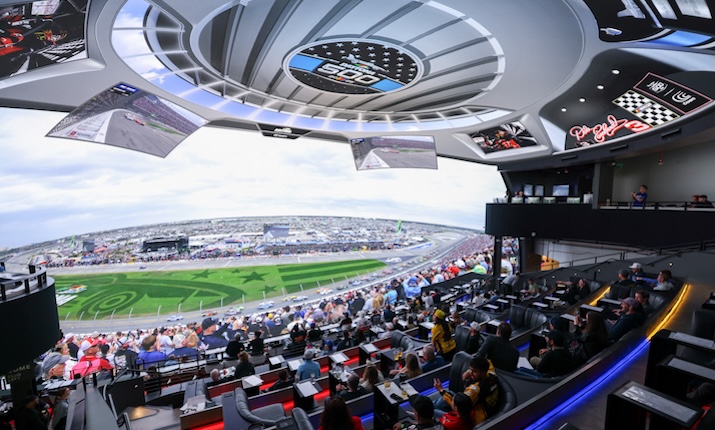
The Cosm experience gave fans feeling of being in grandstand at the Daytona 500.
In a typical production, we’re relying on the broadcaster to provide a great 5.1 audio mix. But we knew that, for the NASCAR experience, just having the announcers and the program audio coming in from the broadcaster — FOX, in this case — wouldn’t be enough to capture the experience of sitting on that turn watching cars flying by. Especially, if FOX is covering pit lane and you’re supposed to be sitting on turn watching these cars fly by 200 mph, there’s going to be a total disconnect if you don’t have the sound of the cars.
Our team worked hand in hand with FOX to pull all their unique audio stems and create a per-camera mix of audio, so we could cut around the track, covering a few corners as well as that high wide shot.
We did a custom immersive-audio mix on a per-camera basis and brought that into the Cosm experience. The sound was amazing, but it was the first time we were trying that on the ground so we were building the plane as we were flying. Thankfully, we have an awesome team, and they did a great job. After the first few laps, the audio was great.
What was the camera-coverage plan for Daytona?
For Daytona, we used a single capture system, typically four or five cameras and an onsite crew. Daytona was three shots on the corner and a high wide, as well as a secondary high wide, and we had audio stems for each of those positions. We’re looking forward to doing more NASCAR in the future.
You’re starting another chapter again this week with golf at THE PLAYERS Championship. How are you bringing a sprawling golf course to the Cosm immersive experience?
This will be our first golf tournament, and golf presents a unique challenge because, unlike with most of the events we cover (even a big racetrack like Daytona), there isn’t one place where all the action is taking place. Instead of one vantage point, there are 18 or more events going on at once. It’s up to us to find the best way to capture the action.
We’re going to try to give the fans the best of both worlds, similar to the old days of going to the baseball game and bringing a handheld radio so you could be there in person but also follow the storyline of the broadcaster. That’s going to be the focus for golf.
Just like going to the tournament [in person], you’re going to pick your hole. The good news is, we get to pick more than one hole and more than one vantage point at a time. We are going to be at the final three holes, including the iconic No. 17 island green. We are going to have a camera mounted in the water looking at the island green, which is going to be a stunning shot that I don’t think people have seen before. Again, it’s better than being there in person.
These featured holes are going to be complemented with the broadcaster’s coverage. It’s going to feel like you’re sitting there watching the golf tournament at No. 17 but still have your TV with all the storytelling offered by the broadcaster. We always have the program feed from the broadcaster coming in, [giving you] the backdrop of the overall tournament, and we’re going to mix that in with the featured holes.

A single four- or five-camera capture system and custom immersive-audio mix were deployed for the Daytona 500 Cosm experience.
Similar to what we did with Daytona, we’re going to have per-camera audio feeds corresponding to wherever we are on those featured holes.
Next up after THE PLAYERS will be the NCAA Men’s Basketball Tournament, which presents an entirely different challenge in terms of the sheer volume of events. Can you preview your plans for March Madness starting next week?
We are picking up one or two locations per day, which means deploying several capture systems and teams. We will be covering 29 [of the 67 games] immersively, including all the Elite 8, Final Four, and Championship games. Of course, we’ll have all the games available to watch simultaneously in The Hall on our wall-to-wall multiview LED screen experience.
Yes, it’s our first March Madness, but the scale is not new for us. The team has been executing on north of a hundred games every 90 days for most of the past four to six months. Our team has the ability to capture games night after night all around the world, sometimes four events per day.
You’ll also be producing the Women’s Final Four for Cosm venues, right?
Yes, we’re thrilled to be delivering the Women’s Final Four and National Championship Game immersively. There are so many stars and so much excitement around that sport right now, our team can’t wait to bring that excitement into Cosm venues.
What’s the next sport Cosm is looking to produce in shared reality?
We’ve been very fortunate to have a wide selection of events and sports and partners to work with, and we’re looking forward to making more announcements. Nothing to announce right now, but we are excited to take some more swings at baseball, we have the NBA and NHL Playoffs in the next few weeks, and we’re already looking forward to the NFL and college-football seasons this fall. We look at everything we’re doing right now as Phase 1, and we’re excited to build up [our portfolio of] events.

Cosm will deliver several NBA Playoffs games at its L.A. and Dallas venues this spring.
In terms of the capture technology, how are you looking to continue to enhance the Cosm production quality?
Our team is always working on what we can do to capture a better image. We’ve started rolling out our custom-designed Cosm Immersive Lens. We’ve used it at a handful of events, including the Super Bowl, and it is truly stunning in terms of the quality of the immersive capture. It has been in development for about two years; we have a handful of them and are working with our manufacturing partnering to deliver more.
The lens captures 180 degrees and is incredibly fast and sharp, which allows us to capture motion better and shoot in lower-light conditions. We’re thrilled with what we’re seeing and think it’s only going to get better.
Plus, it’s going to benefit not just our fans watching at the Cosm venues but also our B2B side working with broadcast and league partners. In terms of image quality, it’s a huge step forward, so we’re going to see that being used at more and more events throughout this year.
Speaking of your B2B strategy, how are Cosm production tools being used by broadcasters and leagues outside of your own productions?
We’ve invested a ton into the quality of the capture technology that we use to deliver into our dome. That technology can be used to deliver to other platforms, like VR headsets. We also deliver week in and week out on NFL and college football via our pylon capture systems.
The C360 system allows us to essentially deliver a virtual robotic camera that sees everything at all times. You have a replay system that can scrub back 30 seconds and get a completely different look at what’s captured. That’s driving more and more value for our B2B partners.
Going back to the Cosm Immersive Lens, that is game-changing in terms of the quality of capture going to broadcast. We can provide an excerpt of a 10.5k video that is beautifully sharp edge to edge, and, on top of that, we can apply super-slo-mo driven by AI. We are able to offer beautiful slo-mo images off a virtual-level camera to our broadcast partners, and it can be done from the same kits that we’re using to deliver into our Cosm venues. There’s a win-win there.
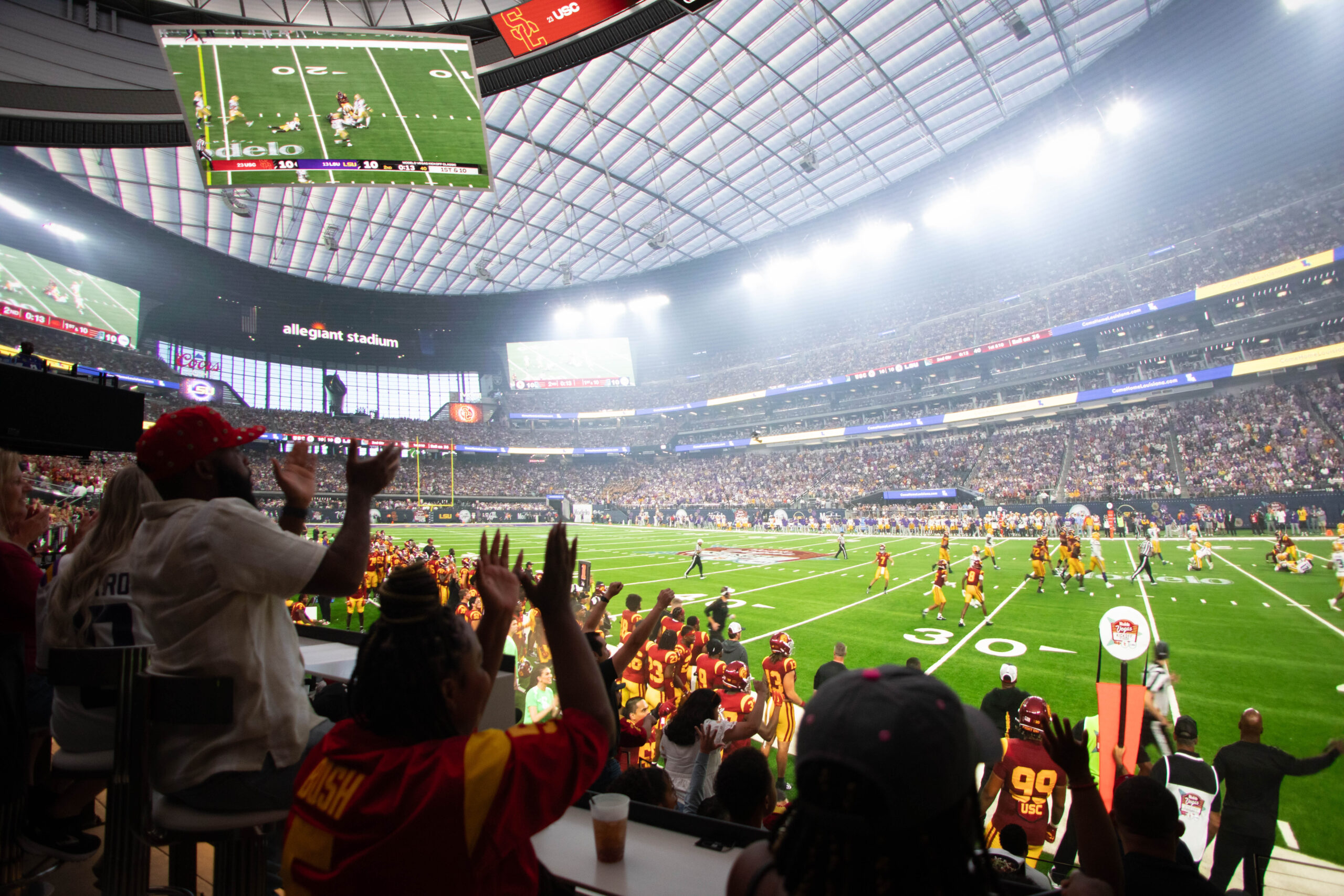
Last season’s USC vs LSU matchup was among the college-football games produced by Cosm last season.
Aside from the capture side, how else are you looking to enhance the overall Cosm experience?
We are focused on weaving in sports data and graphics in more meaningful ways. March Madness is going to be a great example of that: the roof of the dome is going to be one big March Madness bracket that will update in real time. You’re going to see animations and dynamic elements that celebrate big moments when a team wins or a big event happens. We are excited about how the role interactive graphics can play in the whole experience in our venues and bring a new level of excitement.
You have venues coming in Detroit and Atlanta, but what can you share about future growth?
Nothing new to report right now, but we are looking very actively in most major metro areas, trying to find the right mix of location and partner. Keep an eye out for some announcements down the road, but we are [preparing] to stand up our two venues in Detroit and Atlanta next year and will get ready for building more after that.
One of the reasons we wanted to open Los Angeles and Dallas so close to each other was to force our team to think about the scale needed to build more than one of these venues at a time. The intent is to create a repeatable process in terms of construction, technology setup, and day-to-day operations. We’re at a point where we’re running smoothly day in and day out and are excited for what’s next.
I also want to mention that we are very vertically integrated in terms of the design and manufacturing of our domes: from the software that drives the displays to the software capturing onsite and even the team developing the custom experiences. We actually bend the metal at our [Spitz manufacturing facility in] Chadds Ford, PA, to construct the domes; we’ve been doing that for decades with major parks, attractions, and theater partners. Of course, there are scenarios like our LED modules or our lenses — we design them, and they’re manufactured by a partner — but we take a lot of pride in that vertical integration.
You simply can’t get the quality of display if you’re not controlling every single bit of the [chain] from the physical structure to the software. We oversee every pixel and the software to drive the media, capturing it all the way through to deliver a unique value proposition.
This interview has been edited for length and clarity.