An Inside Look as TGL Production Efforts Shift Into Playoff Mode
Mixing the virtual and physical, the young golf league has evolved in its first season
Story Highlights
The playoffs of the inaugural season of TGL begin tonight. For the upstart golf league and TMRW Sports CTO Andrew Macaulay; VP, Content/Producer, Jeff Neubarth; TGL Director Johnathan Evans; and Consulting Technical Producer Colin DeFord, it’s a chance to up the coverage and make the most of more than two months of regular-season coverage that provided plenty of learning about how best to produce a unique event mixing virtual technologies, real physical playing surfaces, and a production philosophy that merges sports and entertainment. It also provides a brief moment to reflect on how the reality matched up with the vision.
The semifinals take place tonight and tomorrow, with the best-of-three Finals Series on March 24 and 25.
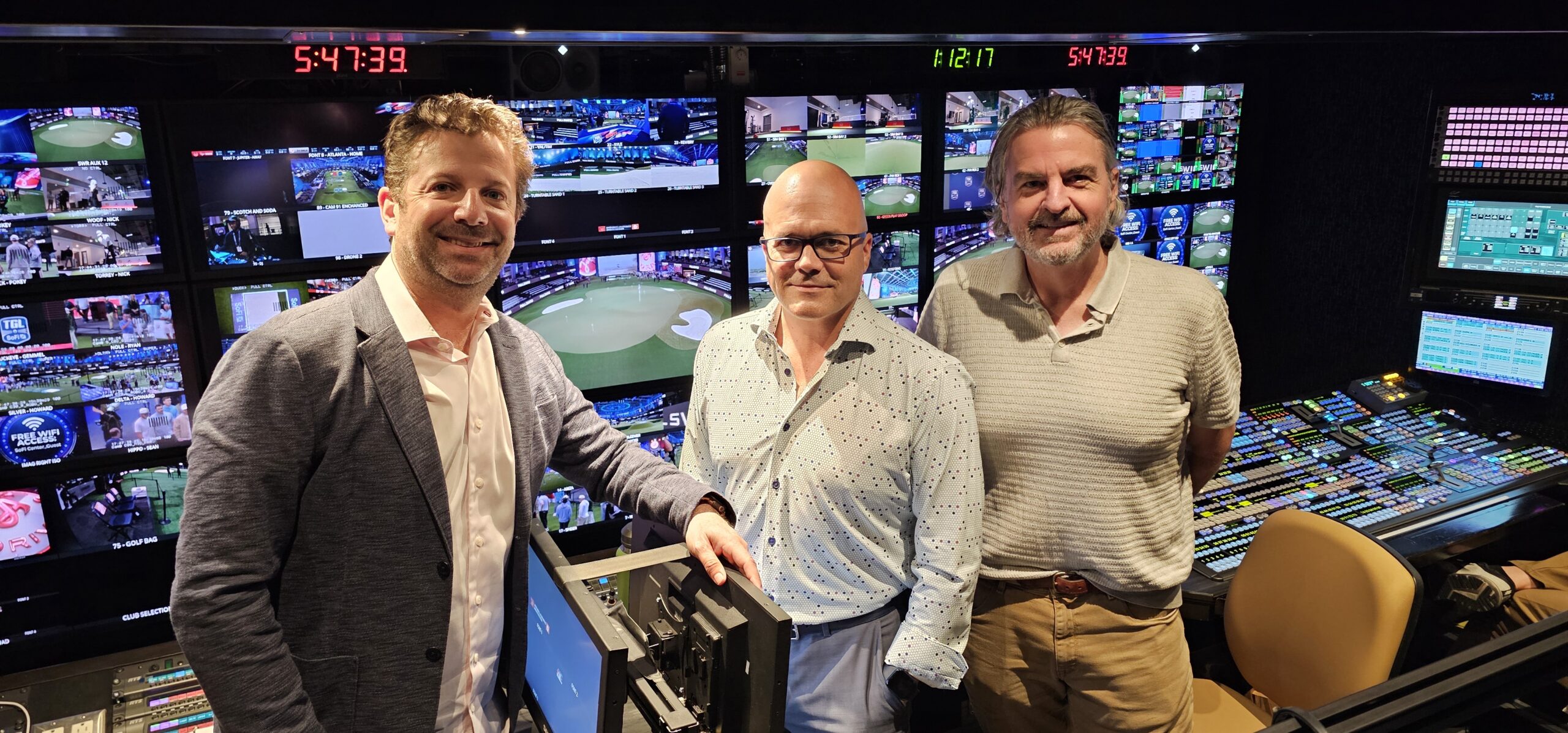
From left: Jeff Neubart, Johnathan Evans, and Colin DeFord inside the main production unit for TGL coverage, Game Creek Video Moonshine.
“It’s exactly what we had in mind,” says Macaulay. “I’m pleased with the outcome, and that’s the tech for the game as well as the digital displays, the broadcast tech, and the non-sexy infrastructure of the building that supports it. This all came together with timelines that overlapped, which meant we had to be super tight in terms of collaboration and communication. We got to know the names of the electricians, the plumbers, and the steel guys as we all worked around each other.”
Neubarth notes that, from a production standpoint, the team learned it’s okay to evolve. “I can’t wait ’til we’ve awarded the SoFi Cup so I can watch the very first show and see how far we’ve come and how far we’ve evolved. Whether it’s getting more clubs in the graphics or knowing when to talk to players or when to lay out, we’re learning how to tell stories. I can’t wait to sit with Johnathan after the season’s over and remap this production based on what we’ve learned and what we’ve seen so we can consistently make it better.”
Evans says he and the team have learned to get used to a pace of play that doesn’t involve following golfers as they walk hundreds of yards down a fairway following a tee shot. Instead, the TGL concept compresses that acres upon acres of coverage down to a small footprint that can fit inside a small arena.
The SoFi Center in Palm Beach Gardens, FL, houses the massive golf-simulator screen (64 ft. wide x 53 ft. tall) and an equally massive, 3,800-sq.-ft. GreenZone short-game area with a 41-yard-wide rotating turntable. Under the putting area of the turntable are nearly 600 actuators that can change the contours and slope of the green. Toss in an onsite crowd of around 1,500, who are encouraged to make some noise, and indoor lighting created by a former WWE lighting designer, and TGL has created a special place for professional golfers, fans, and viewers.
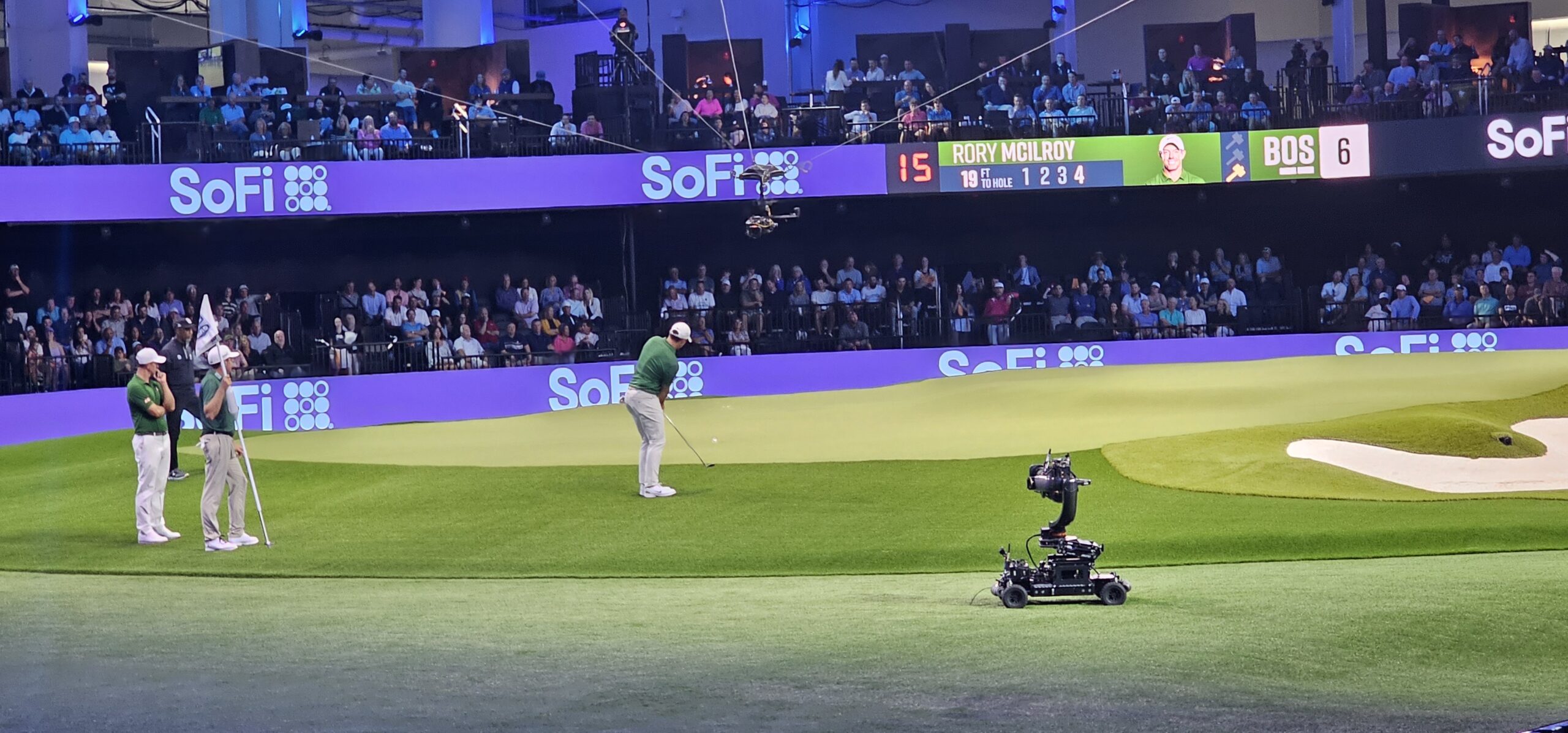
The TGL GreenZone changes contours and rotates from one hole to the next, challenging the camera-ops team to change assignments from one hole to the next.
“I think one of the biggest surprises was how fast everything is,” says Evans. “We can sit there and conceptualize what it’s going to be, and we can plan for everything. But, once we started, we saw how fast the pace was: every single minute of the broadcast, there’s a graphic, there’s a story, there are mics, there are replays. It doesn’t stop for two hours straight.”
While much of the buzz around TGL focused on the virtual world, the simulator technology, and the massive screen that players hit into, one of the biggest challenges for Evans and the crew was the real-world GreenZone, where the players left the virtual world behind and trade in woods and irons for wedges and putters. A real-world golf tournament has dedicated camera positions at each green, where camera operators patiently wait for the next group of golfers to arrive. TGL is vastly different: the camera operators and production crew covering the green complex reshuffle for each of the 15 holes as the TGL green complex rotates on a giant turntable and even changes contours and pin locations.
“We have to make sure the camera guys can get something on the backside,” says Evans, “covering the team that’s on the ball as well as the team that’s off the ball. We do need to capture those reactions because they are the best reactions. But it’s one of the biggest challenges because the green will rotate, undulate, have different pins, and we have to reshuffle the deck of camera coverage. It’s not the easiest thing in the world to do on the fly.”
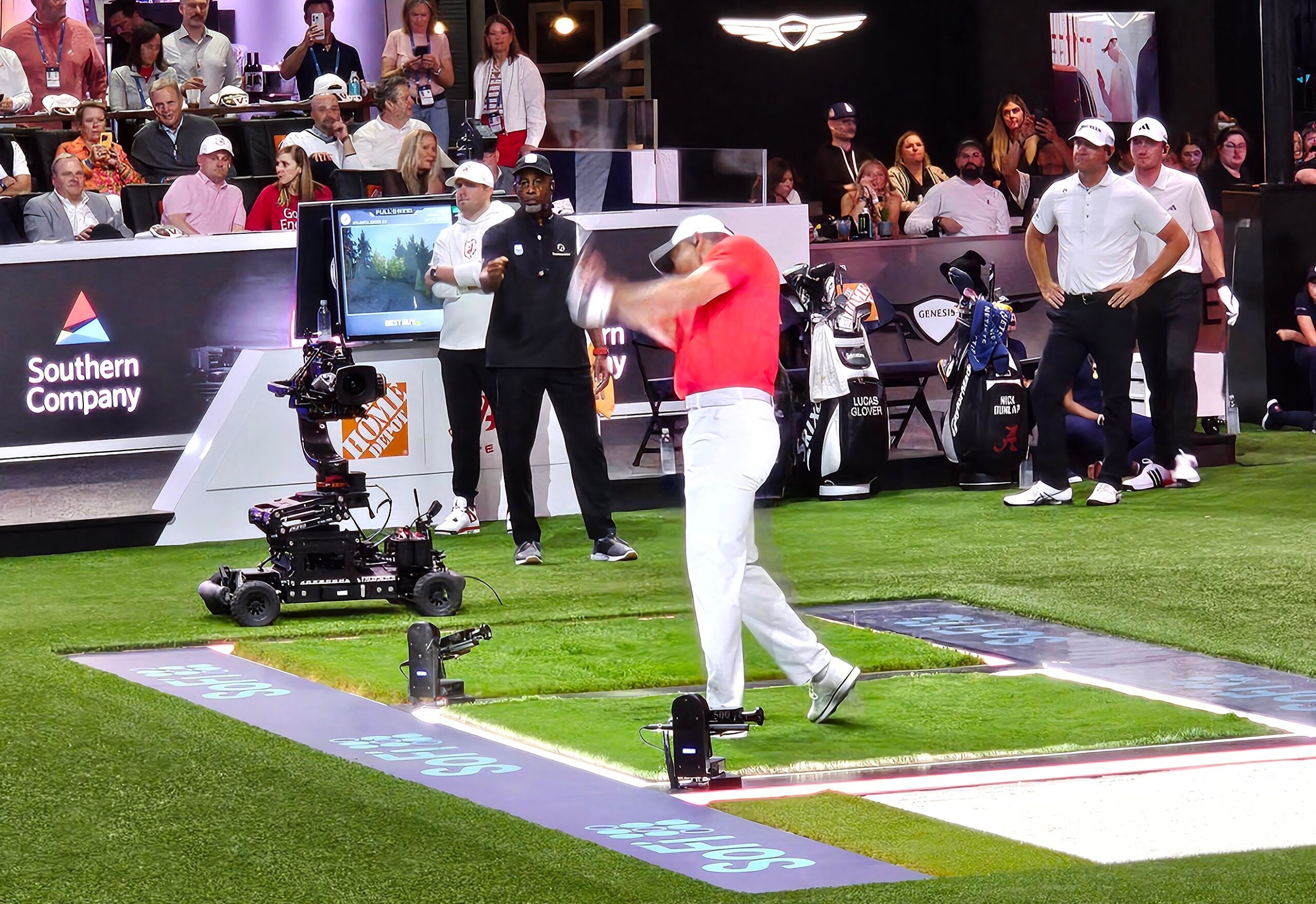
A mix of robotic cameras, a Rovercam, and Steadicam units captures the TGL golfer on the tee box from all angles.
Evans and the team have learned how to make the most of the 70-plus cameras while making sure that other cameras aren’t in the shots as the players move among the three fields of play (the 20-yard tee box, the 35-yard tee box, and the GreenZone).
“We’ve been sparingly using the Steadicam and the RF cameras on the field and, instead, using the Spidercam or the FPV drones as well as the POV cameras,” adds Evans. “We made sure every inch of this building was covered in some fashion, whether [using] traditional cameras or trying to find a way to put specialty cameras out, like the mini POV cameras on tee boxes that are amazing. And the C360 cameras in the bunkers give us a great look.”
During the season, the team has been looking to push the drone coverage in new ways. “At first,” says Neubarth, “it was just, Let’s use it on the way in and on the way out of the break. But there’s no reason not to use it to show what the actual golf shot is on the green coverage. Working with the drone pilots has been a huge experience and a lot of fun. We’re getting them to fly as fast as they can to have one shot that shows the dynamics of this venue.”
When it comes to innovations that could filter into traditional TV golf coverage, SmartPin Cam looks most promising. Evans calls a star of the show. The camera system features two 180-degree cameras mounted on the flag pin, providing 360 degrees of coverage from the pin looking out at the golfers and green.
“We spent a year and a half on that,” he notes. “I couldn’t be happier with the coverage from it. It was a gut-wrenching roll of the dice to take it live, but, the first time we did, Lucas Glover holed out. What more could a director want? It’s like having a camera on the mound at Yankee Stadium.”
The live stitching of the two 180-degree images takes about half a second, notes SmartPin CEO Ashley Loyd. “We can take four outputs from the SmartPin camera, slicing out 1080p sections. Our operator can toggle the joystick and jump between each view and drive the phantom-pole effect [which allows the camera to look straight down at the hole below the pin, but the pin isn’t visible]. That shot surprises a lot of people.”
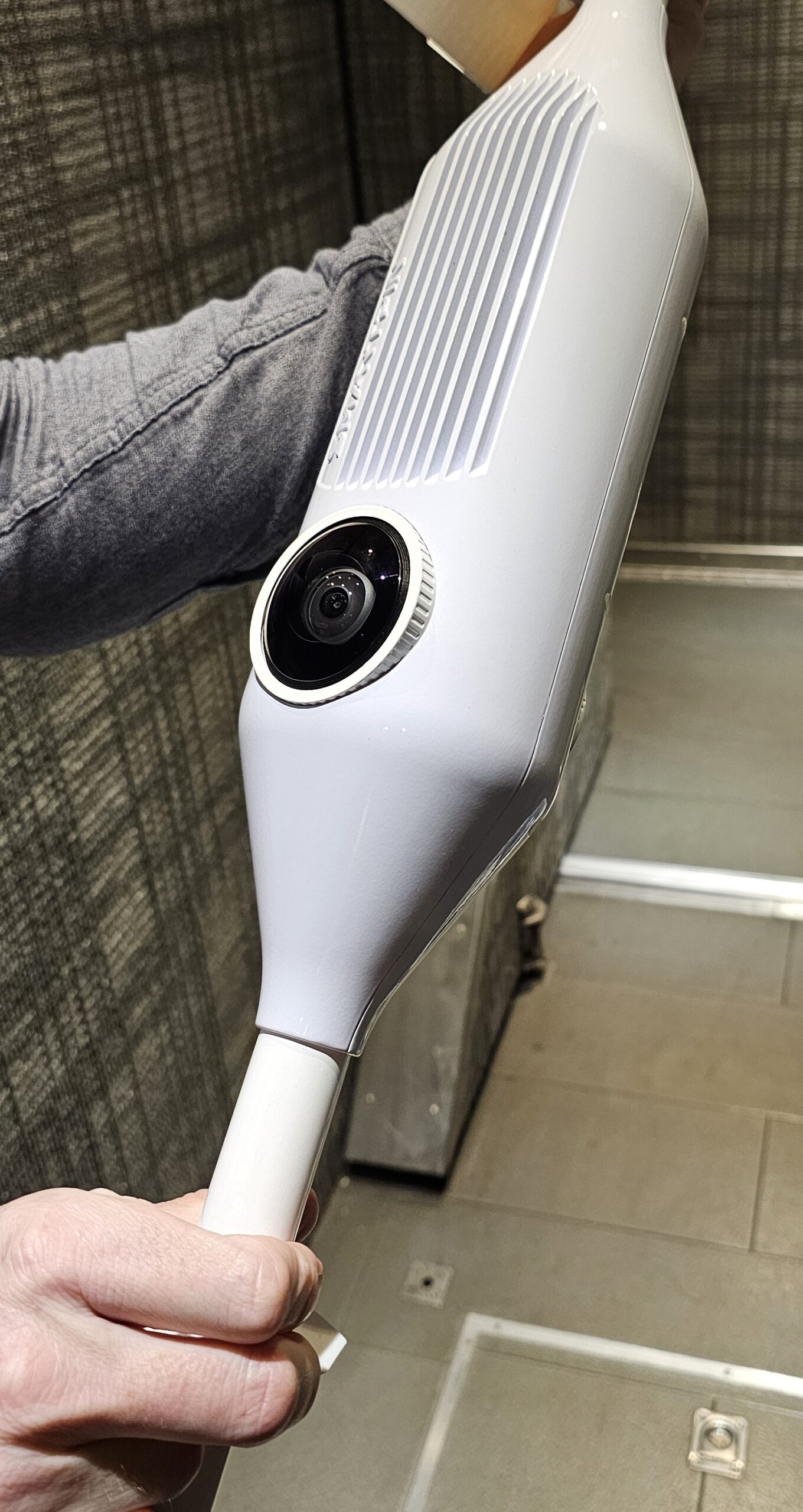
The SmartPin has a camera on each side to capture video from 360 degrees.
Currently, the SmartPin uses Cat 5 connections on the bottom of the pin to connect to Cat 5 connections in the bottom of the cup, and the holes are hardwired to a switch under the green that is tied to the servers in the truck compound. “We’re working on a wireless version,” says Loyd. “I don’t think it will be too long before we’re able to do that. We just need to figure out the bandwidth, because it takes a large amount of bandwidth.”
TGL has also borrowed camera-coverage concepts from other sports in a unique way. For example, NFL broadcasters have dual cart cams: a single cart with two cameras on it. TGL applied that concept to a railcam. “The two cameras allow us to go both wide and tight from the railcam,” Evans explains. “We also have the Rovercam, which can give us an ideal angle without bothering the players.”
It all adds up to multi-layered coverage. “Single-layer coverage doesn’t do anything for me,” he says. “On the tee box, for example, we can wrap around the golfer with the Rovercam to show the background and then reveal the screen in front of them. We can show three elements in one shot as opposed to having to make three cuts.”
The trick is not just making sure every shot is covered technically but following the storylines. “We’ve learned to excel at that,” Evans says. “Jeff is looking for replays, so he pushes me harder to make sure we don’t document just the ball but everything else going on around it. He is also listening to all six player mics at the same time, and that also lets him drive us into the right places ahead of where the action will be.”
That combination of player microphones and the ability to place other microphones super close to the action is one reason Evans credits A1 Joe Carpenter and the audio team with ensuring that the audio side of the production is equal to the video side with its 70-plus cameras.
“They’re putting mics where they could have never put mics before in a golf tournament,” Evans explains. “Usually, you can put a shotgun mic 3 ft. off the tee box, but our mics are a foot and a half away. The sound is so fat, the sound is so rich. It’s something that I can truly appreciate. A closet audio guy, I love sound, and that’s probably one reason I get along with Carp so well. I love hearing the action; I can’t stand not hearing what you’re seeing.”
The golfers have learned to trust the audio team, says Neubarth, who has experience miking players as a producer at Turner Sports and ESPN. “[TMRW founder/CEO] Mike McCarley has done amazing stuff with a lot of these players. If he can get Tiger Woods to agree to do something, there’s a good chance the other players are going to fall in line. They trust us, and it’s up to us to keep earning that trust every single day.”
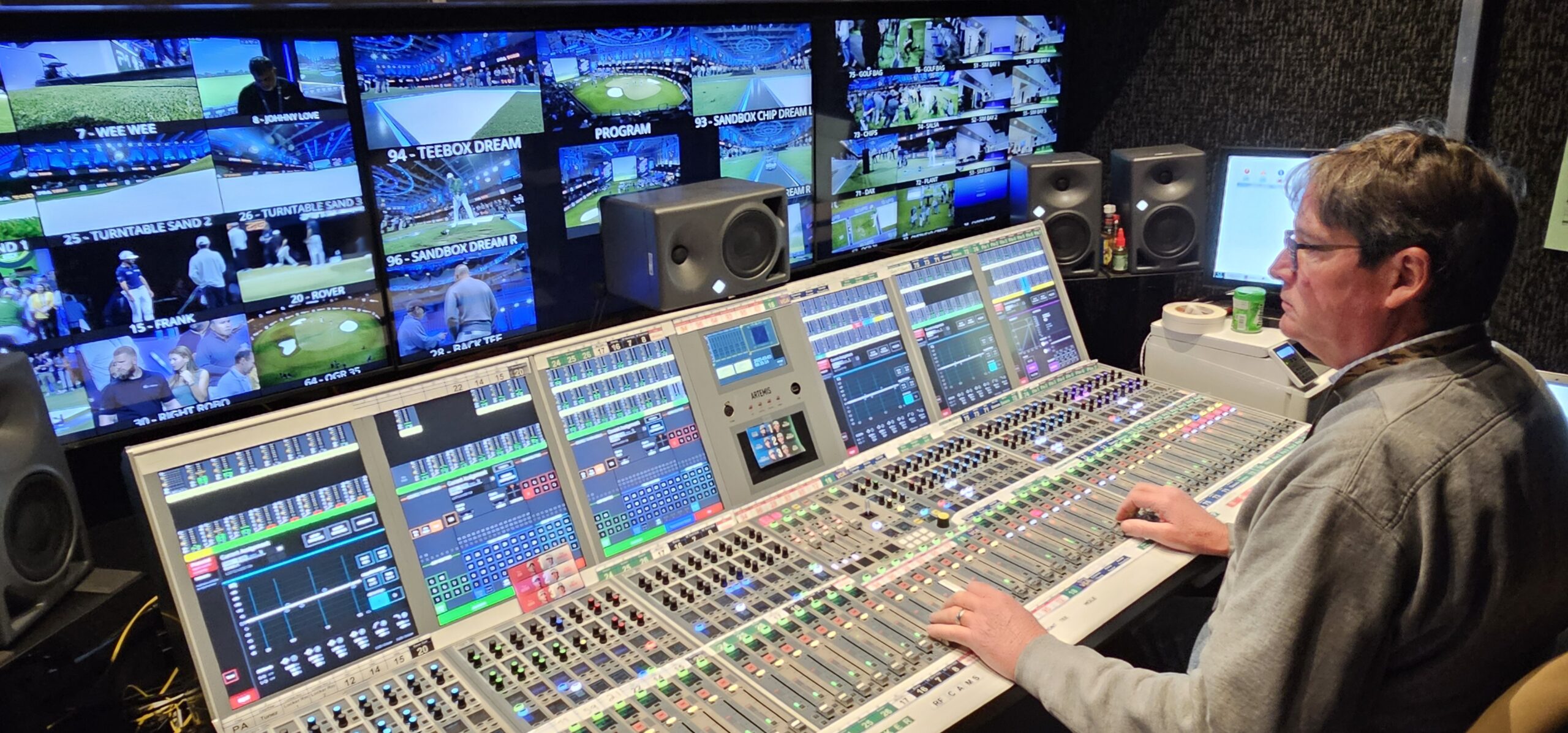
Audio is a big part of the TGL viewing experience, particularly with players miked.
That trust and the competitive spirit of the players have been a learning experience for Neubarth. “[As with] most sports,” he says, “we get to spend a little time with the guys ahead of the event, and you can tell that the teams want to win. Keegan Bradley has had that intensity on his face that looked like he was about to lead the team out for the Ryder Cup. The biggest change you’re going to see in the playoffs is from the players as they amp up their ability to perform at a higher level.”
The production team has also learned how to make the most of AR graphics during the regular season. TGL has AR elements tied to three cameras: the Spidercam; Camera 1, a fixed hard camera; and a Sony FR7 camera, mounted atop the five-story-tall simulator screen at the center of the action.
“Graphically, we want to add more elements,” says Evans. “When we began, we started with the basics, and we have been building from there. There is augmented reality, and that really excites me. We have a spatial environment that can allow us to use more AR environments.”
One Compound for All
The TV compound outside SoFi Center houses Game Creek Video Moonshine A and B and Edit Truck 3, along with two B units and, as a data center, Game Creek Patriot. They handle not only the ESPN TV production but also the in-house video, audio, and videoboard production and digital content.
“We have three teams working in those trucks,” says Neubarth. “The vision of Colin DeFord allowed us to pull off one of the most complicated things I’ve seen within one venue in a very long time. It’s fascinating to see what’s created in those units.”
DeFord notes the use of Patriot as a data center. “We needed to get all those servers installed so we could do testing while the building was under construction. The best solution was to buy an old truck, put racks in it, and start testing.”
The EVS operation records and archives all 78 video sources, making them available to the broadcast team and the in-venue team, he says, adding, “The in-venue team also handles the ribbon boards and all the assets and stats displayed on them. That team shares a truck with the digital team, which creates a second-screen experience.”
Evans and Neubarth credit their vendors with playing a big part in lifting the production to the heights it has reached.
Game Creek Video provides the remote-production facilities as well as a large percentage of the robotic cameras (an Egripment HotHead 3 has been added to the production for the Final).

Game Creek Video is providing an Egripment HotHead 3 that has been added to the mix for the TGL Finals.
A team from Fort Lauderdale-based MMT Jib handles the Rovercam, the railcam, and the dual railcam. New for the playoffs is an IP-controlled HotHead 3. “They’ve been amazing partners,” says Neubarth, “from our original test lab in Orlando to here, building the systems and having a plan for how to use it, which was super-helpful. And [TGL audio specialist] Jason Knapp has been in the locker rooms with the players, helping them understand the player mics and getting them to trust us.”
Neubarth also cites ESPN EVP, Sports Production, Mike McQuade: “It starts for me with Mike. I’ve been lucky enough to have worked with him for a long time. He’s a mentor and friend and has taken such an interest in this project, both in physically being here and, every week, giving me notes that help us get better. Mike doesn’t always say the most information, but what he says is the smartest information you can get.”
Standing inside SoFi Center prior to a match and experiencing it during a match makes clear how TGL focuses not only on serious golf but on serious production values and entertainment values. A crisp and clear audio system ensures that fans in the stands can understand announcer Roger Steele and the music, and ribbon boards and lighting by lighting designer Jason Robinson (formerly of the WWE) adds color and pop both in the venue and for those watching at home on ESPN.
“Jason loved the challenge and gives TGL this great atmospheric presence,” says Evans, adding, “The in-house audio is another thing we had to make sure wasn’t dull and boring. It has a fat, rich sound when you sit in [SoFi] Center, and we have DJ Irie from the Miami Heat so the experience here is as good as it is back home.”
That in-venue experience is closely matched up with the TV production. Produced out of one of the Game Creek trucks in the compound, it’s coordinated by Tim Sullivan, who sits next to Neubarth in the truck. “He’s the key link to all of it,” says Neubarth. “He’ll have multiple meetings during the week after he sees the format to figure it out. It has been great. I hope we’re providing a great experience for the person at home and a great experience for the person who’s sitting in the SoFi Center.”
For much of the team, getting to this point in the season has been a non-stop effort, with many working 240 days without a break. During the off-season, there will finally be a chance to take a break — and get to work on Season 2.
“We have a long Season 2 list that we’ve collected over the last year,” says Macaulay. “Once we take stock of the entire season, we’ll probably throw half that list away and replace it with new things and better ideas that resulted from actually experiencing it versus what we thought was going to happen. I can’t share what’s on that list, but it’s a healthy list, and some of it will probably also be for Season 3.”