ESPN and Game Creek Video’s New ‘Once-in-a-Generation’ Mobile Unit Is Capable of Native UHD HDR at Super Bowl Scale
Launching on NBA Playoffs, ‘Flagship’ will transition to ‘Monday Night Football’ in the fall
Story Highlights
Super Bowl LXI may still be two years away, but ESPN is already ringing in its first Super Bowl season with a new state-of-the-art mobile unit from Game Creek Video. Dubbed Flagship, the three-truck SMPTE ST 2110 facility was designed specifically to produce a Super Bowl–level show in UHD HDR and will serve as home to ESPN’s NBA A-game and Monday Night Football shows prior to Super Bowl LXI on ABC/ESPN in February 2027.

ESPN’s new Flagship from Game Creek Video was designed with Super Bowl LXI in mind.
“We are calling it Flagship,” says Chris Calcinari, SVP, content operations, ESPN, “because it is, without question, our flagship mobile unit. Everything is top-of-the-line across the board, and it has been built with the Super Bowl in mind. We’re going to operate this mobile unit in 1080p HDR for now, but we will be able to flip the switch for UHD HDR any time we want. This gives us the flexibility to adapt to whatever the market demands in the future.”
Agility, Agility, Agility: ST 2110 Drives ESPN’s Ultra-Flexible New Facility
Flagship will have its soft debut tonight in a REMI configuration for ESPN’s Pistons-Thunder NBA matchup before serving its first full onsite production with Lakers–Mavericks on April 9. Then, ESPN will unleash the “once-in-a-generation” (to quote Calcinari) mobile unit on the NBA Playoffs, where it will serve as the A-game truck before working the Western Conference Finals and NBA Finals. It will transition to ESPN’s marquee property, Monday Night Football, when the NFL season kicks off in September.
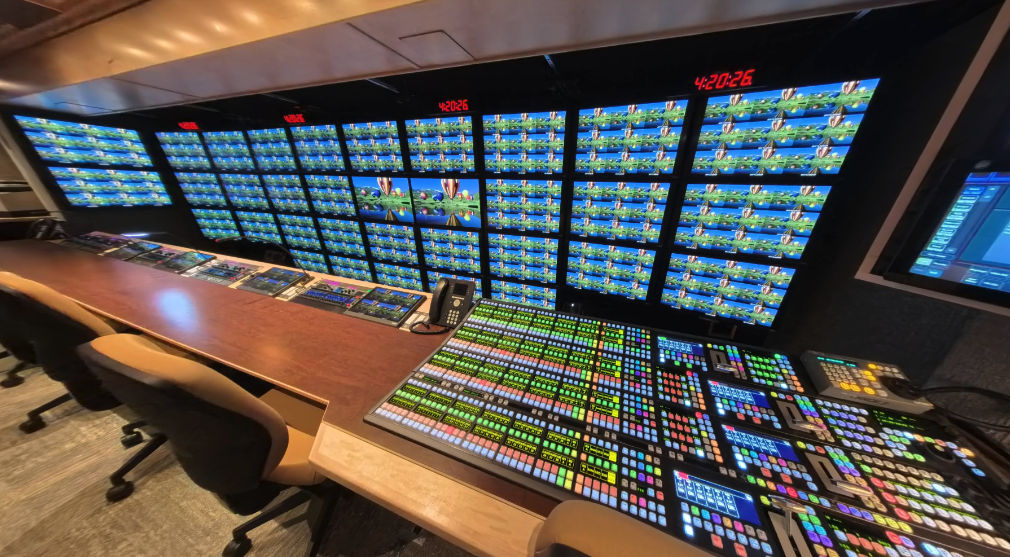
Flagship’s production-control room features Boland LCD UHD HDR monitors.
“This truck was purpose-built specifically to handle a Super Bowl in UHD HDR,” says Eddie Okuno, senior remote operations specialist, ESPN. “The only way we were able to do that is because of the progression of ST 2110. I see the move from SDI to IP as a generational change for [field] production in much the same way that SD to HD was a generational change for us a couple decades ago.
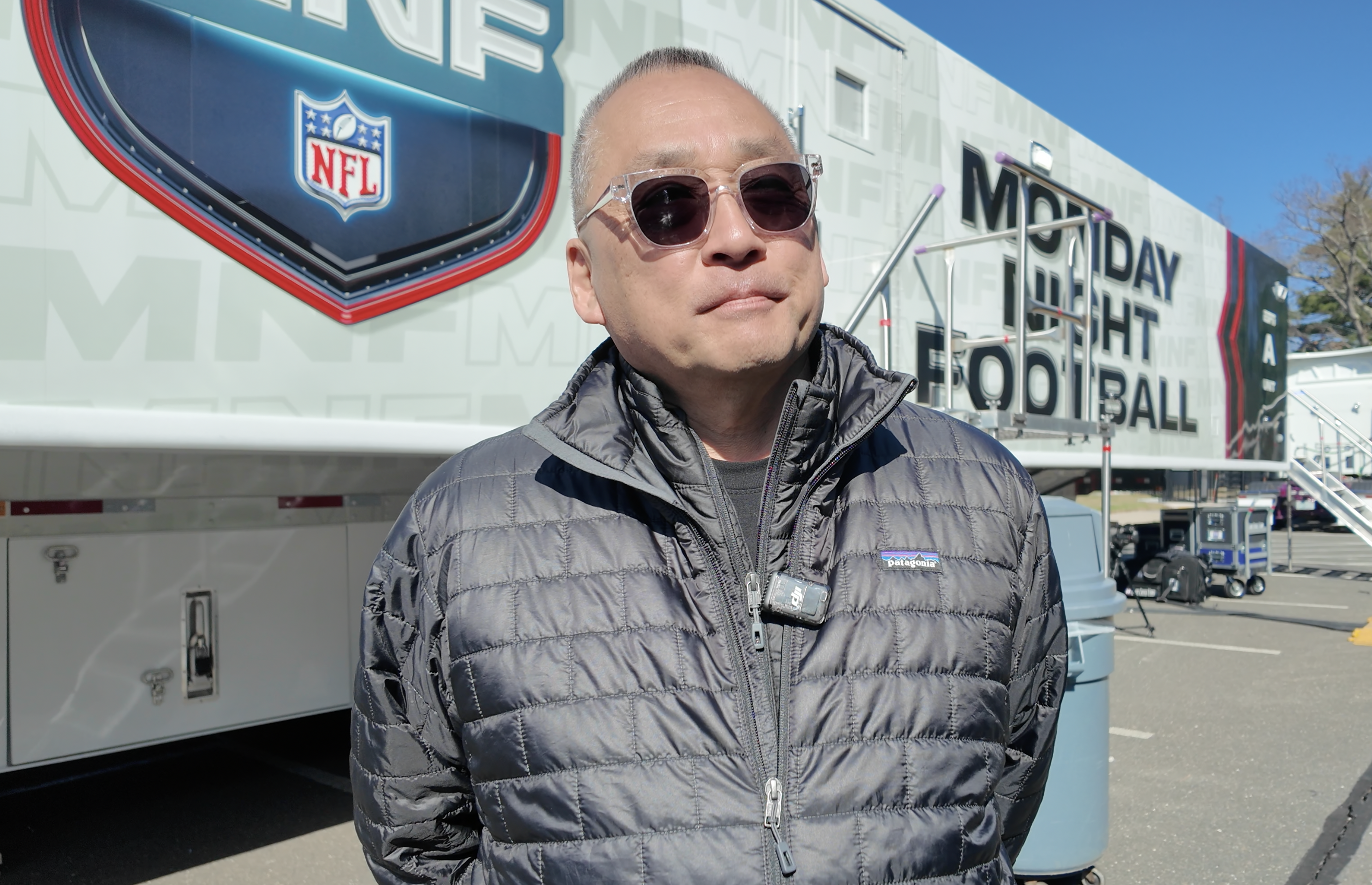
ESPN Eddie Okuno: “Whatever equipment is new, whatever is the latest and greatest, this truck has it.” (Photos: Jon McLeod/ESPN Images)
“IP allows us to do [productions] on a much larger scale but with less of a footprint in the mobile unit,” he continues. “A mobile unit can weigh only 80,000 lb. legally, so ST 2110 allows us to put a lot more firepower in it with a lot less weight. As a result, we have the freedom to give our production team more tools than ever before. The beauty of it is that this truck can handle anything from a Super Bowl to an everyday NBA game and be equally successful at both.”
In addition to featuring the most advanced equipment available across the board, Flagship has been designed to be as agile as possible. Aside from the production-control room and two audio rooms, nearly all the space inside the three trucks is occupied by a series of “sandboxes.” These workstations are equipped with intercom, KVM, and monitor connectivity so that they can serve almost any operator: replay, graphics, video, or something else.

ESPN’s Chris Calcinari: “This gives us the flexibility to adapt to whatever the market demands in the future.” (Photo: Kelly Anne Backus/ESPN Images)
“We are focused on ST 2110 because we believe it offers us the agility that we will need in the future,” says Calcinari. “I think that agility is most apparent in how the entire facility is made up of these sandboxes, which can be used for almost any position you can think of. That’s going to serve us well in the future, regardless of what happens down the road technologically.”
‘The Latest and Greatest’: Top of Line Gear Across the Board
The native UHD mobile unit is built around a high-density SMPTE ST 2110 routing network supported by Arista Networks and Lawo. The IP routing system runs on a pair of 7500R3 Arista modular switches, both 400 Gbps–capable: a 7512 switch for the A unit, a 7504 switch for the B and C units.
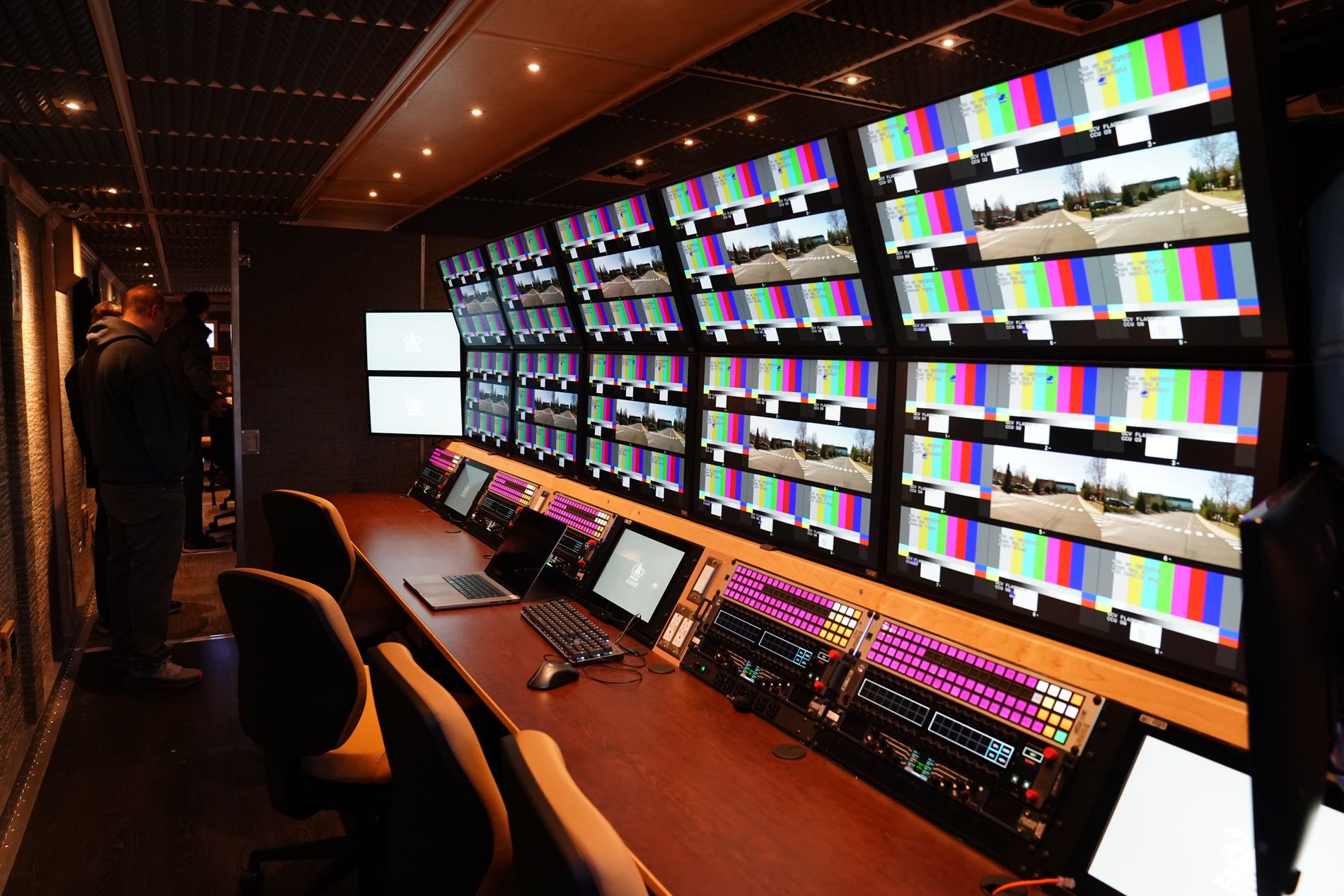
All Flagship workstations, or “sandboxes,” are equipped to serve replay, graphics, video, or almost any other function.
The system also features a 1024×192 UHD multiviewer and 750/720 Campus platform for command and control. The high-density, dual-spine Arista switch fabric is fully non-blocking (allowing all ports to be used) and offers flexibility in port configuration.
Lawo’s HOME IP video management platform manages the ST 2110 network as well as the interop of all the various devices throughout Flagship. In addition, Lawo’s VSM (Virtual Studio Control) controls all production devices and broadcast systems, HOME Apps process all the mutliviewers and Up/Down/Cross converters, and Power Cores provide the complete audio IO.
“Whatever equipment is new, whatever is the latest and greatest, this truck has it,” says Okuno. “Game Creek has done an exceptional job of vetting through all the IP 2110 technology and processes over the past few years to the point where 2110 is their new standard. We are the benefactors of that knowledge.”
The backbone of the production-control room is a Grass Valley K-Frame SXP 192×96 fully IP switcher; the stunning monitor wall is composed of Boland 32-in. OLED UHD/HDR displays.

One of 20 replay-server locations that Flagship houses
The A unit provides 40 UHD camera-control–unit locations (with more CCUs and replay servers available in the B and C units), enabling ESPN to scale up significantly for colossal shows like the Super Bowl while maintaining UHD and HDR capability.
The truck will debut with 15 Sony HDC-5500 broadcast cameras, all with super-slo-mo licenses and Canon glass (including up to 20 122X lenses, three 27X lenses, and three 15×4.3 handheld lenses). The truck also rolls with five Sony BRC-AM7 PTZ cameras and two Canon XF605 pro camcorders. According to Okuno, several cameras will also be capable of the shallow–depth-of-field look that has taken the industry by storm as of late.
With up to 20 replay-server locations (100 Gbps per server), Flagship will house the latest EVS XT-VIA live-production servers with 100% IP integration (all SDI devices in this area require a top-of-rack solution). Once the truck shifts to Monday Night Football, ESPN will also incorporate Sony Hawk-Eye replay servers.
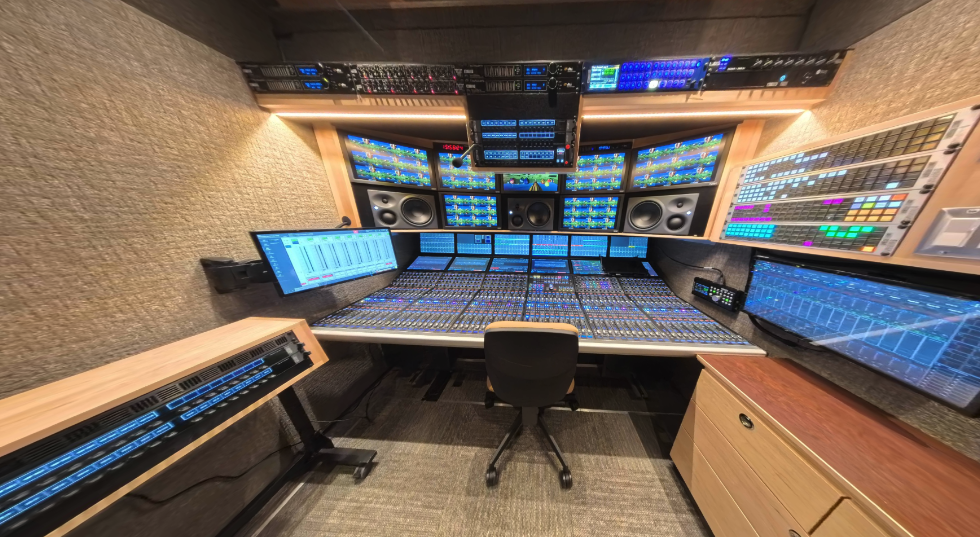
Flagship’s audio room features two Calrec Argo Q audio consoles.
The audio side is driven by a pair of Calrec Argo Q audio consoles (for main and submix) with Impulse Cores. The fully IP-integrated (AES67), 10-Gbps audio network is capable of a whopping 16,385 I/O channels with four router cards. Flagship’s communications system is built around a Riedel Artist intercom frame with 1,024 ports in each unit that requires just 2 rack units of space and is complemented with Riedel Bolero beltpacks/antennas.
Flagship also features TSL’s MPA1-MIX-DANTE units at key workstations for DANTE/AES67 & MADI audio mixing. These are backed by TSL PAM1 and PAM2-IP units for centralized audio QC and supported by TSL’s rackmount PDUs.
In addition to the sprawling Boland production-monitor wall, Flagship features UHD HDR monitoring throughout with 80 Riedel FusioN edge devices converting video from IP to SDI for the monitors in each truck. All operator positions and audio rooms are outfitted with Boland LCD UHD HDR monitors. With 1080p HDR serving as the standard, Flagship is equipped with Sony PVM-X18000 native UHD LCD display for engineering QC and BVM-E171 native 1080p OLED displays for video shading.
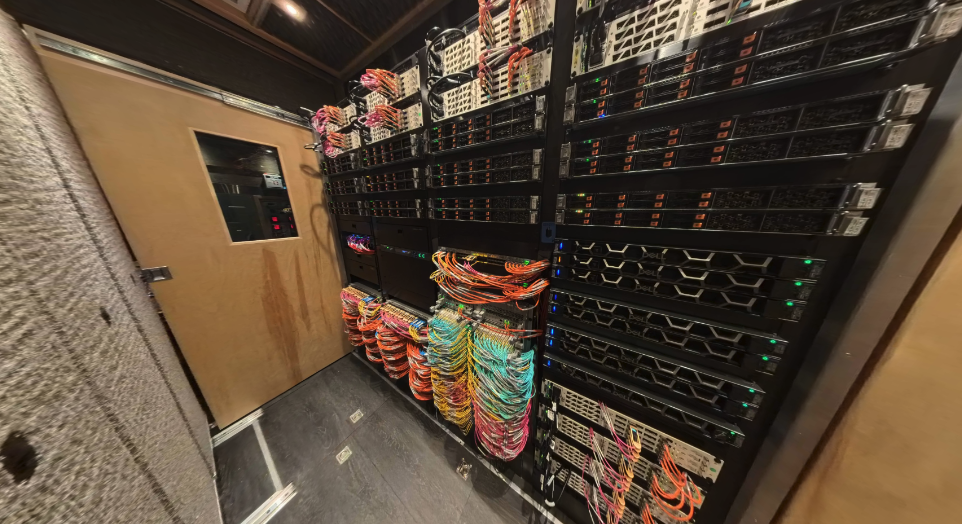
Flagship is wired with distributable, modular video IO fiber.
Flagship also features Cobalt UHD/HDR UDX processors (for SDI and IP integration), providing 96 channels in UHD (or 384 channels in 3G) and six transmission paths in UHD (or 24 paths in 3G) with a user-loadable LUT.
Other key gear includes Vizrt Viz Engine 5 graphics, Adder IP KVM control, and Leader LV5600W/LV7600W scopes for waveform/vector monitoring.
Flagship is wired with distributable, modular video IO fiber instead of fixed copper on the side of the truck. In addition, eliminating depreciated and legacy technology enabled Game Creek to reduce the trucks’ weight by 25% compared with a similar facility.
“Working with Game Creek has been spectacular,” says Okuno. “We have an incredible amount of respect and trust in their team. They offer an amazing amount of knowledge because of what they’ve learned in building these IP trucks over the past few years.
“The best part about it,” he continues, “is that they really listen to what the client needs. Whether it’s [SVP, Technology] Jason Taubman, [VP, Engineering] Paul Bonar, [Director, Technology] Keith Martin, [Engineering Manager] Brian Nupnau, or anyone else on their team, they always do their homework to make sure we get what we need. And they really nailed it with this one.”