Game Creek’s Jason Taubman, Keith Martin Go Inside New ‘Flagship’ Mobile Unit’s Innovations Ahead of NBA Finals
The new mobile unit will make its big-event debut at the NBA Finals
Story Highlights
The NBA Finals are just around the corner for ESPN, and this year’s series will be the first big-time event for Game Creek Video’s latest production system to shine. Three-truck Flagship won’t take full advantage of its firepower until later this year, when it will be at the center of ESPN’s Monday Night Football coverage, but the NBA Finals will demonstrate its flexibility to scale up and down to deliver for big-time events.
“Earning ESPN’s trust to provide facilities for these signature productions is huge for Game Creek Video,” says Jason Taubman, SVP, technology, Game Creek Video. “We don’t underestimate the responsibility we have to execute at the highest level. We worked closely with ESPN’s remote-operations team on this build, and it has been a project easily a year and a half in the making.”
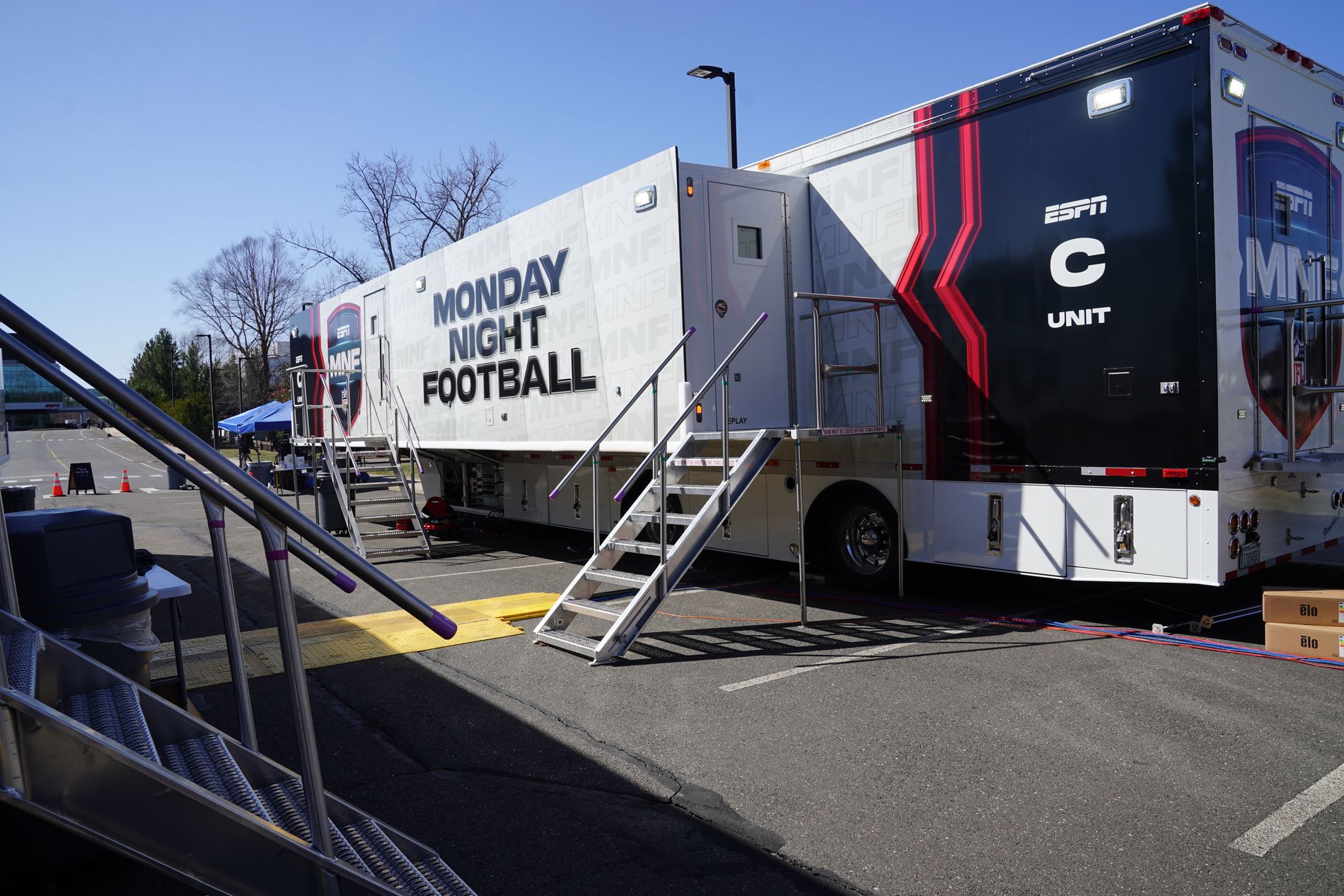
Game Creek Video’s Flagship production unit will make its major-event debut for ESPN at the NBA Finals next month.
The result is a three-truck production system that builds off previous Game Creek Video production units — Encore, Hollywood, Prime One — but also innovates to better meet ESPN demands and reflect the evolution of technology, in particular IP and routing.
“ESPN, for their part, brought their own ideas,” says Taubman. “They wanted a smaller system. They wanted a Riedel intercom. We talked about a lot of different truck-layout concepts, but, ultimately, what we found was that the designs we had used previously put us in the best spot to iterate quickly: we already know the designs and the weight capacity and capabilities of the trailers in those designs.”
At the center of the three-truck system (which can also operate fully with only two trucks) is an evolution in how Game Creek Video’s Systems Architecture team builds an ST 2110 IP infrastructure, in this case based on an Arista and Lawo backbone. The IP routing system runs on a collection of 7500R3 Arista modular switches, all 400-Gbps–capable: a 7512 switch for the A unit, 7504 switches for the B and C units. And Lawo’s HOME IP video-management platform manages the ST 2110 network as well as the interoperability of all the various devices throughout Flagship. In addition, Lawo’s VSM broadcast-control system manages all production devices and broadcast systems, HOME Apps process all the multiviewers, and Power Cores provide complete audio IO (an Adder KVM is also all-IP and on the same IP network).

The Flagship front-bench area in the A unit has full-UHD monitoring and a Grass Valley K-Frame SXP 192×96 fully IP switcher.
“We’re leaning heavily into the network infrastructure,” says Taubman. “This is the first truck where we went all-in on IP with systems like the Riedel intercom, which ESPN really wanted. Intercom was one of the last pieces of the puzzle that wasn’t sitting on the network with everything else.”
Keith Martin, director, technology, Game Creek Video, notes that continued reliance on IP is getting easier especially as the design team (and the industry in general) becomes more familiar with NMOS (Networked Media Open Specifications, which improves interoperability for systems on a network) and how to make sure third-party interoperability is nailed down.
“NMOS has allowed us to go after best-of-breed solutions for specific products, target those, and implement them into the system,” he explains. “We have full control of device integration, and the overall system is also more rapidly scalable because there isn’t a time penalty to having to manually build things out.”
The biggest evolution with respect to IP, Martin says, is on the input/output side of the truck, where historically those IOs were very fixed to the sides and back of the truck. Flagship introduces flexibility by allowing portions of the IO to be removed and deployed elsewhere: on the sideline, at a remote studio, in the broadcast booth, even on another Game Creek truck located on another side of the stadium.
“You can move it to any location where you want to extend baseband video, and it can be any distance,” he says. “You just need two strands of fiber.”
Adds Taubman, “This is the first time we’re letting the ST 2110 media network escape the boundaries of the truck, and we’re also eliminating a lot of physical baseband IO. We’re exposing it elsewhere and letting it exist outside the truck, with the explicit intention of removing baseband wherever we can at the side of the truck and providing a networked way to extend the capability of the truck to anywhere we need it to go.”
The new IP philosophy also allows Flagship to eliminate about two-thirds of the baseband IO on the back of the truck and, in turn, the weight, which was a big goal for ESPN. “ESPN wanted to reduce the number of trucks in the compound,” says Taubman. “To achieve that, we needed to consolidate, and weight reduction was key to that. The lighter the trucks, the more equipment they can carry, and ultimately that means fewer trucks and the ability to shrink the compound.”
IP also provides a lot of flexibility with respect to how the A, B, and C units are managed, based on the size of the production. The A unit is the engine room and features Lawo VSM/.Edge/Home orchestration, a Grass Valley K-Frame SXP 192×96 fully IP switcher, two audio rooms (each with its own Calrec Argo Q console), up to 20 EVS XT VIA replay servers, 384 paths of Cobalt Indigo UDX, Adder IP KVM, and a camera-control–unit area that can handle up to 40 cameras. The truck is currently on the road with 15 Sony HDC-5500 cameras with Canon glass — 122X, 27X, and 15X4.3 lenses — enabling ESPN to scale up significantly for colossal shows like the Super Bowl while maintaining UHD and HDR capability. Flagship also features TSL’s MPA1-MIX-DANTE units at key workstations for DANTE/AES67 & MADI audio mixing. These are backed by TSL PAM1 and PAM2-IP units for centralized audio QC and supported by TSL’s rackmount PDUs.

Cameras and lenses are set up and tested for deployment on Game Creek Video’s new Flagship production unit.
The B unit is just like the B unit in Game Creek Video Encore and Prime production systems, with a big production gallery and a “sandbox” space, which can be used for various functions as needed. The C unit is the hauler and has more sandbox areas. It will be used for ESPN’s Monday Night Football coverage but not for the NBA Finals, demonstrating the system’s flexibility and distributed firepower.
“In all scenarios,” says Taubman, “you need the A unit and theoretically run it with the A and B or A and C units, but, for something like a REMI, you don’t even need the second unit. There’s a lot of flexibility in how you deploy the whole system.”
Hitting the Road With Riedel
Particularly noteworthy among Flagship’s innovations is the move to the Riedel Artist intercom ecosystem, a move requested by ESPN so that the intercoms on the road easily integrate with the Riedel Artist intercom system deployed in Bristol, CT, and other facilities. The system comprises the Artist 1024, which offers 1,024 ports in just 2RU, along with multifunctional, software-defined Smart Panels and Bolero wireless intercom beltpacks and headsets. The A unit houses the Artist frame and supports 110 Smart Panels across the three trucks and 40 Bolero beltpacks for use in the field.
“ESPN wants to have native intercom integration with the truck, especially for the big marquee events,” says Taubman. “Riedel understood what was at stake in this move and supported ESPN and Game Creek in a way that helps plant the Riedel flag in the U.S. sports-OB market. Riedel’s deployment team has done a great job making the transition seamless.”
The move to Riedel removed the need to set aside discreet signal paths for the intercom within the ST 2110 IP environment. “We didn’t need to put a lot of dedicated thought into getting it running, other than making sure we had network links where we needed them,” Martin explains. “But resource consumption was not really a thing that we needed to work with in terms of other audio formats like Dante, MADI, or analog. Those requirements just sort of melt away in the IP environment, especially as Riedel supplied us with all the people, knowledge, and resources to have a successful first outing.”
The only challenge, says Taubman, is developing plans for tying the Riedel intercom system to legacy intercom systems in other production trucks. “We’re laying out a blueprint to do that now.”
Multiviewer Goes HOME
Another advance on Flagship is a massive 1024×192 UHD multiviewer, courtesy of Lawo’s HOME apps platform. Martin says the 192 UHD multiviewer heads are spread across the three trucks while also providing some surplus for use in other trailers. It’s also part of a plan to power true UHD/HDR 32-in. monitors in the main production-monitor wall and other-size Boland monitors at other positions in the truck.
The move to UHD for all positions is an industry first and was done to ensure the highest vertical resolution possible for each picture-in-picture within the multiviewer canvas. “We preserve the vertical resolution, and it’s all about delivering the best image possible to the people sitting everywhere in the truck,” Taubman explains. “It also means we can put fewer monitors in the unit but keep the image count about the same. Again, this is about image quality but also about the weight of the truck. And the main-production gallery monitor wall in the B unit is the best-looking monitor wall in the business. The production staff love it.”
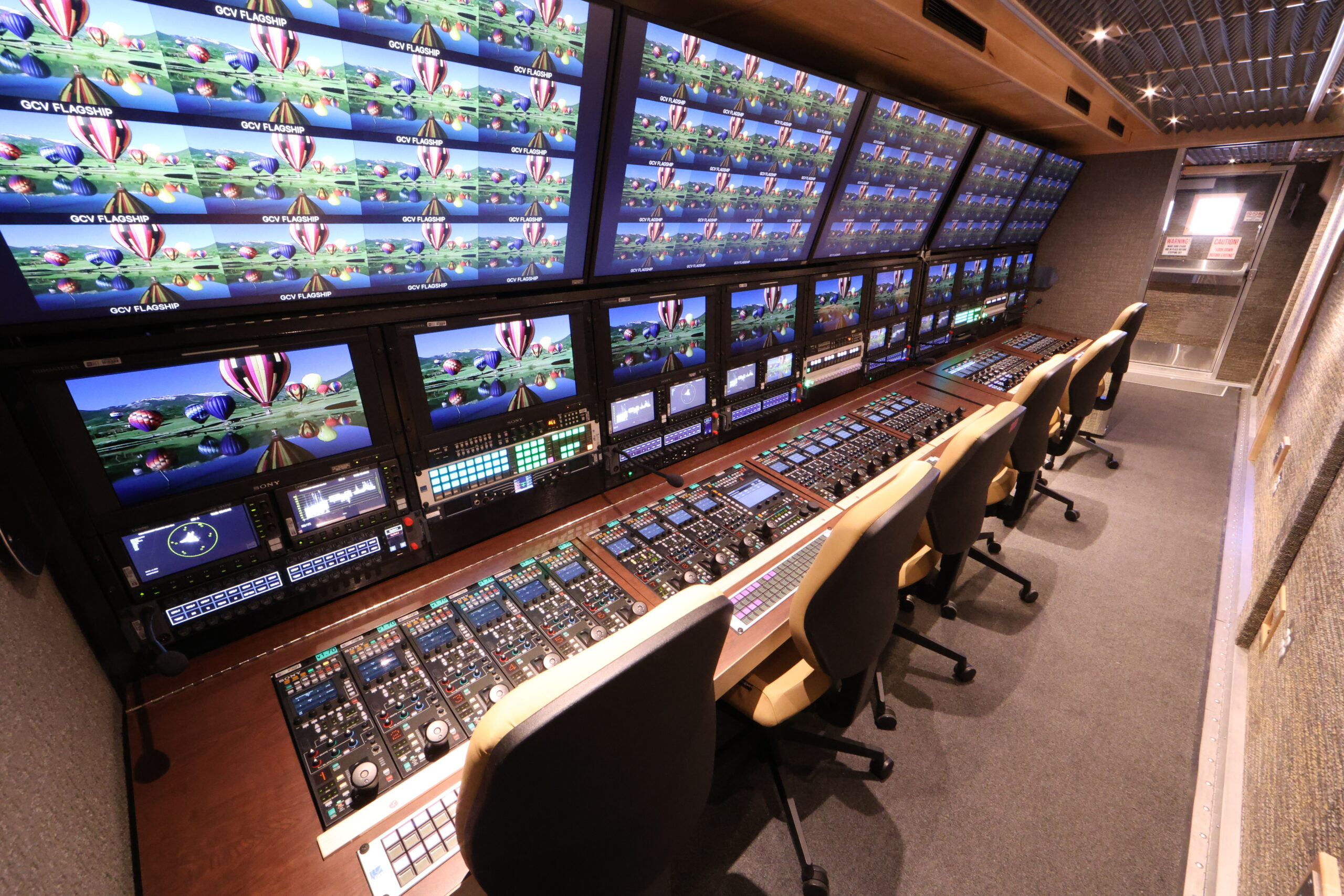
All positions in Flagship feature true UHD 4K monitoring to ensure image quality.
It’s also part and parcel of a truck build that, ideally, will be on the road for at least the next seven years. By the time 2031 rolls around, odds are pretty good that UHD will only be more of a force. “Today, it allows us to do UHD HDR without having to bring in a special UHD HDR monitor,” Taubman adds. “As a company, we have to imagine what the possibilities might be in terms of evolution into different formats in the future. With UHD HDR monitoring. we’re ready to go.”
A-Unit Audio: Twice as Nice
The UHD HDR monitoring is matched on the audio side with two Calrec Argo Q audio consoles located in identical rooms in the A unit. Typically, the main mix unit of a production truck has a larger console and workspace than the submix area. But not in Flagship.

Flagship A unit has two identical audio-control rooms, each with a Calrec Argo Q console.
“ESPN wanted flexibility on which room they wanted to use for the main mix or submix,” says Taubman, “so we built identical spaces, allowing them to decide on the fly which room to use. We equipped each room with a Calrec Argo Q console, which is at the cutting edge of audio mixing for sports-television production.”
Adds Martin, “This is our first pair of Calrec Argo Q consoles, and they share the same Calrec Impulse core, which can deliver 16,348 mono channels to each console. We can fully load it with almost every audio signal someone would want without someone having to go into the control system and route a source into the desk. Everything is just ready and waiting to be used.”