SVG Sit-Down: ProximaVision’s Claudio Lisman on Why Tethered Drones Could Be a Game-Changer for Live Sports Production
Long-duration aircraft delivers low-latency HD/HDR video directly to any workflow
Story Highlights
In live sports production, aerial coverage has become an essential storytelling tool. From fixed-wing planes and helicopters to cable-suspended systems and drones, producers have come to rely on aerial coverage as integral to their operation. ProximaVision has brought a new angle to the mix with its next-gen tethered aerial systems.
The broadcast-ready platform is engineered for reliability, safety, and uninterrupted performance — capabilities that are increasingly vital as sports organizations demand higher-quality visuals and more-flexible production models. Unlike battery-powered drones restricted by flight time, interference, and regulatory hurdles, ProximaVision’s tethered aircraft can remain in the air for days at a time, delivering uncompressed, low-latency HD/HDR (and soon 4K) video directly into any production workflow.
ProximaVision’s breakthrough moment came during the 2025 US Open tennis tournament, when the company became the only aerial system approved to fly live throughout the event. Operating for more than a week in one of the nation’s most complex and highly regulated airspaces, the platform delivered flawless, uninterrupted coverage of Arthur Ashe Stadium and the New York skyline, establishing a new benchmark for both safety and broadcast reliability.
SVG sat down with ProximaVision President/CEO Claudio Lisman to discuss how the technology works, why it matters, and where aerial innovation is headed next, as well as how tethered drones are gaining traction across leagues and venues and what’s ahead in a pivotal 2026.

ProximaVision’s Claudio Lisman: “The US Open operation not only proved the reliability and safety of our platform at a Tier-1 global sporting event but also established a repeatable operational blueprint.”
Tell us a bit about ProximaVision’s tethered drone offerings: technology specs, operational details, and how these systems serve live sports production.
ProximaVision’s tethered drones are engineered for long-duration, broadcast-grade aerial coverage. Our platforms can remain airborne for days at a time with no battery swaps, operating at altitudes up to 700 ft. while delivering 1080p HD/HDR uncompressed video via our fiber-optic tether and noise signature under 40 dB, which is essential to cover sports events without distracting the players or the audience.
We pair this with a camera-and-lens package capable of up to 240X zoom, and our proprietary control software supports multiple pilots and camera operators, whether they’re onsite or operating remotely. With features like presets, camera painting, and multi-operator authority transfer, the drone functions just like a fully integrated broadcast camera.
For live sports productions, this creates an entirely new class of aerial shots that were previously impossible or prohibitively expensive. Because the drone provides an uninterrupted ISO feed into the production switcher, technical directors can use it with the same confidence and flexibility as any hard-wired stadium camera.
What are the primary applications and benefits of using a tethered system over a wireless drone for live sports coverage?
Tethered drones deliver a broadcast-standard, uncompressed, zero-interference video signal — something RF-based wireless drones simply cannot guarantee in a stadium environment.
Other key benefits include unlimited flight time with no battery swaps or downtime. Our technology is immune to interference, congestion, jamming, and spoofing. Offering guaranteed bandwidth, our fiber-optic tether delivers high-bitrate UHD/HDR with ultra-low latency and operational reliability, with predictable performance even in dense urban or high-security airspace.
For broadcasters, this translates to a stable, rock-solid camera that’s always ready when the director calls for the shot.
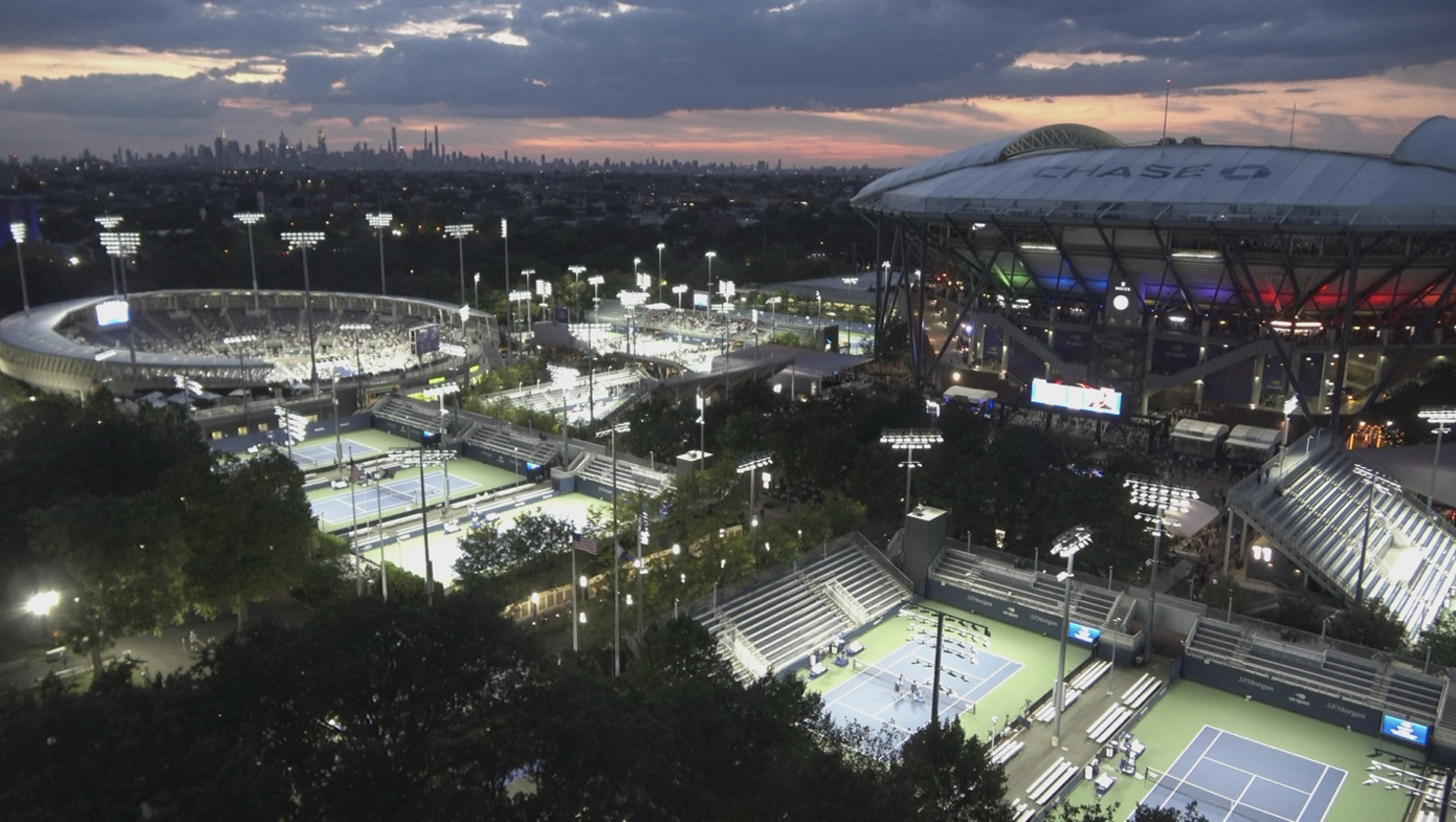
ProximaVision’s was the only aerial system approved to fly live throughout the 2025 US Open.
You played a key role at the 2025 US Open. Tell us more about that deployment and how it exemplifies ProximaVision’s value.
We were honored to be the only aerial drone system flying live during the 2025 US Open. For the USTA — and for New York City — it represented a new era of safe, reliable aerial coverage.
Over 10 consecutive days, our AirReady system flew 8-10 hours per day without interruption, providing spectacular views of the tournament, Arthur Ashe Stadium, and the Manhattan skyline. All feeds were delivered via uncompressed fiber directly to the broadcast compound, where the production team treated our output exactly like any other ISO camera.
This deployment took place in one of the country’s most complex airspaces, with dense RF congestion, proximity to major airports, and continuous NYPD and DHS oversight. Despite those challenges, the system performed flawlessly.
The success of this operation not only proved the reliability and safety of our platform at a Tier-1 global sporting event but also established a repeatable operational blueprint that other major leagues and venues are now evaluating for their 2026 broadcast plans.
How does the fiber-optic tether integrate into a traditional live-production workflow?
Our fiber link brings the camera signal directly from the aircraft to the ground station with minimal latency. From there, we hand the signal off to the truck or broadcast facility using the production’s existing fiber or SDI infrastructure.
Because there are no battery swaps, no RF links to tune, and no risk of a mid-show signal drop, the production team can rely on our aerial camera just as they would any other live source. It’s always available and always on.
From a creative standpoint, what new camera angles or “looks” do tethered drones unlock for sports broadcasts?
Tethered drones fill a creative gap in helicopters, cranes, blimps, and free-fly drones. They provide stable, high-altitude beauty shots; dynamic, sweeping motion unavailable to cranes or cable cams; long-duration aerials that helicopters can’t provide affordably; and high-zoom storytelling shots from safe stand-off distances.
At a major event like the US Open, tethered drones deliver all the production value of a helicopter or fixed-wing aircraft at a fraction of the cost, without the risk of RF dropout or the limitations of free-fly battery life.
How do you address FAA and safety concerns for tethered drones at sports venues?
Safety is the foundation of our system design. Because our aircraft is tethered — providing power, video, and telemetry through a single fiber-optic line — we eliminate many of the risks associated with free-fly drones.
It also offers geo-fencing (the aircraft cannot leave its predefined airspace); stand-off zooming (our lenses deliver close-ups without flying over spectators); reduced FAA concerns (we don’t fly over people, one of the agency’s biggest risk factors); highly controlled flight envelope (physically constrained, the drone cannot lose power or link mid-flight).
This operating model resolves the majority of the safety and regulatory barriers that typically restrict free-fly drones in stadium environments.
How feasible is remote operation — potentially spanning the country — and what infrastructure is required?
Remote operation is core to our design philosophy. Traditional drones rely on a single RF controller, meaning the pilot must also act as the camera operator and must be physically onsite. This limits flexibility, safety, and redundancy.
Our system includes a server within the ground control unit, enabling multiple remote operators to access the aircraft and camera controls simultaneously. For example: the pilot may operate onsite in New York, the camera operator may work from Los Angeles, and a co-pilot may be stationed in Miami.
This distributed-operations model is supported by the new FCC Part 108 remote-drone-pilot licensing framework, which formalizes remote piloting for tethered and high-reliability UAS. The result is a broadcast workflow with true redundancy, national staffing flexibility, and enterprise-grade security and reliability.
What’s ahead for ProximaVision in 2026?
2026 will be a pivotal year. While live broadcast remains a cornerstone of our business, our technology is expanding rapidly into ISR (intelligence, surveillance, and reconnaissance), defense and national security, disaster recovery, and situational-awareness public safety and event security.
We’re also launching uncompressed 4K video via our fiber-optic output, a new leasing program for networks, OB companies, and drone-rental providers.
In partnership with government agencies, we’re integrating our systems into stadium- and event-security operations, providing persistent overhead surveillance to help protect fans and families from emerging threats. Our goal is to make tethered aerial security a standard part of large-event safety planning.