2025 Sports Broadcasting Hall of Fame: Bill Rasmussen, the Entrepreneur Who Dreamed Sports Into a New World
Story Highlights
The lights hum to life inside a makeshift studio in Bristol, CT, as the countdown begins. It’s 6:59 p.m. on Sept. 7, 1979, and Bill Rasmussen stands just off the set, eyes fixed on the monitor as the opening seconds of an entirely new idea flicker into reality. He can hear the nervous breathing of young staffers behind him. He can feel the vibration of the clock in his chest.
Five… four… three…
 Fourteen months earlier, this moment wasn’t even a dream. It was a sketch born out of desperation in a traffic jam. The “network” had no office, no equipment, no money. He had been fired from his public-relations job with the World Hockey Association’s Hartford Whalers and was armed with little more than a $9,000 credit-card advance and a stubborn belief that cable television could be something bigger. He had been laughed at more times than he could count.
Right…counting!
Two… one…
And suddenly, impossibly, a man named Lee Leonard and a highlight show called SportsCenter is beamed into the homes of potentially more than 1 million Americans.
To everyone else, it is a shaky broadcast on an obscure cable channel named ESPN. To Bill Rasmussen, it is the beginning of a revolution, the moment when the sports world pivots toward a future only he could see.
Rasmussen’s story begins far from Bristol, on Chicago’s South Side, where he grew up a baseball-loving kid drawn to every box score he could get his hands on. After earning an economics degree from DePauw University and serving in the U.S. Air Force, he entered the business world at Westinghouse before making his first entrepreneurial leap: an advertising-services company he founded in Newark, NJ, in 1960. That company survives six decades later, long after he walked away to chase a different dream.
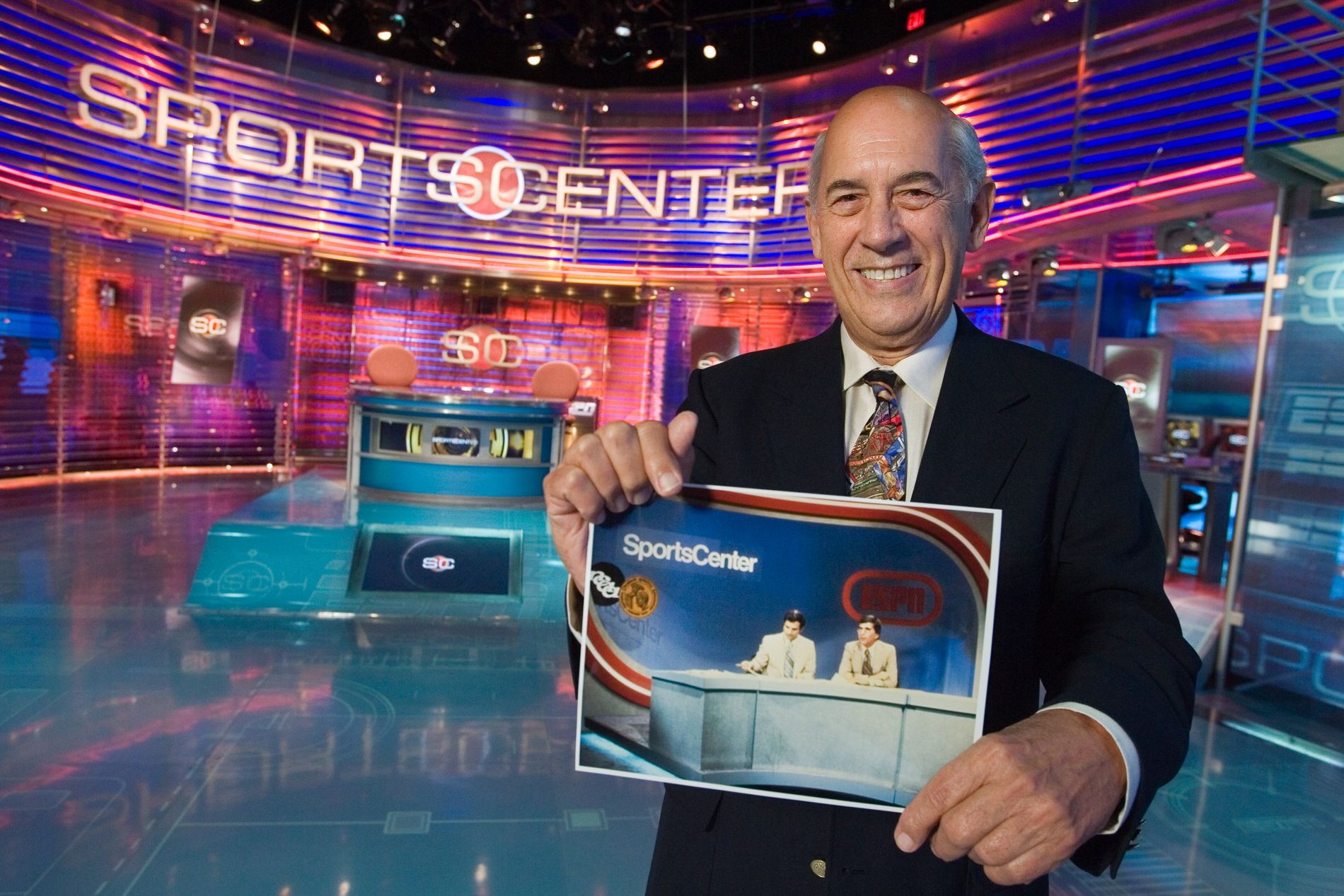
Rasmussen on the set of SportsCenter in 2005, holding a picture of the first episode of the show that launched in 1979. (Photo: Rich Arden/ESPN Images)
Broadcasting called to him. In 1962, WTTT, an AM radio station in Amherst, MA, hired him as a sportscaster, and Rasmussen built the University of Massachusetts’s first radio network for football and basketball. Two years later, he moved to WWLP-TV Springfield, MA, working eight years as sports director and two more as news director. He called football, basketball, baseball, and hockey — anything that kept him close to the games he loved.
In 1974, Rasmussen jumped to the New England Whalers as communications director. It was a stable job, until it wasn’t. At the end of the 1977-78 WHA season, the entire front office was fired.
It should have been a setback. Instead, it became the catalyst.
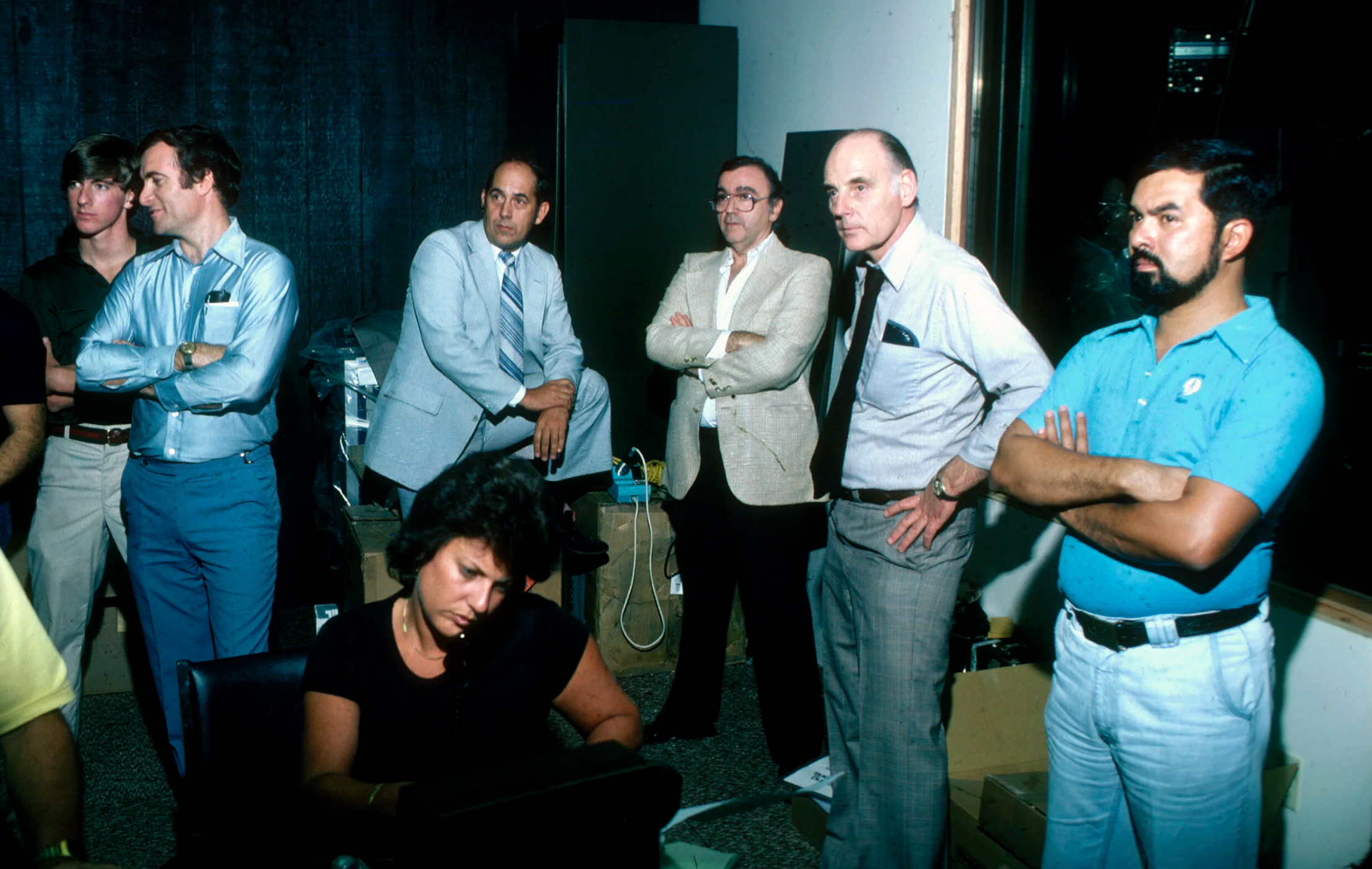
Inside the control room during the launch of ESPN in September 1979: Rasmussen (third from left) is joined by Sports Broadcasting Hall of Famers Chet Simmons (center) and Scotty Connal (second from right) and other members of the team. (Photo: Bill Rasmussen)
Driving with his son Scott that summer, the idea came to him: a cable-television network devoted entirely to sports. Not highlights once a week. Not a single nightly show. All day. Every day. Sports around the clock.
“Bill is the classic case of the innovator,” says Sports Broadcasting Hall of Famer David Hill, former FOX Sports chairman. “Initially mocked — ‘Who wants to watch sports 24/7???’ — then hailed as a seer.”
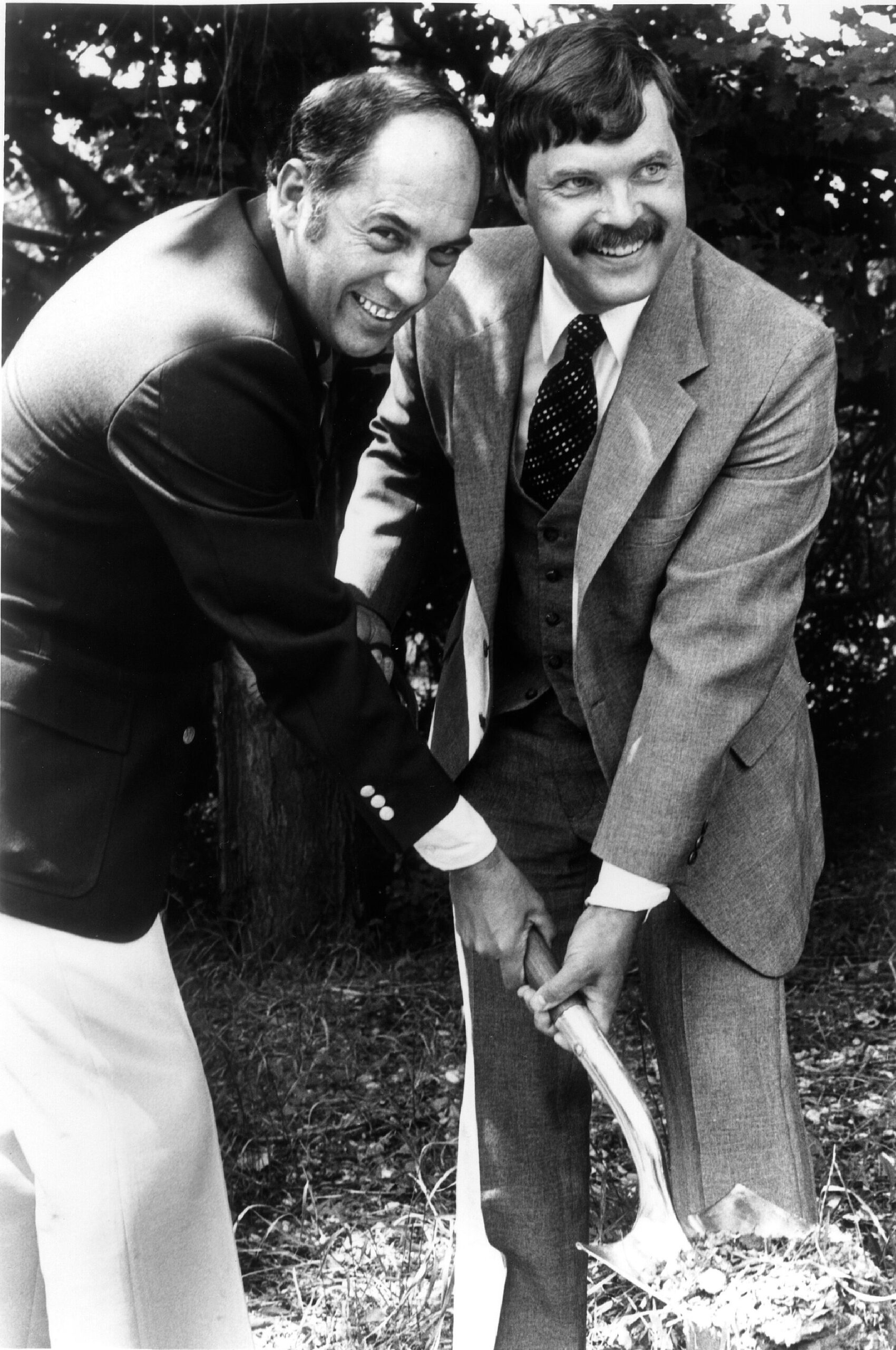
Rasmussen (left) and Bristol, CT, Mayor Michael Werner at the groundbreaking for ESPN’s Administration Center building on June 24, 1980. (Photo: ESPN Images)
Rasmussen and Scott incorporated the fledgling network on July 14, 1978, and the race was on. They secured satellite time. They negotiated with the NCAA for rights to regular-season and tournament basketball — wall-to-wall coverage that no one had ever attempted. They built a production facility out of almost nothing. And Rasmussen persuaded Anheuser-Busch to sign the largest cable-TV advertising deal in its history — a seismic moment that legitimized ESPN before it aired a second of programming.
“Bill is a true pioneer who saw an opportunity where no one else did,” says Sports Broadcasting Hall of Famer Sean McManus, longtime CBS Sports chairman. “Most thought his idea for a 24-hour sports network was ill-advised, but he persevered and what he envisioned became the most powerful and valuable cable channel in America.”
Rasmussen didn’t just build a network; he built the brand. He created SportsCenter, the program that still embodies ESPN’s mission nearly five decades later. He helped define the tone of cable sports coverage — urgent, constant, informed — and opened the door for every college sport, every league, every athlete who had never enjoyed national visibility.
“Bill is the true visionary who saw before any of us what our futures would look like,” says Sports Broadcasting Hall of Famer John A. Walsh, one of ESPN’s most influential editorial leaders.
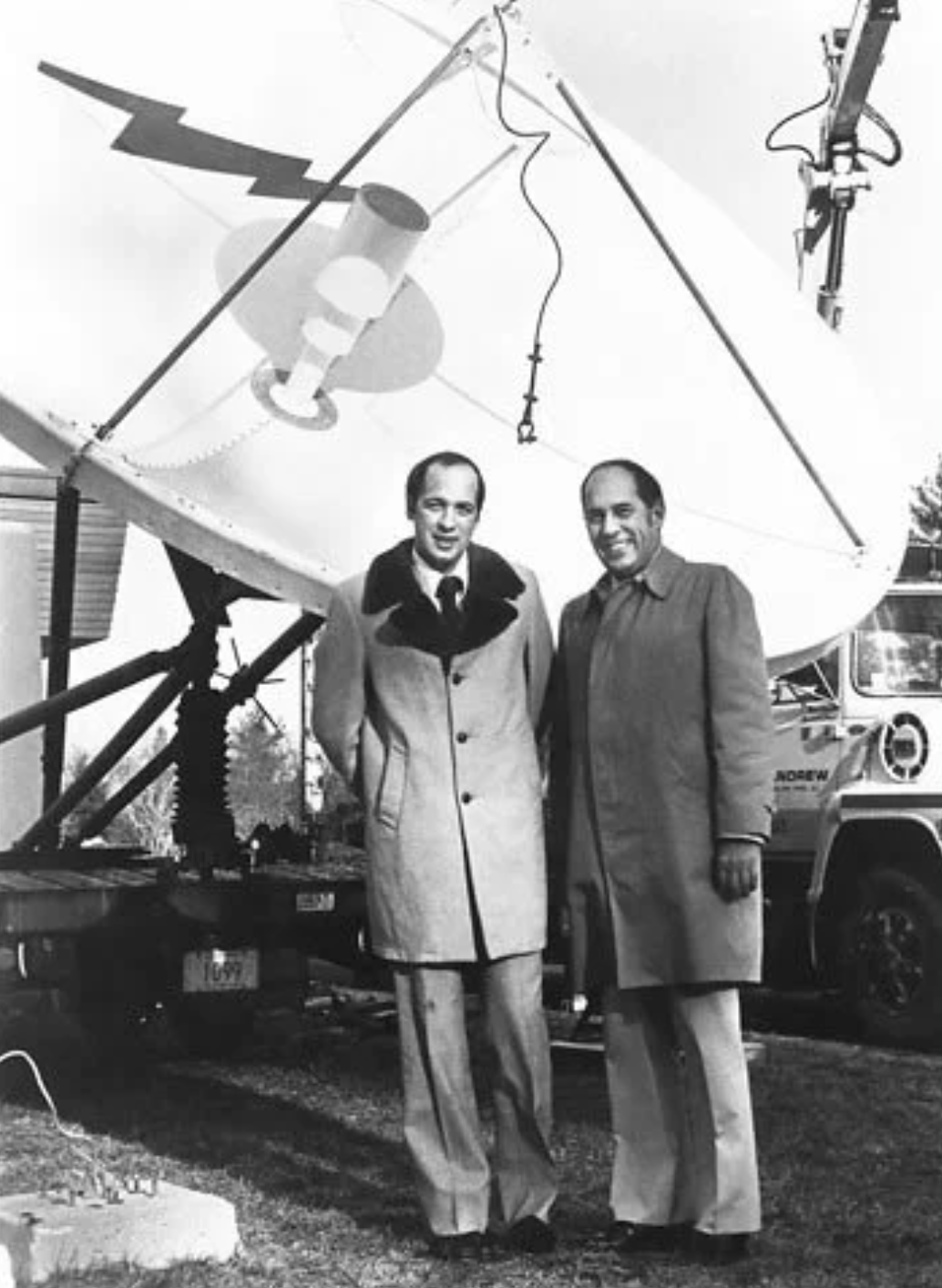
Rasmussen with son Scott at ESPN Plaza in September 1979. (Photo: Bill Rasmussen)
Although Rasmussen’s time at ESPN was short, the foundation he laid became the bedrock of a cultural force. ESPN’s growth — into college basketball, the College World Series, NFL rights, and beyond — flowed from his original blueprint: serve the fan, nonstop, with passion and imagination.
“Bill persevered against all odds to build his dream of sports around-the-clock,” says Sports Broadcasting Hall of Famer George Bodenheimer, former ESPN president. “I admire him so much. His passion and can-do attitude sum up the spirit and culture of the company today. That’s him.”
After ESPN, Rasmussen remained a relentless entrepreneur. He advised the Big Ten Conference on television strategy, championed early internet ventures Happy Puppy and Games Domain, and founded College Fanz Sports Network, one of the first online communities devoted entirely to college sports. His work in digital media was as pioneering as his early cable efforts — long before streaming made such ideas commonplace.
His influence echoes through every screen, every scroll, every scoreboard.
“ESPN has a 46-year history of innovation, and it all started with Bill Rasmussen and his original vision,” says ESPN Chairman Jimmy Pitaro. “He’s an eternal optimist, a bright light, and I am so appreciative of his friendship and guidance over the years.”
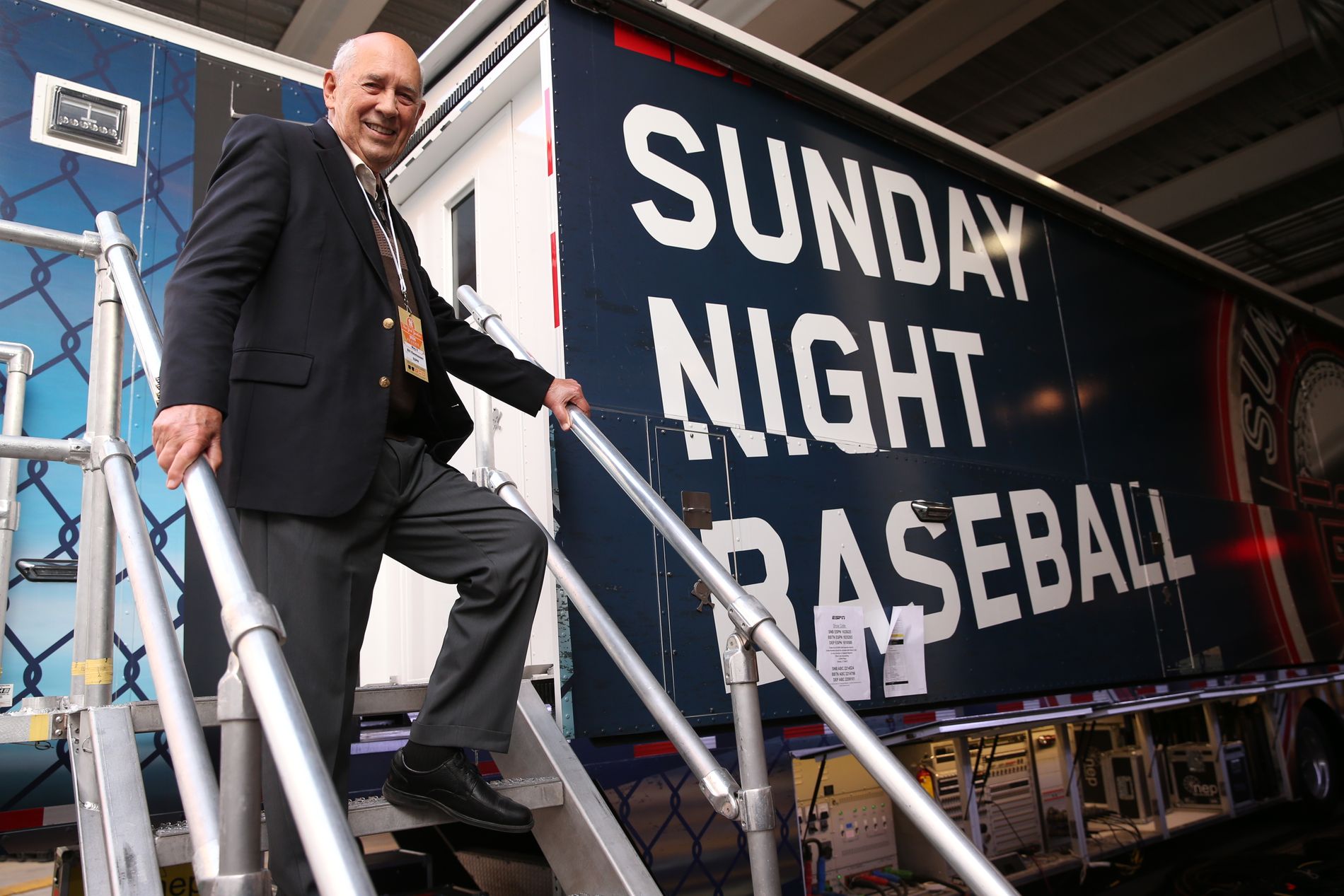
Rasmussen visiting the Sunday Night Baseball trucks during a regular-season game at Yankee Stadium in 2016. (Photo: Allen Kee/ESPN Images)
Rasmussen’s optimism also shaped his character. He has spent decades supporting charities, scholarship programs, senior-tour events, and community initiatives. His reputation across sports media is one of humility, gratitude, and persistence.
“This is a guy whose idea gave birth to, arguably, the most successful media story of our time,” says Jim Miller, author of Those Guys Have All the Fun. “He was pushed out in 1980 and basically harbored no resentment. I don’t think there are a lot of people who could have gone through what he went through and emerged like that.”
Rasmussen’s contributions have been lauded by Sports Illustrated (“Forty for the Ages”), USA Today (“The Father of Cable Sports”), and Sports Business Journal (“Pioneer and Innovator in Sports Business”). He altered the relationship between sports and television — and between fans and the games they love.
As for the skeptics who doubted a 24-hour sports network, Sports Broadcasting Hall of Famer and on-air talent Chris Berman puts it simply: “Without Bill Rasmussen, we’re nowhere.”
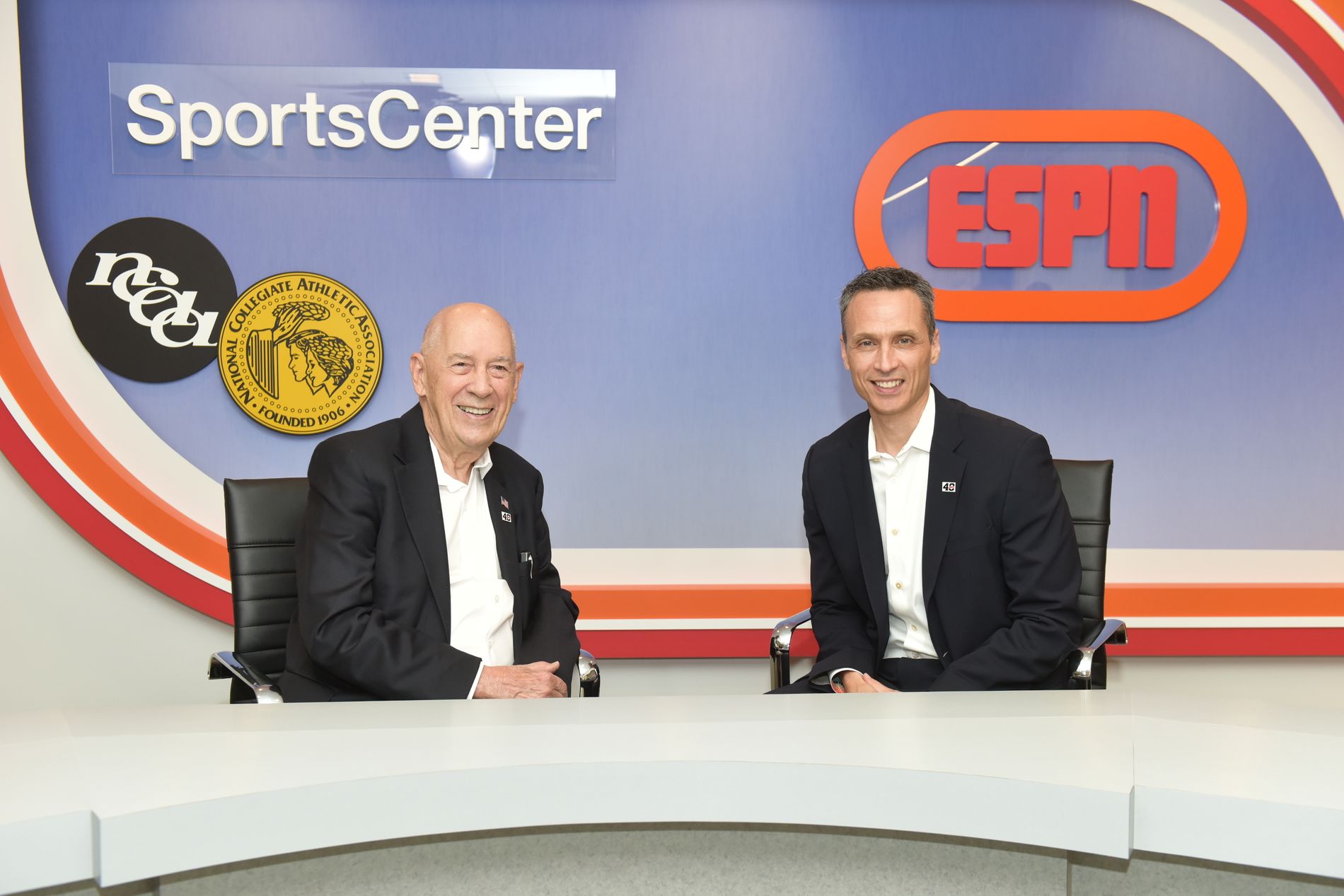
Rasmussen with current ESPN Chairman Jimmy Pitaro during the “ESPN The Exhibit” ribbon-cutting ceremony in 2019. (Photo: Nick Caito/ESPN Images)
In that studio in 1979, Rasmussen didn’t know if ESPN would survive. He didn’t know that cable households would grow from thousands to millions. He didn’t know that SportsCenter would become a cultural touchstone or that ESPN would expand across continents and platforms. He knew only that the countdown had reached zero and no one could stand in his way anymore. No one’s laugh could deter him.
The camera light came on. The screen filled with color. A new era started in a tiny building in Bristol. And Bill Rasmussen — the fired PR man with a credit-card advance and an impossible dream — changed sports forever.