SVG Sit-Down: NESN’s Kenny Elcock and Harmonic’s Jean Macher Talk Next-Gen Distribution for Live Sports
NESN streamlines its workflow with XOS advanced media processor and DMS X distribution
Story Highlights
New England Sports Network (NESN) has its hands full. The regional sports network that is home to MLB’s Boston Red Sox and Pittsburgh Pirates and NHL’s Boston Bruins and Pittsburgh Penguins aims to deliver live sports action to millions of homes via both linear and streaming mechanisms.
NESN’s customers increasingly demand more in terms of video and audio superiority, and the RSN sees the need to deliver such quality to affiliate partners. That’s partly why, at the beginning of 2025, NESN collaborated with Astound Business Solutions and Harmonic to re-create the way NESN distributes live content.
The RSN turned to Harmonic’s XOS media processor, which offers up to 50% reductions in bitrate through AI-powered EyeQ content-aware encoding, delivering cost-effective video-quality optimization while extending support for formats up to native 4K UHD HDR. NESN also integrated Harmonic’s ProStream X stream processor to distribute live sports content to all affiliates using SRT protocol, ensuring high-quality, reliable delivery.
SVG recently connected with NESN VP, Technology, Kenny Elcock and Harmonic Senior Director, Global SaaS Solutions, Jean Macher to discuss how everything came together.
EDITOR’S NOTE: This interview was conducted prior to today’s announcement of MediaKind acquiring Harmonic’s video business.
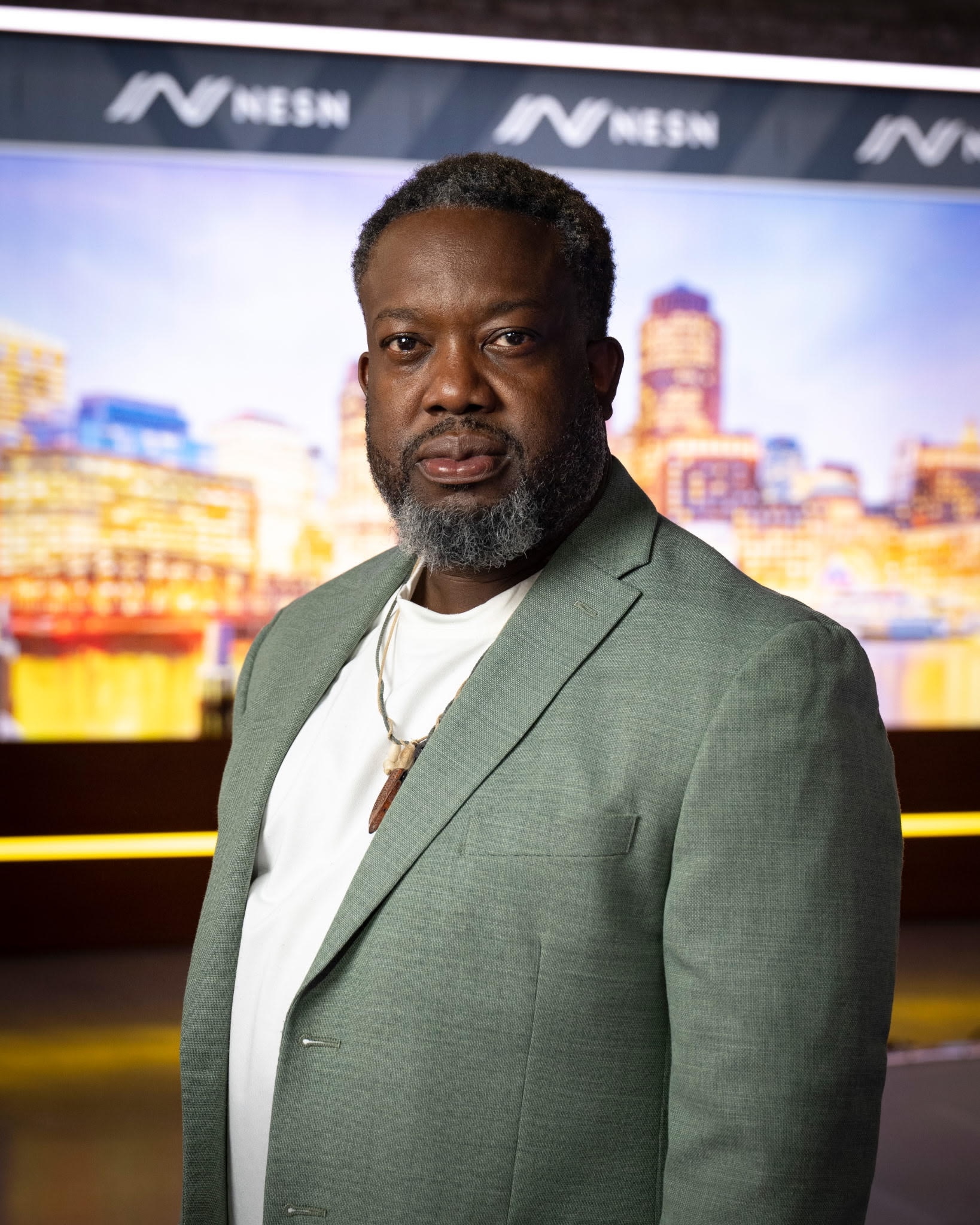
NESN’s Kenny Elcock: “This is a solution where technology did drive the business. It wasn’t just because of cost cutting. This was [about] how to get the best product to the customer and be as agile as possible.”
Elcock: We definitely needed to create a distribution-convergence solution. We were traditionally a linear company that provided distribution for our linear and growing digital affiliates. We partnered with Harmonic to create the backbone and foundation of a solution to provide our partners a cleaner delivery option with improved quality at a lower cost. We also wanted a solution that was extremely agile. With the foundation we build, we could adapt the solution for our digital, DTC, and FAST-channel partners. One of the unique aspects of this relationship is the solid infrastructure, which delivers NESN content in multiple formats to many partners, creating a secure stepping stone for next-gen technology.
How many channels do you manage?
Elcock: We have a combination of 12 linear playout channels, 19 total channels when you encompass our DTC partners across the New England and Pittsburgh DMAs.
You also work with ViewLift. What do they do?
Elcock: ViewLift handles New England: HD for both NESN and NESN+, 4K for NESN on our DTC app and some of our other digital partners.
When did the integration of Harmonic’s tech occur?
Elcock: We completed the integration of the Harmonic equipment, at the start of 2025, after three or four months of building the backbone infrastructure using the Harmonic XOS delivery system. We put all our linear partners onto the Harmonic distribution solution. Once we were comfortable, we transitioned our NESN digital delivery to the Harmonic solution, delivering the content to ViewLift. That transition was completed within the last 90 days.

Harmonic’s Jean Macher: “Here, the topic is the primary distribution solution. What we are trying to accomplish is to bring the maximum flexibility to the customer.”
Jean, you work with a lot of RSNs. How did you get into business with NESN?
Macher: NESN is a historical customer for us; we have a great relationship with Kenny in particular. And yes, we also have a good footprint with RSNs in general. We do a mix of primary distribution solutions that we deploy for those RSN customers, and sometimes also a streaming solution that we deploy for them. Here, the topic is the primary distribution solution. What we are trying to accomplish is to bring the maximum flexibility to the customer. We provided the primary distribution headend.
And we try to bring a new generation of receivers that has full flexibility. As Kenny said, you might need a specific format for your partner, but tomorrow they might need a different one: different codec, different output type, linear versus streaming. All of this is built into the IRD [integrated receiver/decoder] and offers the flexibility of adapting to any affiliate situation.
On top of that, with all the capability at the edge, you need a strong management solution. So we also offer that. It’s called DMS X (distribution management system).
We should also touch on the partnership with Astound, which was an important component to all of this. And we offer an additional component built around telemetry: we help you get feedback on what’s happening with your distribution partners.
Elcock: That was one of the key selling points for my team. We have the ability now to support all our linear partners in a real-time capacity. We are able to monitor all devices in real time and provide our partners with immediate feedback as to what’s going on before the content is delivered within their environment. We’re able to provide switchable format solutions as needed, within hours if required. What that helps us do is echo loudly a white-glove, five-star service for our affiliates. It wasn’t the traditional way where you hand it off and say, “Bye.” We are engaged in our partner’s success.
Maybe, in 101-ish terms, you can describe the essential evolution here?
Elcock: Traditionally, what was provided from us as a content provider is an IRD to each affiliate. Within that IRD, we were providing HD/SDI source. The challenge for the affiliate is, number one, the traditional solution would be delivery via satellite, direct hard fiber, or a DIA solution at the affiliate side, which consumed a lot of bandwidth and have cost restrictions.
The traditional solution was also a one-to-one, content-to-provider relationship. If we had to send them four content streams, we would have to multiply those individual streams: (in simple numbers) at 10 megs apiece, 40-meg streams per IRD. We would have to provide them directly, or [the affiliate] would have to source out specific bandwidth within their environment to capture those feeds. In addition, we didn’t have the constant feedback. If an IRD fails or the delivery service fails, it was the responsibility of the affiliate to re-cycle the unit, solve the problem themselves, or reach out to NESN.
In this era of challenges, you don’t always have the talent like you would in a larger company. That became a massive undertaking for a lot of our affiliate partners. The Harmonic solution provided a reduction in the bitrate delivery, an open solution whereby we’re not consuming a lot of bandwidth on the affiliate side. We can provide multiple streams for each of our affiliates in a very efficient delivery system, so they’re not paying for unused or excessive bandwidth costs. We can give them multiple formats with MPEG, MPEG-2, or MPEG 4. And HEVC — I am really excited about that.
Maybe talk a little more about the feedback element?
Elcock: We have monitoring capabilities, real-time feedback, and a control mechanism that allows us to restart the IRD ourselves. We can check for errors and control bitrate. We are actively engaged with customer support at the affiliate level.
You’re trying to do one of the hardest things you can do: broadcast and stream live sports with fewer folks involved.
Elcock: This whole solution internally was managed and deployed by three NESN technology-team members. A massive undertaking: we’re talking about the whole New England DMA. It was executed under budget, on time, with minimum challenges — feedback echoed by our partners. Normally, when they do a format change or when we do a technology change or exchange, it’s usually one of the things that everybody dreads. And look, we had only one game to play, and we played the game and won.
How does the relationship with Astound work?
Elcock: Astound was the key spoke in this wheel, where the edge system devices, the electronics, the gear — the stuff that we all see and like with the blinking, flashing lights and the color marker — was all Harmonic. But Astound was our secret partner. They provided the backbone solutions to deliver our SRT feed. They provided the cloud options to go ahead and make this solution as efficient as possible with reduced latency. They were the partner that said, “Hey, we could bring all the pieces together” at a very significant reduced delivery cost. At the end of the day, this was a three-partner venture.
Macher: Kenny and NESN had strong leadership in [bringing Astound in]. Harmonic is providing the gear, the appliances that enable the primary distribution, but Astound provides the managed service, the connectivity. These were strong choices by NESN, by Kenny to assemble that team and then execute on that vision for the next-gen primary distribution. It’s not always like this, is what I’m trying to say.
Let’s go back to talking about the future-proofing.
Macher: One example Kenny touched on, the distribution partners can receive multiple channels very efficiently compressed, and we can deliver whatever output they need. So we have multiple type of outputs available. Today they use one; maybe tomorrow they use a different type.
Another example is built into the XOS: we have also some capability for edge customization. Edge playout, if you’d like, that can be turned on if, one day, you want to deliver different content for particular distribution partners: different ads, different local content. This is possible also as a feature that can be turned on easily for a given distribution partner.
It goes back to that notion of collapsing a lot of functions. It’s like a mini headend that you have in your receiver at the edge that can, if needed, deliver new flavor, add some new content, maybe one day connect from one type of source feed to a different type of source feed. All of that is available and centrally managed under that control plane that we call DMS X, that NESN and Astound access to manage the platform 24/7. You have both the flexibility and the central management.
I’m guessing you also want to talk about video quality.
Macher: Harmonic is a household name for video compression, of course. One of the features that we enable is EyeQ Content-Aware Encoding, which uses machine-learning, AI applied to video compression where we mimic the human eye. It’s a little trick that we play: we focus the bits where your eye will see, and we remove the bits where your eye will not see.
Of course, a lot of machine learning goes into this. We have over 100 customers deployed with EyeQ. It delivers tremendous result for video quality. The net-net is that you can deliver top video quality at lower bitrates to your distribution partners. That’s especially important when you start doing formats like 4K. 4K is demanding in terms of bandwidth, so we enable that as well. Again, I’m giving you all that flexibility built into the primary distribution solution. You turn on what you need — either at a given moment or for a given distribution partner, all under the central management of the DMS X central management.
Elcock: It’s not pie in the sky. We’re using all of what Jean just said. [With] EyeQ for our 4K delivery — all our home games for both the Bruins and the Red Sox — the reds are vibrant reds, and the blues are dominate blues. I mean, we are passionate about what we see. The viewers are passionate — and not only from a quality standpoint. We’ve seen an increase in our viewer asks for 4K. We know it works. The viewers are happy; they’re embracing it, just like the tech geeks [do]. And we’re delivering 4K at a lower cost because of the solution, and we’re seeing the growth in it.
As for the edge, we have not totally deployed the edge regionalization yet, but, in the next 12 months, we are going to deploy it, especially in the areas where we see there’s extremely high streaming value. Why do we want to do it? Because it does reduce backend resources. Let me give you an example. It takes one-to-one, one linear playout per market. Even though the content is the same, if the commercial is different, there are opportunities where we could push that resource down to the edge, and now we have not only a reduction in the backend but a DAI monetization strategy that is second to none.
What kind of viewer feedback are you getting?
Elcock: The reality is that the market is tough. Everybody wants to have the edge. Everybody’s trying to figure out, “How do we get our content to the viewer at any time at the maximum quality possible,” not at a reduced compression rate where the quality is impacted. How do we get the best quality to all our viewers at the most efficient rate possible? Because of that feedback, that’s why we made a decision. We restructured the design because we listened to the viewers, we listened to the affiliates, and we did it at a price point that made sense for the business.
This is a solution where technology did drive the business. It wasn’t just because of cost-cutting. This was [about] how to get the best product to the customer and be as agile as possible, regardless if they’re watching in their home on their laptop, on their smart TV, or on their phone. They want to have the best quality, and this was the only and right solution on the market that we found. The Harmonic/Astound solution made that possible for us.