University of St. Thomas Ushers in Division I Era With New Arena and a Broadcast Operation Built for the Big Time
Dual control rooms feature Ross production gear, Sony imaging, robust infrastructure, IPTV
Story Highlights
When the University of St. Thomas — a private, Catholic research institution in Minnesota’s Twin Cities — made the unprecedented leap from NCAA Division III directly to Division I in 2020, the move came with questions about whether the Tommies could truly compete at the highest level.
Last week, they offered their clearest answer yet when the women’s volleyball team became the first St. Thomas program ever to qualify for a Division I NCAA Tournament, winning the Summit League’s automatic bid. On the field (court, ice, etc.), the Tommies have arrived, but this landmark moment follows years of work behind the scenes within the athletic department.

The Lee & Penny Anderson Arena on the University of St. Thomas’s St. Paul campus hosted its first athletics events on Oct. 24: a doubleheader of women’s and men’s ice hockey games vs. Providence. (Photo: St. Thomas Athletics)
The move to DI has been highlighted by the opening of the Lee & Penny Anderson Arena, a new $183 million facility in St. Paul designed to elevate the entire athletics department’s competitive and production capabilities. Its broadcast infrastructure just may represent its most ambitious effort ever.
“This whole project is a microcosm of the DIII-to-DI jump,” says Mike Gallagher, assistant athletic director, branding, digital content, and production, St. Thomas Athletics. “Every step built toward this. And now we’re in a place that lets us compete — and produce — at the level we want to be.”
The arena’s opening weeks were a whirlwind: the team produced streaming and in-venue videoboard shows for 26 events across the entirety of athletics. (That’s crossover season for you!) Undergirding the successes is an operation representing a quantum leap from what St. Thomas had known before — one built in close collaboration with Alpha, the Minnesota-based integrator that joined the project early, alongside Ryan Companies, Collins Electrical, and WJHW.
Control Rooms Built for Flexibility — and Built Twice
Inside the arena, St. Thomas’s broadcast backbone consists of two fully equipped control rooms, each designed to support simultaneous in-venue and streaming productions. The primary control room features Ross production gear: Carbonite Ultra 60 switcher with expanded I/O, an Ultrix 5RU router, Ultriscape multiviewers, dual XPression Studio/Designer systems. Four Sony HDC-3100 cameras (with RCP-3500 control) and a network of Panasonic UE100 PTZs and Marshall POVs are placed strategically throughout the venue. Through Alpha’s integration work, the room ties directly into the Daktronics show-control space, enabling tight coordination between broadcast, videoboard, audio, lighting, and fan-engagement elements.

St. Thomas Athletics’ video-production staff produces a men’s basketball videoboard show from one of two control rooms inside the new Lee & Penny Anderson Arena. (Photo: St. Thomas Athletics)
The secondary control room — added to the design spec after Alpha and St. Thomas jointly reallocated budget — mirrors much of the workflow of the primary. It houses a Ross Carbonite Ultra Solo switcher, Ross Ultrix 12RU frame for routing, Zeplay replay, Sony BRAVIA monitoring, and full KVM and conversion infrastructure.
Together, the two control rooms give the Tommies the ability to run parallel events, support overflow production, and take on an expanding slate of Summit League and non-conference broadcasts.
But the star of the technical plan — and the element Gallagher and Casey Eakins, senior media production systems technician, ITS Central Engineering, St. Thomas, are proudest of — is the network of 11 JBTs (junction boxes) embedded throughout the building. Retaining all 11 of these broadcast-signal connectivity boxes was not guaranteed, and, as the design moved from concept to actual budget, something had to give.
“To me, the biggest thing was being able to retain all the JBTs,” Gallagher says. “It’s not sexy, but, behind the scenes, you can count on, specifically, Casey and our other engineers and rely on what you’re going to get [from the JBTs].”

St. Thomas Athletics’ Mike Gallagher: “We’re in a place that lets us compete — and produce — at the level we want to be.” (Photo: SVG)
While researching the build, Gallagher consulted St. Thomas’s “aspirational peers” — Creighton, Marquette, Notre Dame, Georgetown — plus Summit League colleague Omaha. He learned from colleagues at Georgetown, which play men’s basketball games at Capital One Arena, that they rely heavily on 20 JBTs in their NBA/NHL-caliber venue.
“The home of the Washington Wizards and Capitals — which seats four times the people we do — has 20,” Gallagher notes. “We were able to retain 11. That speaks to the ample flexibility and possibility for future expansion we will have, not only for varsity events but for commencement, external sporting-event rentals, concerts — all of it.”
Additionally, the venue’s IPTV system, powered by VITEC EZ TV, comprises 71 endpoints feeding nearly 140 displays. Concourse monitors, club areas, premium lounges, and lobby features all operate as extensions of the broadcast environment.
“We got past the initial learning curve, and it has been awesome,” Gallagher says. “We deliver the game feed everywhere. We run branded L-bars before games. We flip between matchup graphics, radio, and stream feeds.”
A Videoboard That Catches the Eye
The arena’s visual centerpiece is a Daktronics-designed centerhung that gives St. Thomas a true Division I stage. The structure features four curved displays — each roughly 11½ ft. high by 21½ ft. wide with a convex profile — wrapped by a 4-ft.-high halo ring more than 90 ft. in circumference. All five displays use a 5.9-mm pixel pitch, ensuring clean motion and crisp imagery across the bowl.
Built for variable zoning, the centerhung allows the Tommie Athletics Productions’ team to treat each face as a single canvas or divide them into multiple windows for live video, replays, statistical inserts, crowd prompts, or sponsor elements. With both control rooms feeding the Daktronics Show Control system, the production team can quickly shift layouts depending on sport, moment, or game-presentation needs.
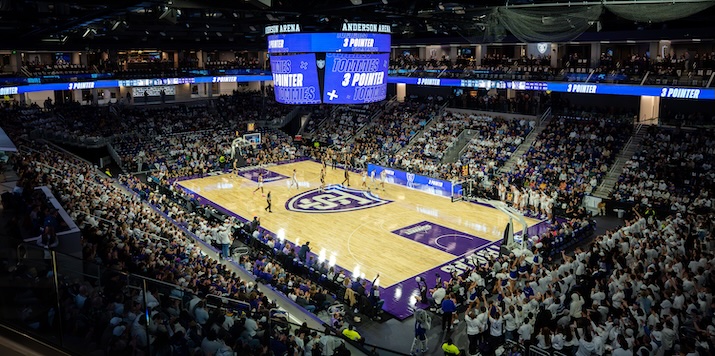
Lee & Penny Anderson Arena is also home to the Tommies’ men’s and women’s basketball teams. (Photo: St. Thomas Athletics)
Surrounding the action, a 2½-ft.-high 622-ft. ribbon board with a 10-mm pixel pitch lines the seating fascia, extending storytelling and partner inventory throughout the lower bowl. For basketball, five modular scorer’s tables provide an additional 50-ft. display surface at 5.9-mm pixel pitch and can be reconfigured to fit the broadcast plan or event layout.
Even the front door becomes part of the show. A 9- by 16-ft. smart-video wall with a tight 2.5-mm pixel pitch greets fans inside the lobby, giving St. Thomas a premium platform for matchup graphics, hype content, and campus messaging.
All displays are driven through Daktronics Show Control, which integrates display management, video processing, data, and playback into a unified workflow. Daktronics Creative Services partnered with the Tommies on a package of custom content to support the arena’s launch.
Production Environment Designed With Help From a Deep Bench
Gallagher arrived at St. Thomas just in time to experience the project growing pains. Within his first year, the program completed $1.6 million worth of videoboard upgrades at its current football stadium and former basketball arena, launched its first third-party streaming deal with Midco, and landed its first linear TV partnership — all within six weeks.
Alpha’s onsite engineering and project-management team — including Michael Jacobs, Darren Whitten, and early-phase contributor Jonny Sehloff — helped St. Thomas turn a high-level design into a system the university could operate, staff, and sustain.
“We had a four-hour meeting the day after the arena was announced,” Gallagher recalls. “The integrator and designer will give you the relatively stock thing that most places get. The ability to adjust that and cater it to what worked for St. Thomas was huge.”
Eakins describes those months of system-commissioning from a different vantage point. “We had a ton of training on a variety of systems. Being able to take those and actually understand how to run everything was a big thing we would not have had a year ago.”
Both Gallagher and Eakins describe the weight of the project, though, with a collective pride.
“You’re doing your day-to-day job,” Gallagher notes, “while also building the biggest construction project that’s going to carry the university for 20 or 25 years. To not feel that weight is impossible.”
Eakins says the alignment between athletics and IT, strengthened through Alpha’s collaborative approach, made the final push possible. “Hundreds of devices, late nights, configs — you can’t do that unless everyone’s aligned.”
Eakins, whose father teaches at St. Thomas, grew up around the school, worked games as a student, and helped plan systems for the arena even before graduating. He sees special potential in the building: “To see where this was and where it is now, it’s incredible. It’s home. And it’s a home built for the future.”
Running Two Shows at Once — at Every Event
St. Thomas produces everything: the game broadcast, the in-venue show, out-of-venue streams, and content for both Midco and Big Ten Plus. There are no production trucks except for football or the rare national game. That makes communication between the two control rooms essential.
“These two rooms are listening to each other at all times,” Gallagher explains. “It’s intimidating at first, but, once you get reps, the flow becomes natural.” With Alpha’s wiring and routing architecture allowing all eight replay channels to be shared across both rooms, directors can seamlessly coordinate camera usage, replays, and fan-engagement shots.

Lee & Penny Anderson Arena will become an epicenter of the university, hosting non-athletics events: commencement ceremonies, academic convocations, speakers and career fairs, even entertainment acts. (Photo: SVG)
Supported by the talented pairing of Associate Director, Live Production, Mari O’Neill and Production Coordinator Megan Bloomer, 80%-85% of St. Thomas productions are staffed largely by students. Tommie Athletic Productions has grown from seven students to about 50. Freelancers from the Twin Cities professional-sports scene now support replay and in-venue directing for men’s hockey and men’s basketball, giving students access to real-time mentorship.
“You’re doing fan cams, instant replay with bugs, live rotations — real stuff, not a simplified show,” Eakins says. “Being able to bring pro experience here elevates the show and prepares students.”
Lee & Penny Anderson Arena is the new flagship arena, but St. Thomas still runs productions for football, baseball, swim, diving, and volleyball out of the Anderson Athletic & Recreation Complex and Schoenecker Arena. Studio space in the O’Shaughnessy Educational Center adds another control-room option. An interconnect project — supported again by Alpha’s network design — will soon allow any show to originate from any control room on campus.