For TGL Season 2, Unity 6 Boosts Virtual-Graphic Quality; COSM 360 Cameras Improve Hitting-Box Coverage
Tech changes were made with production, players, and fans in mind
Story Highlights
Season 2 of TGL is underway, marked by changes on both the production side and the virtual-course and playing-surface side. All of them are designed to bring more dynamic shot making, chipping, and putting to the hybrid team-based golf league, along with new ways to cover the action and make the game easier for fans to follow.
TGL’s second season continues tonight when the Jupiter Link Golf Club faces off against New York Golf Club at 7 p.m. ET on ESPN. Tonight’s action will feature golf greats Rickie Fowler, Matt Fitzpatrick, Max Homa, and Cameron Young.
“One of the goals in Season 2 is to make it easier for the viewer to understand what is happening in the match at all times,” says Jeff Neubarth, VP, content, TMRW Sports, which created TGL. “We’ve added Virtual Eye this year, which is similar to the technology used for the PGA TOUR, LPGA, and major championships, and it makes it easier to see who is closer and how far they each have to hit to reach the pin. Also in that vein, we have added ball tracing from the tee to the screen using any of three cameras, including our rail camera, which runs around on a 300-ft. track. It lets us show how high the player is hitting the ball into the screen as well as the angle, which is really cool.”
TGL coverage has also been improved with increased shot-data visualization in real time, as opposed to after the ball reaches its landing spot. “As soon as a shot is hit,” he explains, “you see the ball speed and the apex of the shot and other statistics as well. Both hardcore golf fans and those who love technology are being served by that.”
In terms of cameras, the big addition this year are Cosm C360 cameras mounted in front of the tee box. They replace last year’s remotely controlled cameras, which were larger and more intrusive.
“With C360,” says TMRW Sports CTO Andrew Macaulay, “the camera isn’t moving, and there are no distractions for the golfer. [The cameras] can digitally zoom or pan, [giving] different camera angles depending on if [the ball is] in the rough or in the sand.”
Adds Neubarth, “Those cameras are smaller in form, which better suits the aesthetic that we wanted. They also allow us to reframe the replay after a shot has been hit. For example, if I [tell] the operator to just show the player’s feet, they can go in, rewind, and show an iso of the player’s feet or anything else we want to focus on.”
Another change is that two towers housing ball-tracking sensors, previously located behind the tee-box area, were removed from the field of play. The sensors have been moved to the ceiling, becoming part of a group of four sensors and giving plenty of tracking redundancy because only one of the systems has to be working properly to track ball flight.
“The system automatically determines which of the four has the best reading,” says Macaulay. “Last year, we learned that the most accurate readings were from the two systems in the ceiling. It made sense to put two more in the ceiling and get rid of the towers, which were also in the fans’ sightline.”
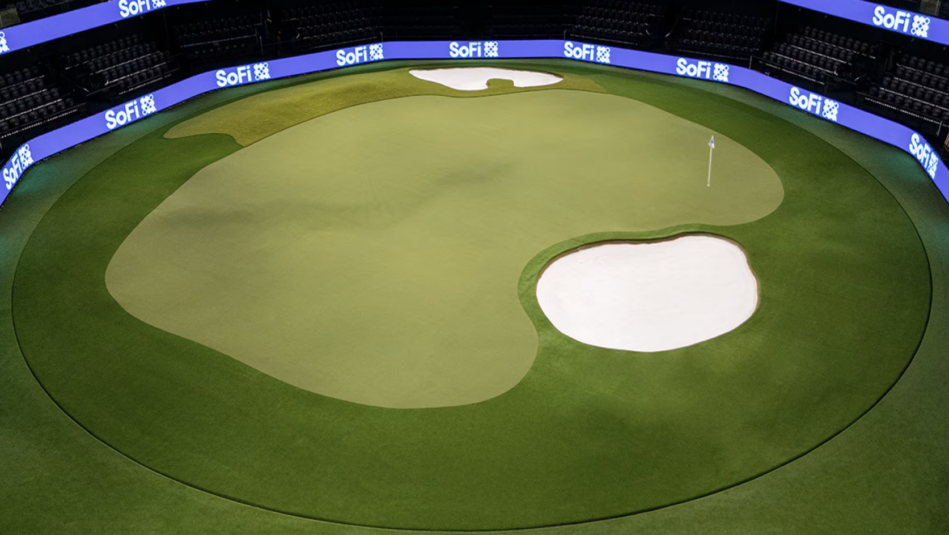
One of the big changes this year was lowering the highest point of the GreenZone, the knoll, by 18 in.
Season 2 has also seen changes to the GreenZone rotating green, which is where the virtual world is replaced by a real-world green built on a table that rotates and whose green contours can change, thanks to a vast hydraulic system beneath the playing surface. The putting surface has increased 38% in size: from 3,800 sq. ft. to 5,270 sq. ft., which is much closer to the average size of a green on the PGA TOUR (5,701 sq. ft.).
Also, two Full Swing Virtual Greens under the turf now total 1,250 sq. ft., with 608 actuators to morph the putting surface (up from 1,215 sq. ft., 567 actuators). The larger Virtual Greens add 60 sq. ft. of adjustable putting surface to bottom tiers.
“We basically stripped off everything that we had put on top of it, [took] the turntable back to the steel, and built it all up again,” Macaulay explains. “It took us about two months to do that; it’s a pretty big undertaking.”
In another big change, the highest point of the GreenZone, the knoll, was lowered 18 in., a move that opened more sightlines for fans in the arena as well as camera angles. It also lessened the slope of the top-tier section of the green, a move that allows more shots onto the green and more styles of attacking the green (bump and run, etc.).
“We also removed a third bunker,” says Macaulay, “and now have two bigger bunkers and also a playing surface that is almost 40% larger than last year and has 12 pin positions instead of seven. That gives us a lot more flexibility. The bottom line is, with the changes, a lot more balls will get onto the green, which means more putts for birdies and eagles.”
There have also been some changes related to the ScreenZone hitting boxes. First, they have been enlarged to provide more space and to improve divot management.
Also, enlarged sand trays allow a larger bunker lip, which can be raised or lowered at the front of the bunker, increasing difficulty for fairway bunker shots. “It adjusts based on how much of an obstacle is in front of the player [in the virtual game],” says Macaulay. “If the player is in the middle of a fairway bunker, there isn’t much of a lip. But, if they’re at the bottom of a big bunker, it can angle up to 45 degrees and be around 20 in. tall. It’s fun seeing the players figure out how to get over it.”
TGL also took something away from the hitting boxes: the LED lights along the ground at the back of the tee box. “It gives [the players] a bit of a bigger space so they can tee up wherever they want,” says Macaulay. “Also, they don’t have to step over it in order to get to the hitting zone.”
As for game technology and graphics improvements, the big leap was from the Unity 5 to the Unity 6 graphics engine. Unity 6 adds HDRP (High-Definition Render Pipeline), which, according to the supplier, offers more physically accurate lighting, a physically based sky volume (with volumetric clouds), updates to the water system, dynamic resolution, variable-rate shading (VRS), and lens flares.
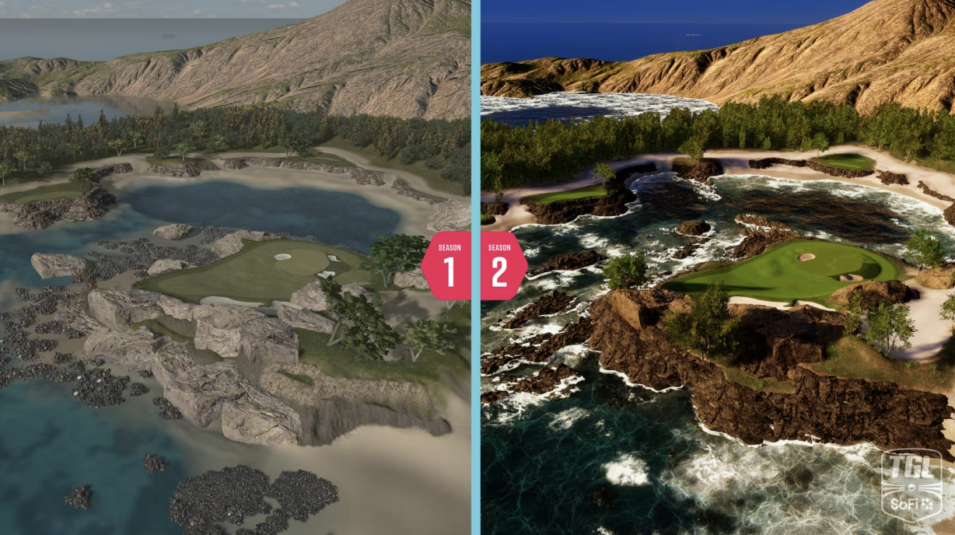
The quality of the virtual graphics for TGL Season 2 is markedly improved, thanks to the move to the Unity 6 graphics engine.
“From a layman’s point of view, it’s like the move from SD to HD in terms of projection-image quality, and that was really, really important,” says Neubarth. “We also added multiple new angles in the virtual game via two new observer cameras that we developed with Full Swing. One of them, for example, hovers as if it was a drone 50 ft. above the green so that it can keep the ball in the frame the whole time and show where the ball lands. The other camera is like a reverse trace in the middle of the fairway, which is great for showing some of the crazy forced carries the players have to hit.”
Neubarth says the changes this season are the result of bringing together ideas from fans, players, and others (even at real-world golf tournaments). The company challenged vendors and the TGL team to improve the experience for everyone, both in the venue and at home.
“That’s where my partnership with Colin DeFord, VP, broadcast engineering, TMRW Sports, and Director Jonathan Evans comes in as we figure out what we want to test and try out,” Neubarth says. “We are still testing some things that we expect to add later this season, similar to how we added the Smart Pin camera last year.”
One thing that remains the same is the truck compound outside SoFi Center in Palm Beach Gardens, FL. Once again, Game Video Moonshine A and B and Edit Truck 3, along with two B units, are onsite, and Game Creek Patriot is serving as a data center. With all or the graphics servers, Game Creek Video also provides a large portion of the robotic cameras.
One addition that Neubarth particularly highlights is Robert Castro, director, golf, CapTech, a TGL partner that helped design the gameplay. Castro is now an analyst, and Neubarth says it isn’t very often that someone who helped invent a game or sport is on-air as an analyst.
“His audio doesn’t go to the players,” he points out, “so he can talk about strategic moves like how to use the hammer [to challenge the other team]. That also helps make the viewers smarter.”