Milano Cortina 2026: OBS CEO Yiannis Exarchos Previews Production Innovations
First Person View drones, AI-based tech target greater fan engagement, efficiency
Sports fans will benefit from the wealth of tech innovations that Olympic Broadcast Services will deploy during the 2026 Milano Cortina Winter Games. For two weeks beginning Feb. 6, OBS will deliver 1,000 hours of event coverage, along with an additional 5,000 hours of content and highlights. The goal of the tech enhancements is to increase fan engagement and production efficiency.
It will begin with what OBS CEO Yiannis Exarchos describes as a particularly interesting Opening Ceremony: given the unique geography of this year’s Games, many of the athletes will be located across Italy and not gathered at Milano San Siro Stadium. With the help of technology, he says, the athletes in five separate locations will be connected not only to watch the ceremony but to participate as well.

OBS’s Yiannis Exarchos: “We are a company that is very technological, full of engineers, full of creative people, and we need to remember that this is about storytelling.”
“There will be a parade of athletes in every location, and it will be happening concurrently,” explains Exarchos. “It’s orchestrated in a way that everybody will be able to see and participate in what’s happening in every venue. This has been a core objective that we had with [Director of Ceremonies] Marco Balich and the creative team: to try to achieve this sense of unity especially in the parade of nations because you will have teams that have athletes in all four locations. We want them to feel that they are parading together at the same time, and we did a very detailed rehearsal a couple of months ago that went very well. Also, there will be core elements of the ceremony everywhere, not just in San Siro.”
The connectedness of the Opening Ceremony belies what Exarchos says has been the biggest challenge: the distances between venues, because even the Alpine events have been split into two locations a multi-hour drive apart. Telecom Italia has been a key partner in ensuring connectivity of venues spread across the Dolomites.
“The fact that Alpine is split in two geographically very different places is not a huge problem so much for OBS,” he says, “but it is a challenge for the broadcasters. Alpine events are usually in one space, but now they have to split their operations. This is where connectivity and the cloud and so on will help them. There will be a lot of broadcasters calling Alpine events either from Cortina or from Bormio, but it will appear as if they are present in both places [at once].”
Storytelling Is the Point
And, though focusing on the technical side of production, Exarchos makes clear that the tech is not the point: the athletes, their stories, and their nations are. “I try to always remind our team and remind myself that this is not about technology; this is about telling the stories of the most important athletes in the world and telling the stories about the values and the emotions that are being generated by them.” he says, noting that the Olympics’ ability to bring people together is needed in this time in world history.
“We’re not tech-narcissists,” he adds. “We are a company that is very technological, full of engineers, full of creative people, and we need to remember that this is about storytelling.”
To that point. he refers to the “3Es” that guide OBS efforts: Enablement, doing things that were not possible before; Engagement, making storytelling and coverage exciting and compelling; and Efficiency, making the Games more sustainable, easier, and less wasteful.
Topping the list of new production tools that will enhance engagement are what OBS is calling “First Person View Drones.” Drones have been a part of OBS efforts since Sochi 2014, but Exarchos says the technology has gotten much safer and will now be much closer to the action. The FPV Drones, for example, will be used at the Sliding Center in Cortina d’Ampezzo, zooming down the course behind the athletes in Bobsled, Luge, and Skeleton competitions. “They can go very close to the action,” he notes, “and offer a sense of being part of the competition.”
Also, 360-degree live replays will take another step forward after debuting during the 2024 Paris Summer Olympics. AI powers the new tech and allows stroboscopic coverage, with data related to the athlete’s performance developed within seconds instead of minutes.
“We will better show the movement of the athlete, but we will also overlay data, which gives completeness to the narrative as it explains the sport and makes the sport more understandable,” he adds. “It also makes the efforts of the athletes far more impressive.”
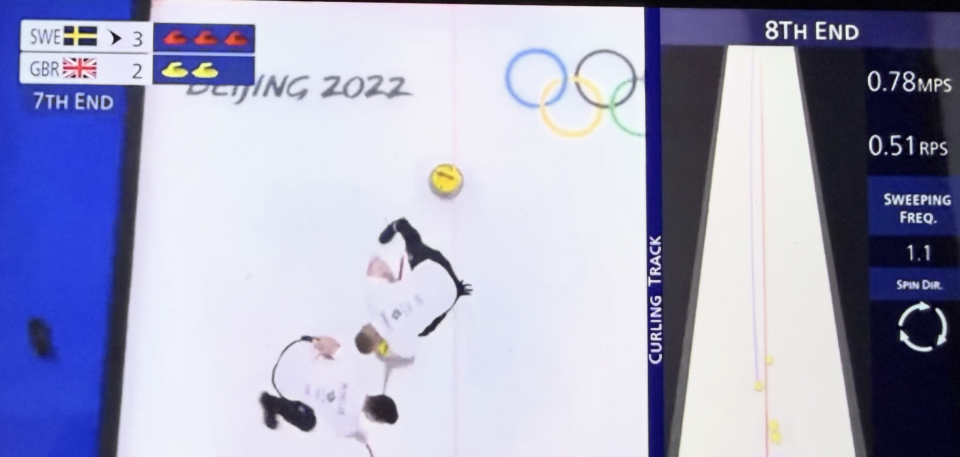
OBS’s new graphics for Curling will show the speed and revolutions (and sweeping frequency), giving viewers greater insight into the sport.
AI technology also is going to play a part in Curling coverage. Debuting this year, a graphic displayed alongside video of the stone sliding down the ice will provide such information as speed and spin rate. Notes Exarchos, “It allows the viewer to better understand the technique and also the frequency of the sweeping that members of the team are doing there.”
Olympic Channel Services, the OBS sibling that runs the Olympics.com website, will offer a new service that uses AI to answer fans’ questions on the competitions, rules, schedules, and more. The service will be available in 12 languages. “What’s special about it,” says Exarchos, “is that the source of all this information is not random sourcing from the internet that may contain a lot of mistakes, a lot of inaccuracies. It is framed to provide very accurate, unbiased, checked information around anything Olympic. We are pretty excited with this development.”
As for production formats, native coverage will be shot in 4K HDR, he says, adding, “Mapping of that signal allows us to derive an equally if not better HD signal without the need to do parallel coverage for HD.”
The Goal Is More-Efficient Production
Among production advances that will make production of the Games more efficient, Exarchos says the expanded Virtual OB Van project tops this list. “This is a breakthrough effort of engineering technology to not rely on the traditional big trucks that we use for the production at many venues. OBS has fully transitioned into IP technology, and that creates a lot of savings. For example, we will be using half the compound space we needed previously, as well as far less electricity. The [Virtual OB Van] is somewhere we feel sports-broadcast technology is going.”
Similarly, he says, master control is now a very intelligent cloud-based system. Distribution of the signals and feeds carrying more than 6,000 hours of content will delivered to rightsholders around the world via an Alibaba-based cloud interface.
“This creates big efficiencies for broadcasters but also for the hosting of the Games,” he explains. “It means a significantly smaller IBC, and that means less consumption of power, less travel, less movement of equipment in the Games. As broadcasters become more comfortable with working remotely, we are providing them the means to receive signals everywhere in the world.”
The result is an International Broadcast Centre that will be 25% smaller than the one in Beijing four years ago, as well as a 33% reduction in power consumption. “For L.A. 2028,” he adds, “we are planning for an IBC that will be half the size of what the broadcast center was for Rio 2016 but will produce more than two times the amount of content. That is precisely where technology becomes an enabler.”
Is it possible that an IBC will one day become nonexistent? Exarchos can’t see a time when everything can be remote or virtualized, given the physical realities of an Olympics: “We are headed towards a significant reduction of the physical presence in the host city, which is a great thing for broadcasters, for OBS, but primarily for the organizers [of the Olympics]. But physical realities are such that the complete elimination of an IBC and of studios in the city is not foreseen.
“It’s also part of the beauty of the Games,” he continues. “There is no event in the world where you have, in the Summer Games, 21,000 media present. We do want media [present], but what we don’t want is that they come there to do something that they could easily do back home spending less money and being more efficient.
“Even in Milan,” he adds, “we will have something like 6,000 broadcasters present because they want to be close to their athletes. Remember that not all broadcasters around the world are at the same level of development. Our colleagues from NBC obviously have the resources, the technology, and so on to [work remotely]. But we need to make sure that the small broadcaster in Africa or Asia can also deliver content to their audience.”
Hardware virtualization, Exarchos says, will be the transformative technology. “The ultimate solution is virtualized broadcast production — meaning you do not need a proper physical facility to transport [content] — and that is why we were early adopters of cloud technologies when people were saying we were crazy and it would never work.
“In Milan,” he continues, “65% of the signals are being transmitted over the cloud. When we started the cloud with Alibaba [for Pyeongchang 2018], we thought that, by Milan, we would have an adoption of 25%. But we are at 65% because everybody’s seeing the benefit and because we had the pandemic, which forced people to learn how to work differently.”
A mix of cloud-based services and very powerful servers running very specialized broadcast software exemplifies how OBS leverages technologies offered by Olympic partners like Alibaba and, previously, Intel.
“Alibaba is a very clear example of a partner that helped us with developing a broadcast cloud,” Exarchos explains. “When they came into the Games as a sponsor, they were using cloud services for administration systems and stuff like that. We said how about broadcast? And we started talking and realized that there is something there, and they have been great partners in developing that. Intel is not a partner any longer but helped us a lot in developing the Virtual OB Vans. We’re looking into similar opportunities with Omega and with Samsung, who are doing a mobile broadcast with us [this year] for the first time.”
Look for live reports from both SVG and SVG Europe staffers as we descend on Milan and Cortina beginning on Feb. 5 and have a presence there for the entire Games.