How Vizrt, TriCaster Helped Harvard Athletics Embrace Vertical Video and More to Serve Fans
Story Highlights
On an average weekend day, the Harvard Athletics team produces up to four simultaneous live broadcasts of the university’s sporting events for ESPN+. A weekend this past winter, however, presented a particularly monumental challenge. With an unprecedented demand for coverage, the team successfully delivered 13 separate productions, including eight overlapping broadcasts. Events ranged from women’s water polo and men’s and women’s fencing to men’s ice hockey, women’s basketball, men’s and women’s track and field, and women’s tennis. This ambitious undertaking highlighted both the operational capacity and innovative spirit of Harvard Athletics Multimedia department.
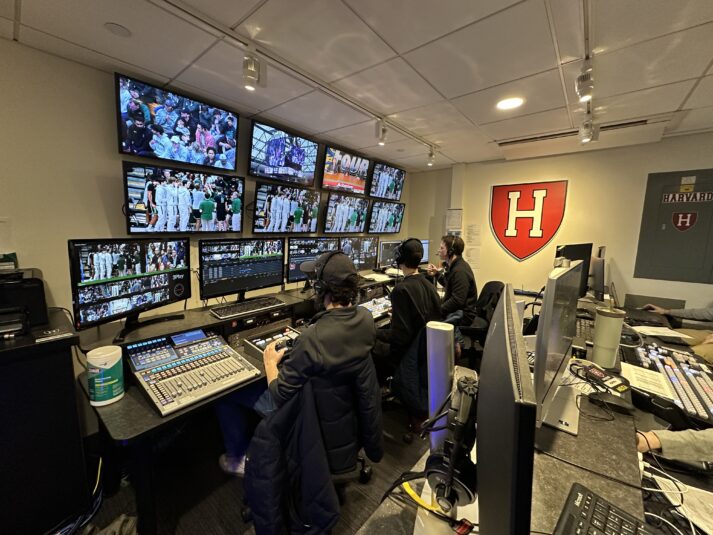
Harvard’s staff hooping it up in the control room for basketball coverage.
Under the leadership of Imry Halevi, Senior Associate Director of Athletics, Content & Strategic Communications, Harvard Athletics has set a new benchmark for dynamic sports streaming, deftly responding to an increased demand for parallel broadcasts. With Halevi and his team, the evolving complexities of modern college sports broadcasting have met their match.
“While I particularly enjoy the technological innovation part of production, that’s not really why we do what we do. It’s all about the fans,” says Halevi. “If your daughter or son play sports at Harvard, you want to see them compete on a regular basis. That’s why we do what we do, to provide that service and enable that connection between student-athletes, parents, alumni and fans.”
Scaling production with precision and innovation
Harvard Athletics undertook these production feats with an extensive technical setup that prioritized efficiency and quality. The department operates from two cutting-edge control rooms, each equipped with two TriCasters. The first room includes a Viz 3Play 4800 system, while the second features one Viz 3Play 4800 and a Viz 3Play 3P2, supported by NDI technology for signal contribution. Most of the infrastructure relies on AV-over-IP systems, with traditional SDI connections reserved for supplementary needs at the edges. This reliance on advanced broadcast technology allows Harvard Athletics to achieve seamless coordination during high stakes, overlapping productions.
Particularly noteworthy was the team’s hybrid approach during men’s ice hockey and women’s basketball games. For both events, they simultaneously produced content for ESPN+ and the live videoboards present at the venues using one switcher per sport. This dual production format catered to both virtual audiences tuning in remotely and in-person spectators, creating a visually engaging but cohesive viewing experience.
Serving a diverse and international audience
Harvard is home to 42 Division I sports teams, ranging from mainstream sports to those with more niche followings. Halevi and his team emphasize the importance of broadcasting a wide array of events, striving to connect diverse audiences worldwide. Addressing this mission, Halevi consistently considers, “Who are we doing this for?”
“It’s all about storytelling. We tell the story of the game or race or match. We tell the story of the student-athletes, coaches and teams. And we tell the story of the University,” says Halevi.
The team tells stories not just by broadcasting the competitions, but also by carefully considering break content. During half-time, intermissions or commercial breaks, they play feature content that exemplifies what makes Harvard special – stories about what the student-athletes do in the classroom, videos about how the coaches got to where they are today, features about the departmental mission and goals. “Every minute of every broadcast, from start to finish, is a chance to tell a story and make an impact,” concludes Halevi.
The answer is clear in their dedication to reaching recruits, alumni, current students, and families, including international viewers. For instance, fencing, while popular in the U.S., has a very significant global audience. Similarly, sports like skiing and sailing consistently draw dedicated fans. Once, a single live stream of a skiing competition attracted over 30,000 viewers for Halevi’s production, reflecting the universal appeal of these specialized disciplines.
Training the next Generation of production talent
Behind the scenes, Harvard Athletics’ production efforts are accomplished with the support of an extensive and talented student workforce. Remarkably, Halevi oversees a team of 100-120 students from various Boston-based universities, including Northeastern, Boston University, Boston College, Emerson, and UMass. These students gain hands-on experience while contributing to the department’s ambitious broadcasting operations. Importantly, Harvard ensures all students are paid for their work, reinforcing its commitment to fostering a professional, educational environment that trains the next generation of production professionals.
A glimpse into the future: expanding digital horizons
Recognizing the growing significance of social media platforms, Harvard Athletics seized the opportunity to innovate further with its tennis broadcasts. Typically, tennis matches broadcast on the Ivy League Streaming Platform allow viewers to select individual court cameras, offering a personalized, but limited, experience. Recently, Halevi’s team decided to experiment with a whip-around, fully produced vertical video format designed specifically for social media.
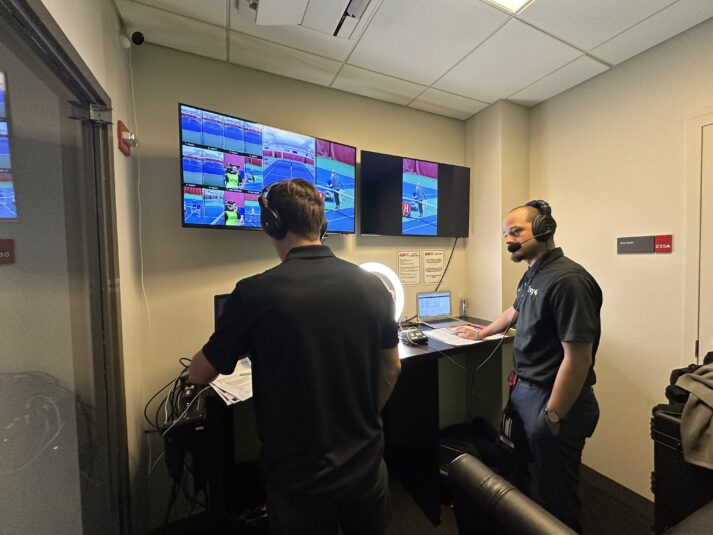
The Harvard tennis broadcast booth helps announcers keep on top of the action.
During a marquee matchup between Harvard and the University of Memphis, they live-streamed tennis matches directly to TikTok, Facebook, and Instagram. Utilizing a 9:16 vertical format, the broadcast dynamically shifted focus to courts with the most compelling action, mimicking the popular NFL RedZone model. Halevi noted the key role of their TriCaster systems in enabling these vertical productions, underscoring the adaptability of their existing technology to meet new demands.
“This idea actually came from the captains of our tennis team. They came to us and asked if it would be possible to showcase their matches on social media,” Halevi recounts. “We were pleasantly surprised to find that our TriCaster systems were already ready for such an endeavor. 9:16 sessions were already an option, so we just needed the idea – and then we were ready to go. That’s what the best technology does: it facilitates ideas becoming a reality.”
This experimental approach yielded impressive results, drawing viewership figures comparable to those seen in high-demand sports, like basketball. With the success of this first attempt, Halevi notes, the team is planning to dive further into the expansive digital possibilities with other sports and games.
What’s next?
The success of the vertical tennis live stream exemplifies Harvard Athletics’ ability to combine tradition with innovation, pushing the boundaries of sports broadcasting. Looking ahead, Halevi and his team plan to deepen their focus on social media-based broadcasts, aiming to engage younger audiences and further diversify their reach. By leveraging platforms like TikTok and Instagram, Harvard Athletics is poised to expand its influence, connecting with viewers in fresh and exciting ways.
Through a strategic blend of cutting-edge technology and forward-thinking leadership, Harvard Athletics continues to redefine what is possible in collegiate sports broadcasting. Their work not only solidifies Harvard’s standing as a leader in the field but also inspires other institutions to explore new possibilities in delivering exceptional sports content to audiences worldwide.