CFP National Championship 2026: ESPN’s Sweeping Live Game Production Leverages Deep Specialty Camera Lineup, IP-Connected Compound
Native HDR, ST 2110, unique camera angels support the broadcaster's biggest football game of the year
Story Highlights
By the time the College Football Playoff National Championship Game kicks off at Hard Rock Stadium tonight, ESPN’s presence in Miami will look less like a traditional big-game show and more like a fully networked broadcast campus. Nearly every element of ESPN’s championship coverage — from the main game telecast to a dozen MegaCast presentations — is originating onsite, supported by a large-scale, IP-connected compound designed to operate multiple parallel productions simultaneously.
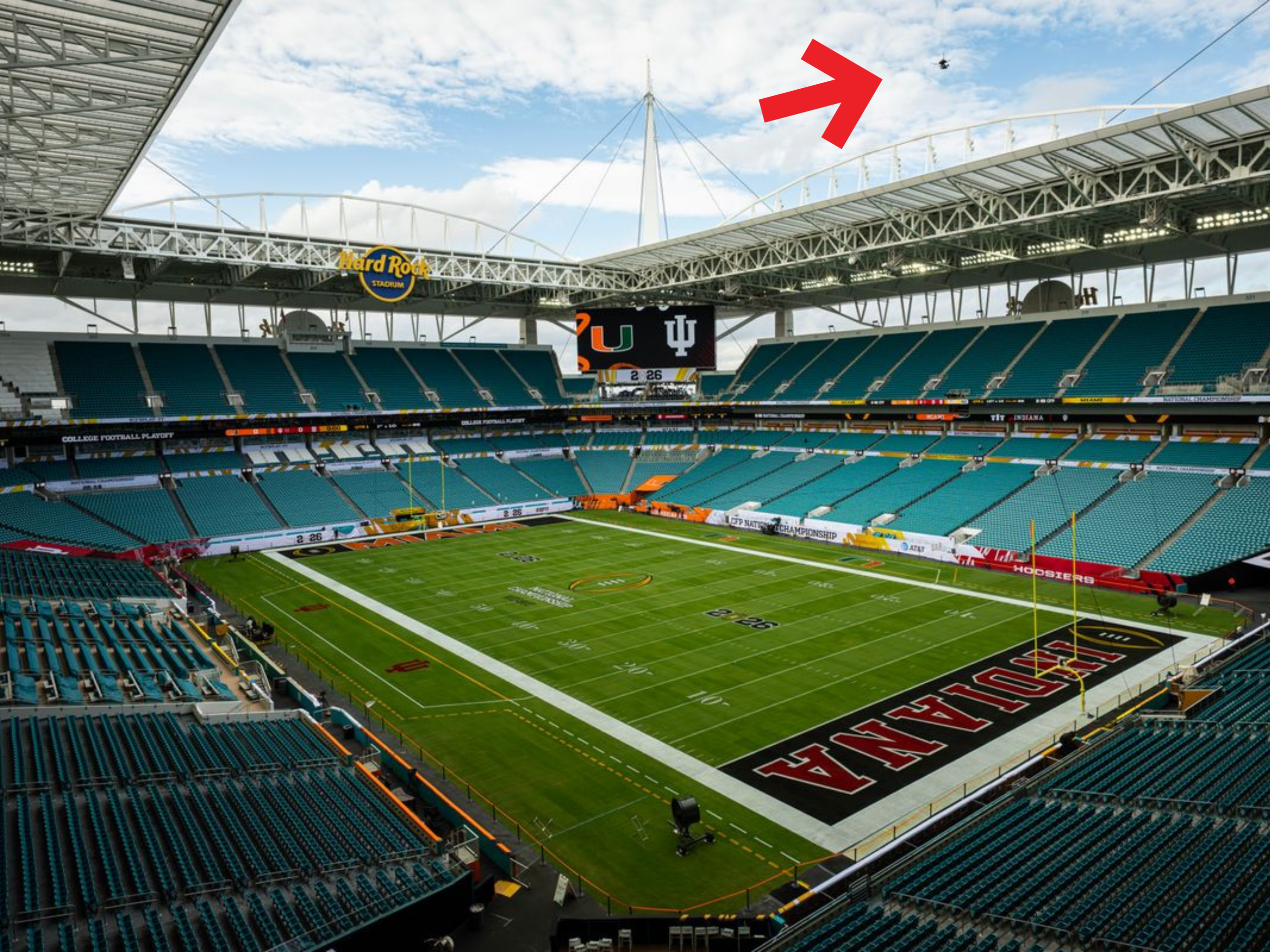
At the 2026 College Football Playoff National Championship Game, ESPN is using the famous spires at each corner of Hard Rock Stadium to add a second, much higher SkyCam to its game-camera arsenal. (Photos: Phil Ellsworth/ESPN Images)
“This is pretty much made whole as full productions here,” says Jim Birch, senior remote operations manager, ESPN, noting that only one MegaCast element, Field Pass With The Pat McAfee Show, is being produced via REMCO out of Bristol, CT, and includes four remote EVS replay positions. “Everything here is coming from site.”
That onsite commitment is reflected in the scale of the build. ESPN’s compound at Hard Rock Stadium comprises roughly 30 mobile units and support trailers and houses a credentialed workforce approaching 900 people across game, MegaCast, studio, ACC Network, and technical operations.
A Championship Built on IP and HDR
Underpinning the entire operation is an IP-based infrastructure that has become central to ESPN’s largest college-football efforts. Hard Rock Stadium is operating as a native-HDR production environment, with core trucks interconnected over a SMPTE ST 2110 backbone that allows game, MegaCast, and studio productions to share feeds, resources, and workflows.
“We’re integrating as a full-HDR compound, and a lot of the compound is connected via IP,” says David Baker, tech specialist, studio, ESPN. “During the regular season, with our studio show and our game trucks, we end up linking up throughout the year. By the time we got here, we were pretty well practiced with sharing feeds and linking up on that 2110 backbone, and it just scales up throughout the playoffs.”
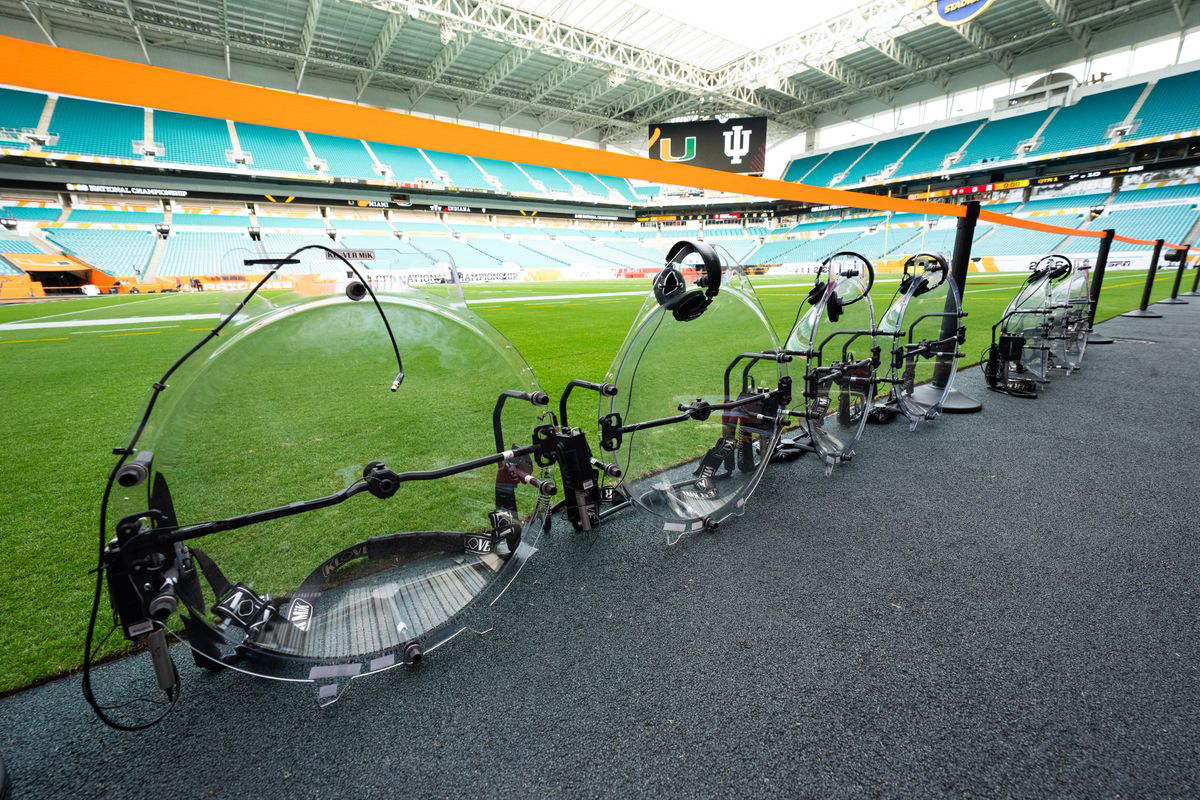
Parabolic microphones are lined up and at the ready prior to tonight’s 2026 College Football Playoff National Championship.
The scaling process has been deliberate. ESPN’s operations team has spent the entire postseason building toward the championship, adding complexity at each round. It’s been a key focus of ESPN’s executive leadership, which includes SVP, Content Operations Chris Calcinari and Executive Director John LaChance.
“It scales up throughout the year to this point,” Baker explains. “From first round to quarterfinals to semifinals to now, you’re adding more and more elements. It’s something we’re well-practiced in and just continue to build.”
For Birch, that architectural consistency allows ESPN to transform what would once have been siloed productions into a unified ecosystem. “This is the time of year where everything comes together,” he notes. “You have all these productions operating side by side, and the infrastructure has to support that without friction.”
Second SkyCam, Wearable JockeyCam Add Dimensions to Visuals
With the foundation in place, ESPN’s production team has leaned heavily into venue-specific opportunities at Hard Rock Stadium, deploying new camera placements and continuing postseason testing of emerging tools.
The most visible addition is a second SkyCam system mounted to the stadium’s signature spires. According to Catherine Chalfant, manager, remote operations, ESPN, that creates a second overhead perspective positioned more than 350 ft. above the field.
The elevated platform opens the door for what ESPN is branding as High SkyCast, and a gondola running on the stadium property is being fitted with a small POV camera to generate additional beauty and atmosphere shots. “We’re setting up one of our POV cameras on the TVU that’ll run the gondola up and down,” Baker explains. “Along with studio [cameras], we’re throwing out some of our [Sony] FR7 PTZs and a couple of beauty cameras mounted in fixed positions — some new looks for our studio and game shows.”
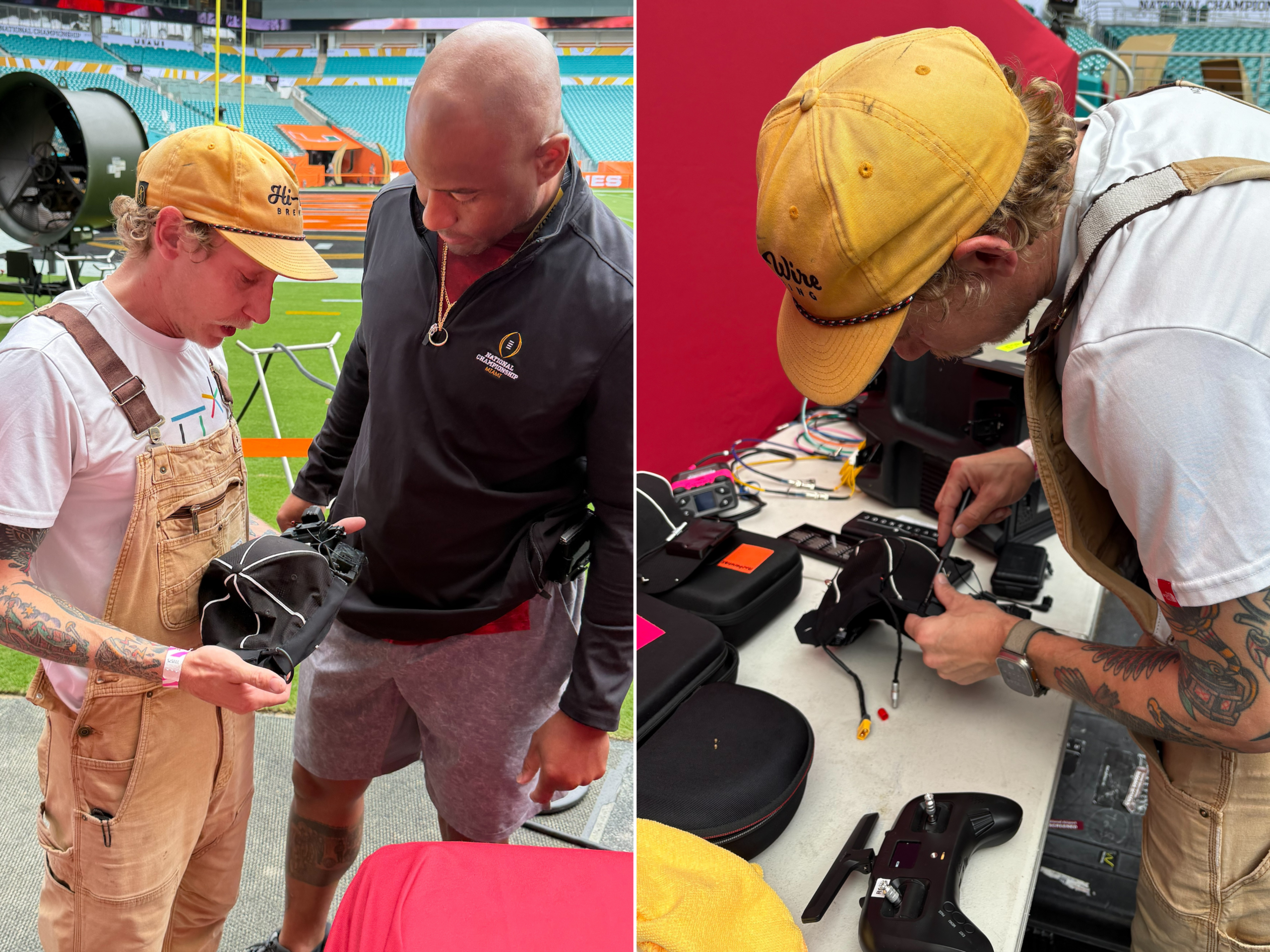
A technician works with a CFP game official on the outfitting of the JockeyCam camera system. The official will wear the POV device on his hat. (Photo: ESPN PR)
On the field, ESPN continues to expand its wearable and POV strategy. The JockeyCam system, which has been deployed throughout the postseason, returns for the championship following a full season of refinement.
“It has been really good,” Chalfant says. “We were fortunate to work with the ACC in the regular season to test and refine our workflows. Because of that, we’ve felt really good throughout the postseason using them.”
Baker notes that vendor collaboration has been key to getting the technology championship-ready. “They’ve been able to cater and customize for our needs. What we started with at the beginning of the season and where it has evolved to is very different. They were willing to work with us and meet the demands from the conferences and officials to get it to a point where it was approved to be at the national championship.”
Beyond POV, ESPN is continuing to integrate software-based innovation, including the use of Extra Motion AI tools through its EVS environment for replay and creative elements. “We’re using it only in very specific applications: replays, bumps, that type of flavor,” Chalfant explains. “But yes, it’s something we’re utilizing here.”
The championship also serves as a proving ground for optics. ESPN is evaluating a Fujinon UA125x8BESM-S35 2/3-in. 125X box lens in a slash position, along with a Fujinon UA22x4.8BERD field lens deployed closer to the action.
Additionally, NEP Specialty Capture (formerly BSI) and CP Communications have played critical roles in the established infrastructure. Contractor Kilowatt Inc., again, has been essential in setup of the impressive compound, as has CAT Entertainment Services, which supports the compound with primary and backup power where needed.
For on-site and remote media management services, CMSI has supported ESPN throughout the college football season. During the first two rounds of the CFP alone, CMSI managed more than 24 million frames of EVS XT VIA Melt clips and ENG clips delivered across ESPN’s platforms and distribution partners.
Other key vendors of note include Fully Armed Productions, Clay Loveless, Bexel, Illumination Dynamics, West River, JayBird Jibs, DDT Productions, Faction Media, GoVision, Oasis Catering, and Rock Steadi Pictures.
MegaCast as the Operational Payoff
All that infrastructure and capture ultimately feed ESPN’s signature MegaCast presentation, which returns for the 12th CFP National Championship with 14 distinct viewing options across ESPN platforms.
This year’s MegaCast slate reflects how ESPN now programs alternative productions as distinct shows rather than novelty feeds. Two separate Field Pass productions — including one led by ACC Network — will originate from opposite ends of Hard Rock Stadium, and Coaches Film Room is produced in Bristol. Additional presentations include SkyCast, High SkyCast, All-22, Command Center, a 4K UHD feed, and team-synced hometown radio offerings.
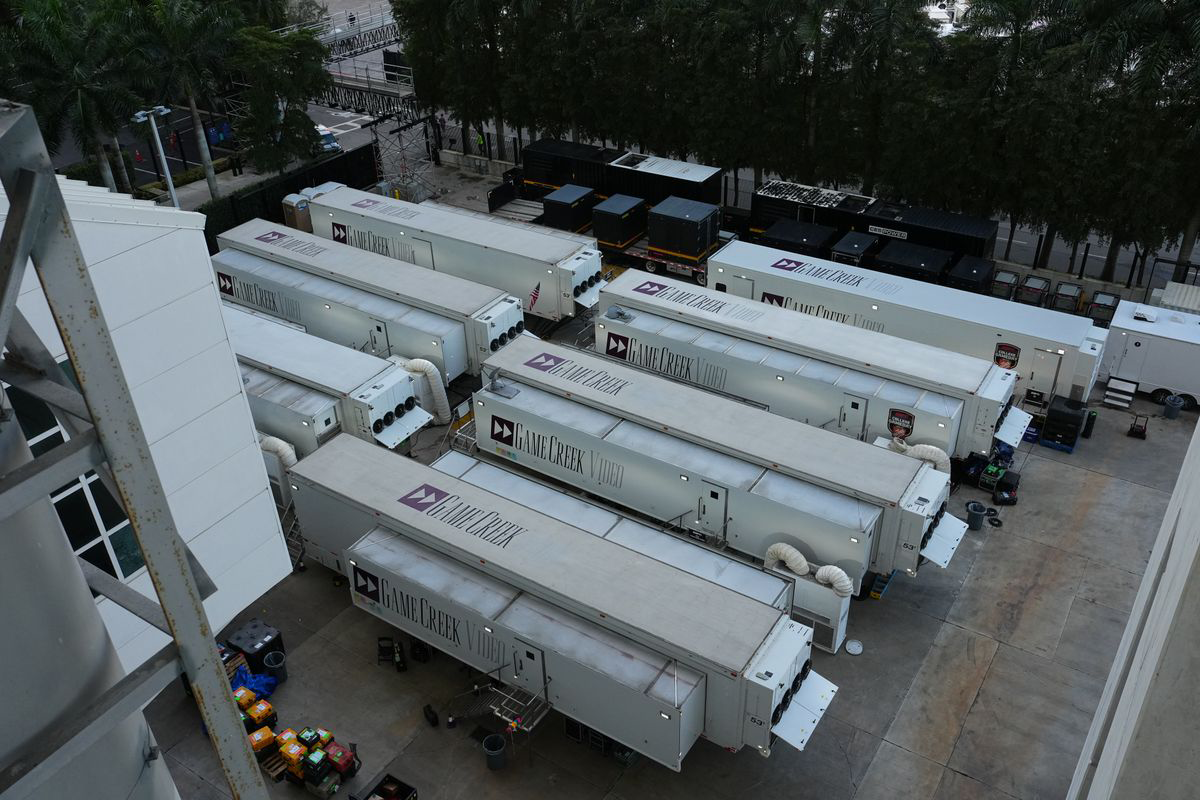
Game Creek Video has built a huge production compound outside Hard Rock Stadium.
“One thing that’s unique this year is that the conference network has joined us again,” says Judi Weiss, manager, remote operations, ESPN. “This is the first time in a couple of years that ACC has been onsite with us. That adds another layer to what we’re building and coordinating.”
Chalfant notes that the expanded Field Pass presence alone reshapes the physical layout of the operation. “There are now two Field Pass shows: an ACC Field Pass and the McAfee Field Pass on opposite ends of the stadium.”
For ESPN’s operations team, MegaCast is no longer something layered on top of the main telecast; it is a core design driver for the compound itself. The IP-connected environment allows productions to draw from the same camera, replay, and data resources while maintaining their own production identities.
An 18-Month Build Meets a Six-Day World
Although Championship Monday may be the public culmination, internally, the event represents the endpoint of an unusually long planning cycle. “This is a year and a half of planning coming to fruition,” Chalfant explains. “Many of our events are six-day picks. To go from that to something we’ve been planning monthly for 18 months — while still balancing all our weekly games — it’s a stark contrast.”
The championship environment highlights something deeper about ESPN’s operations culture, she adds. “Seeing our teams balance the down-and-dirty quick turnarounds with planning for the biggest event this company does has been impressive. The wide breadth of what these groups can handle — quick hits and the long haul — really stands out.”
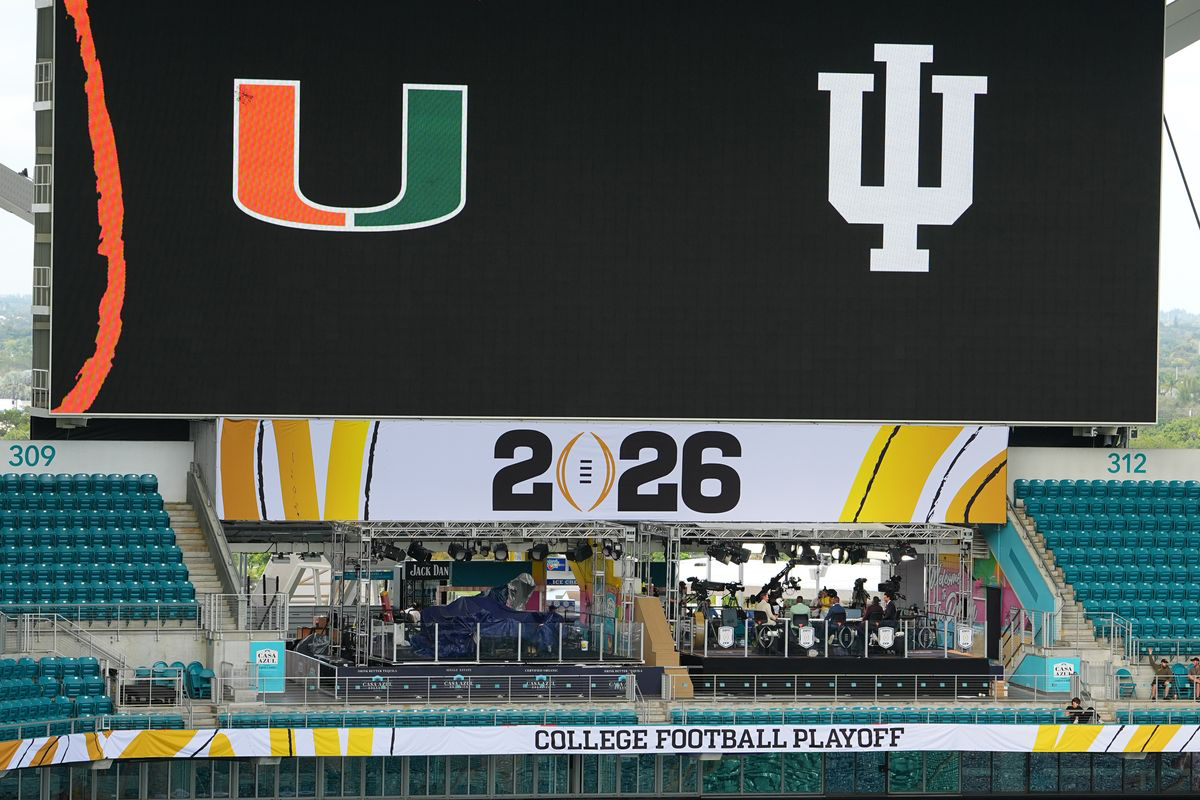
For pregame and halftime coverage, ESPN has set up a row of spaces for live studio shows in the Hard Rock Stadium concourse.
For Birch, the national championship is as much a cultural moment as a technical one. “This is the one time of year we get all of our studio partners and game partners together. We work with each other all season over Zoom, but this is where we actually get to see everyone in one place.”
Supporting this championship-level build is a deep operations bench drawn from across ESPN’s college-football arm. The CFP operations management team on site includes Birch, Chalfant, and Eric Kimmel, alongside specialists Mitch Workman and Terry Cook. Event support operations producers Kevin Wendling and Charlie Skoog are overseeing day-to-day execution, while CFP coordinators Tatianna Montalvo, Renee Greenwood, Aaron Thompson, and Arsen Shtefan are helping manage the many moving parts of the production. CFP transmission leads Brian Burney, Kevin Cleary, and Tim Denyes are overseeing championship transmission, with crewing leads Anna Ciccone and Kim Gunkel managing staffing.
Mobile-unit leads Kim Kanner and Liza Cole are coordinating truck operations across the compound. On the game-production side, the Game Creek Varsity A+B, Gridiron A+B, and Edit 1 units are supporting the main telecast with game operations led by Cindy Pennington, Tony Gregory, Lindsay Bohlen, and Jovy Serviss. Field Pass productions are operating from Game Creek 79 A+B with Kelsey Hahn, David Quintanilla, and Bob Simon leading that team, while MegaCast operations are anchored by Adam Ramirez.
Birch adds that the event serves as a showcase not just for technology but for the people behind it. “We bring our best technicians out here. It’s our A-level folks. We focus on morale, communication, and making sure people know what they’re walking into. That’s a big part of what makes this event special for us.”