CFP National Championship 2026: For a Slew of Studio Shows, ESPN Turns Hard Rock Stadium Into a Production Campus
24+ hours of live studio programming are planned across ESPN nets, ACC Network, ABC, digital
Story Highlights
For ESPN, the College Football Playoff National Championship is more than just a game. By the time Miami Gardens hosts college football’s final kickoff of the season, Hard Rock Stadium will have been operating for days as a temporary broadcast center: a multi-network, multi-platform production campus supporting wall-to-wall studio, digital, and shoulder programming from Friday through Tuesday.
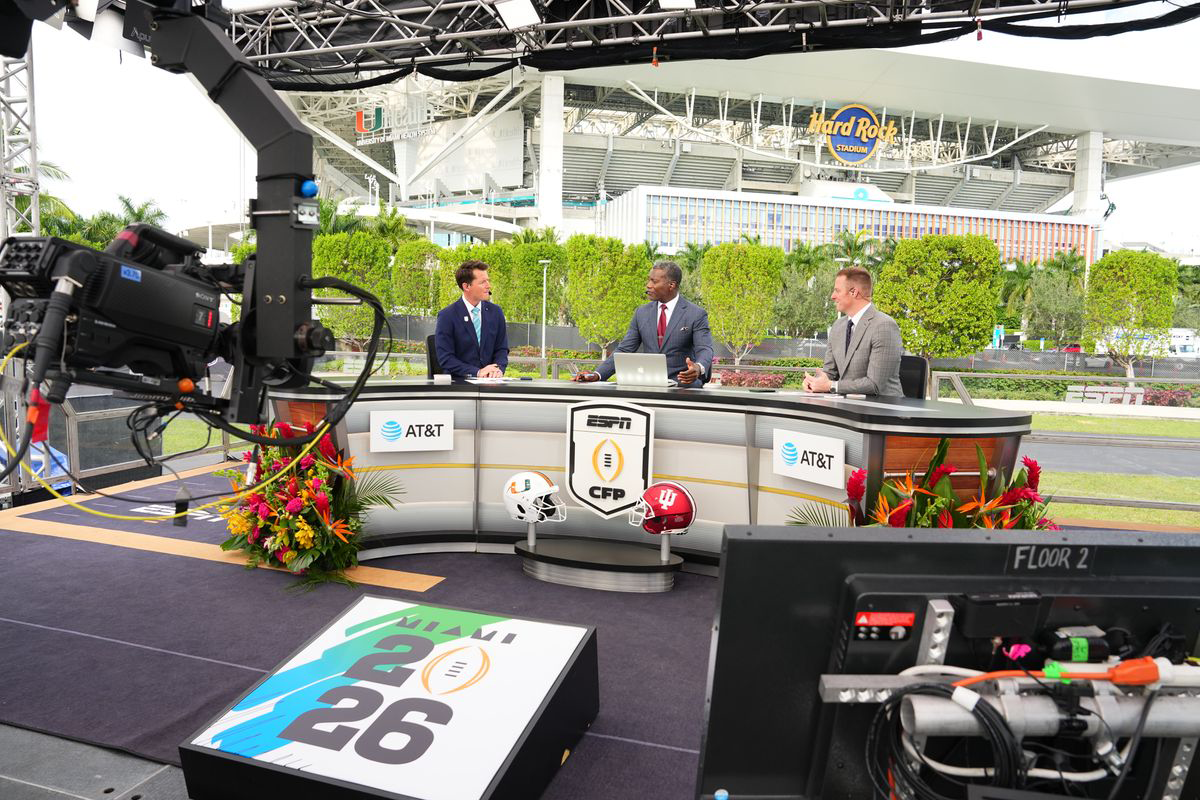
Studio shows have been airing live from the site of the CFP National Championship Game all weekend. Here, the set of Championship Drive is located in the stadium parking lot on Saturday. (Photos: Phil Ellsworth/ESPN Images)
“It’s not just about Monday night anymore,” says Judi Weiss, manager, remote operations, ESPN. “We’re coming in bright and early and staying well past the game. It’s a long haul, and it takes a real campus approach to pull it off.”
In total, ESPN is producing more than 24 hours of live studio programming from South Florida across ESPN, ESPN2, ESPNU, ACC Network, ESPN Digital platforms, and ABC, with Hard Rock Stadium serving as the operational hub.
From Game Site to Broadcast Campus
Instead of scattering sets across the city, ESPN centralized nearly all championship studio activity on stadium property — a strategic choice that simplifies logistics while dramatically increasing the density of production in one location.
“We’re centralized at the stadium,” says David Baker, tech specialist, studio, ESPN. “We’re utilizing one outdoor set with the stadium as a backdrop, a set inside the concourse, and a field set. We roll crews on and off each of those positions depending on the show.”
The approach turns Hard Rock Stadium into a studio village, where multiple shows can originate simultaneously or hand off among locations without leaving the compound footprint. Limited teams will be dispatched offsite to gather supplemental content, but the physical production infrastructure remains concentrated.
“Having everything in one spot really helps,” Weiss says. “In other years, we’ve gone all over cities. Here, the focus is building one campus that can support everything.”
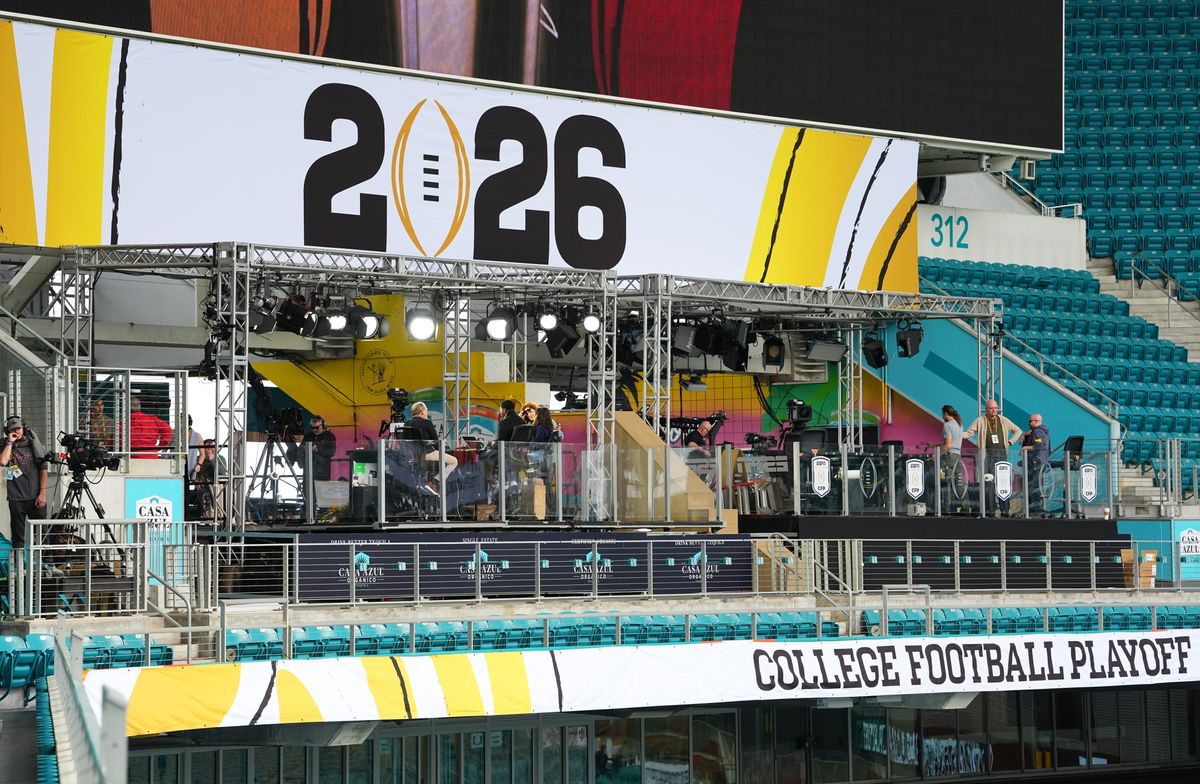
ESPN has erected a row of studio-set spaces in the upper concourse of Hard Rock Stadium, beneath one of the building’s corner videoboards.
Designing for Choreography, Not Just Shows
The campus mindset extends well beyond set construction. The studio operation is designed around constant motion: overlapping shows, rotating crews, shifting technical resources, and a schedule that runs from early-morning programming straight through post-championship coverage.
“We come in early Monday morning, and we’re here until well after the game,” Weiss says. “First crew call is around 5:30 a.m., and the last people will probably be walking away close to two in the morning.”
Throughout the day, ESPN will cycle through a wide range of live programming, from morning and afternoon studio shows to pregame coverage, halftime hits, and multiple postgame productions. Field sets, concourse positions, and outdoor desk locations are all active parts of the plan, with camera crews and technical teams moving fluidly among them.
“From a studio standpoint, this becomes choreography,” Baker notes. “You’re not just building one set for one show. You’re designing an environment where shows can hand off, overlap, and share resources without friction.”
Multi-Network Integration Onsite
The championship studio operation is also one of the rare moments each year when ESPN’s broader ecosystem fully converges at a single event. Alongside ESPN’s primary studio coverage, the campus is hosting ACC Network productions, ESPN Digital shows, and crossover programming, all emanating from the same physical footprint.
“One thing that’s unique about this year,” Weiss says, “is having the conference network back onsite with us. That adds another layer to what we’re building and coordinating.”
For the operations teams, that convergence demands a different level of communication and planning than a typical road show. Resources, space, transmission paths, and staffing are all mapped months in advance to account for the number of overlapping productions.
“We rely heavily on communication between our event partners and our studio teams,” Weiss says. “They’re at these venues all season. They know the buildings, the quirks, what’s changed. That information is huge for us when we come in to build a studio operation.”
Built on an IP-Connected Foundation
Like the game production, the studio environment at Hard Rock Stadium is supported by a native-HDR, IP-connected compound, allowing studio shows to share feeds, camera resources, and infrastructure with the game and MegaCast operations.
“We’re integrating as a full-HDR compound, and a lot of it is connected via IP,” Baker says. “We’ve been linking our studio and game environments throughout the season, so, by the time we get here, those workflows are well-established. Then it just scales up.”
Season-long integration allows ESPN to treat Championship Week less like a technical outlier and more like the largest expression of workflows in daily use. The difference is scale — and density.
“At this point,” Baker says, “it’s not about introducing something brand new. It’s about expanding what we already do every week into a much larger, more interconnected operation.”
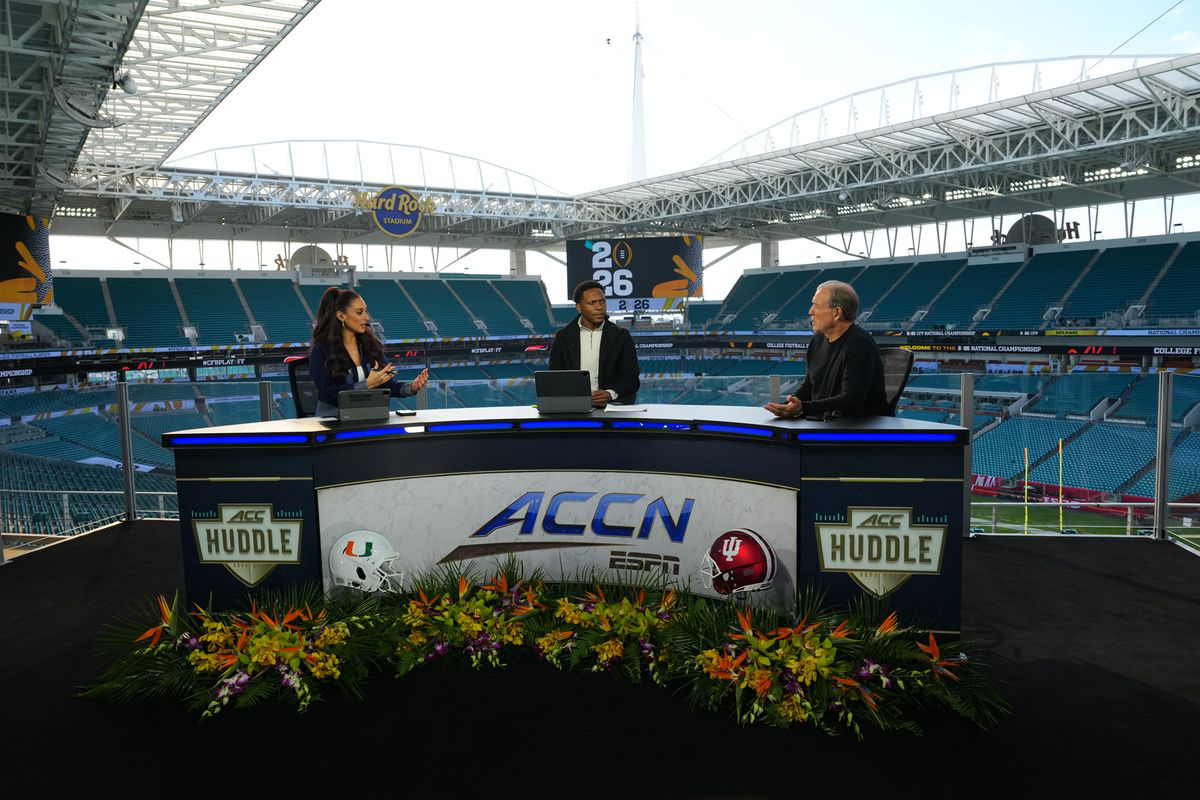
ACC Network’s ACC Huddle is one of the many ESPN and Disney shows broadcasting live from the 2026 College Football Playoff National Championship.
Staffing the Longest Days of the Season
Behind the cameras, Championship Week brings some of the longest and most complex staffing challenges of the year. In addition to marathon studio days, ESPN is managing overlapping schedules: some personnel are arriving directly from NFL Playoff productions to produce college football’s biggest event.
“We have 25-30 people coming straight from Sunday’s Monday Night Football crew,” says Catherine Chalfant, manager, remote operations, ESPN. “They’ll work that game, fly overnight, and come straight here to start their week.”
Weiss notes that endurance becomes a real operational consideration. “It’s a long season. With the expanded playoff, we started in August, and here we are in mid-January. There has been one gap weekend. Part of the job this week is helping people pace themselves.”
Many of ESPN’s best, as it pertains to on-site studio operations, are in Miami Gardens. That includes Senior Director for Studio Operations Carlton Young and year-round leaders on the College GameDay circuit, including Operations Specialists Jake Daigle and David Baker; Operations Producers Danny Reifert and Fred Clow; and Operations Coordinators Jason Dorsey, Alex Frutuoso, Yesenia Osorio, and Britney Araujo. Also, here from ESPN’s flagship daytime studio show First Take are Operations Producer Kristianna Bryant and Operations Coordinator Gianfranca Focareta. ACC Network, meanwhile, is supported by the ops team of Steve Widuch, Matt Bagan, Kevin Hendel, and Madison Haynes.
Weather and outdoor-stadium variables also factor into planning, particularly with sets positioned outside and in open concourse areas. Wind, temperature swings, and the physical wear of extended days all become part of the operational equation.
An 18-Month Runway to Championship Week
Although the shows themselves may feel immediate, ESPN’s championship studio build is the product of more than a year of planning.
“This is an 18-month process, very deliberate,” Baker explains. “When you get onsite and things are on schedule and there aren’t many surprises, that’s when you know that work paid off.”
Weiss agrees, noting again the importance of early venue work and constant communication: “It’s not just meetings. It’s seeing how things are executed when there’s a live football game here, learning the building, understanding what we’re walking into. All of that feeds into what we build this week.”
By the time the final postgame show signs off in the wee hours of Tuesday, Hard Rock Stadium will have hosted not only a National Championship but also one of ESPN’s most ambitious studio operations of the year: a rolling, 24-hour broadcast campus built to support every layer of championship coverage.