FloSports Prepares To Broadcast Outdoor Hockey Game Amidst Brutally Cold Temperatures in Southern Minnesota
Temperatures are expected to be colder than the "Ice Bowl" or any NHL Winter Classic ever played
Story Highlights
For live–sports-production crews, there’s a certain gravitational pull to events that break the mold. A basketball game on an aircraft carrier. A baseball game in an open cornfield. Outdoor hockey. Shows like these push technical planning, crew endurance, and creative instincts all at once — and they’re often the ones people remember the fondest.
That’s exactly the environment FloSports is stepping into this week as it produces the Iowa Wild Outdoor Classic, an American Hockey League game staged outdoors as part of the 20th anniversary of Hockey Day Minnesota in Hastings. The matchup between the Iowa Wild and Milwaukee Admirals will stream exclusively on FloHockey and FloHockey’s 24/7 FAST Channel on Friday afternoon. Behind the scenes, though, the bigger story is what it takes to build — and protect — a full broadcast operation when temperatures are expected to sit well below zero.
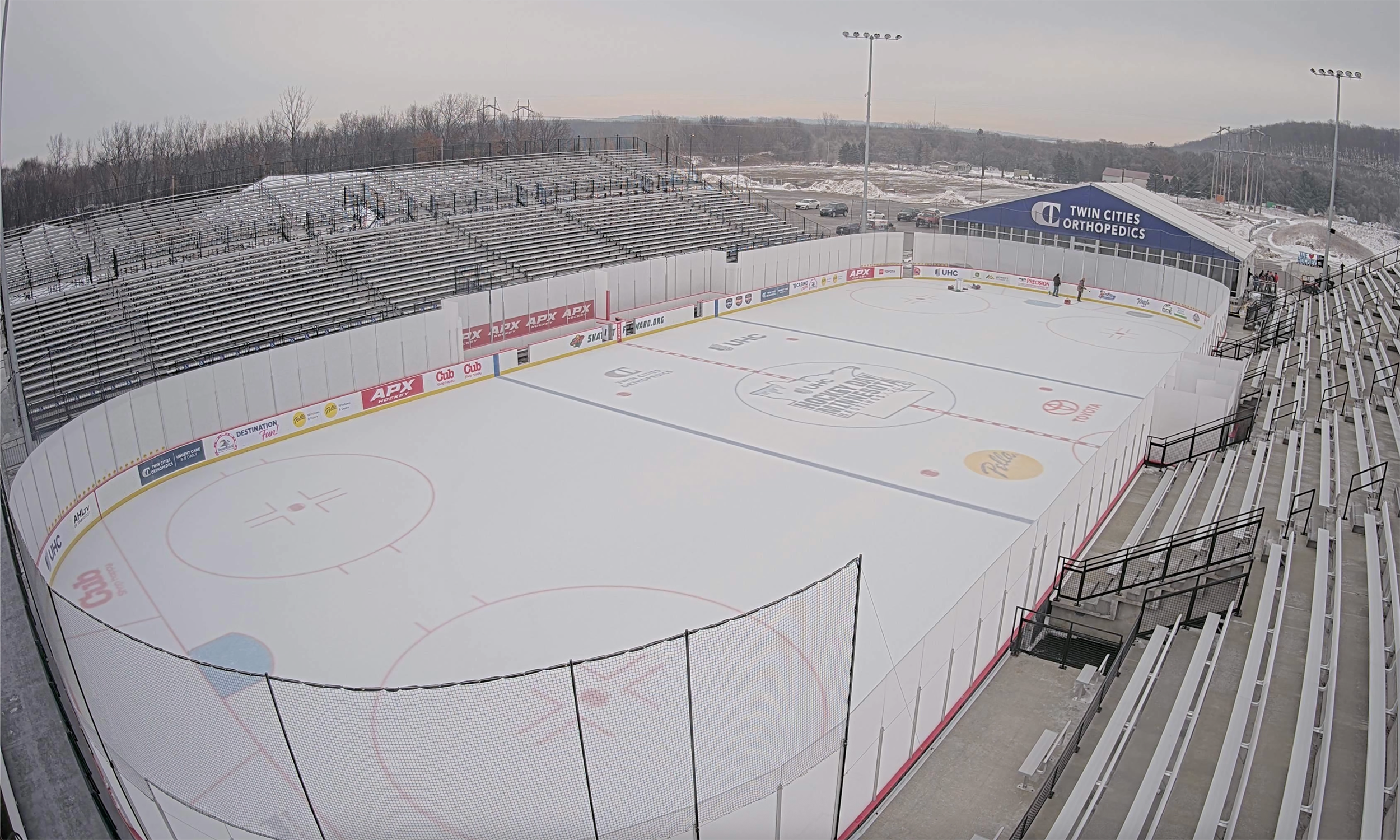
FloSports will broadcast a live AHL game from an outdoor rink built in Hastings, MN, to host the 2026 edition of Hockey Day Minnesota.
Forecasts as of midweek call for highs near -8 degrees Fahrenheit and evening temperatures dropping to around -16. For a puck drop set for 4 p.m. local time at a venue that didn’t exist just months ago, that reality shapes nearly every production decision.
“Outdoor hockey immediately makes you appreciate indoor hockey,” laughs Jeremy Cook, senior manager, events and streaming, FloSports, who will serve as producer of the game broadcast. “You add the elements, and suddenly there’s a whole new list of things you wouldn’t normally worry about. You’ve got to keep the people warm. You’ve got to keep the equipment warm. Health and safety become a top priority.”
Protect the People First, Then the Gear
FloSports’ production plan has been built around telling a fantastic visual story, of course, but its operational goals lie chiefly in keeping the show’s people and equipment warm and safe.
Heated blankets will be deployed not just for cameras but for tripods and fluid heads, because extreme cold can affect their performance. Of the 10 cameras planned for the show, three will live fully in the elements. Their positions will be rotated to limit exposure, and an extra camera operator has been added specifically so that crews can cycle inside.
“It takes longer to set up in the cold. It takes longer to break down in the cold,” notes Fred Cambria, coordinating producer, FloSports. “We’ve added staff on both ends. And we’re rotating people so no one is stuck outside too long.”
For context, historically cold sporting events haven’t approached what this event could face on Friday. The infamous “Ice Bowl” between the Dallas Cowboys and Green Bay Packers in 1967 is recorded at -13°F, while the coldest outdoor NHL game on record was the 2022 Winter Classic at Target Field in Minneapolis, where temperatures dropped to -10°F during the game. The coldest Hockey Day Minnesota on record was the 2019 edition in Bemidji, when the temperature was a staggering -26°F at puck drop of the first game.
Creature comforts — heated tents, hot drinks, warm food — are also part of the technical plan.. And, in Cook’s case, bulk orders of glove warmers from Canadian Tire. “There’s always three pairs of socks,” he adds. “That helps.”
The crew itself reflects the scale of the effort. Technical Producer Brett Ward leads the onsite production team, along with Director/Technical Director Scott Dailey. Browning Stubbs oversees graphics production; James Goodloe, engineering. Audio is handled by A1 Randy Meador and A2s Nate Kulenkamp and Brian Beneke; Mark Dreckman handles video. Camera operators Dan Wasserman, Patrick Frost, Billy Hershkowitz, Scott Lindell, and Sam Pigeon are supported by RF tech Mike Forman. Replay is run by Jon Walker and Christian Rangel, with David Pokorny on graphics operation and Shamus Grady handling the remote bug operation. Joseph Parades serves as driver, Brittany Jorgenson is production assistant, and utilities Rose Woodworth and Austin Tigner round out the onsite crew.
Adding to the complexity, FanDuel Sports Network will be producing games at the same venue on Saturday. Space, access, and teardown schedules overlap, including late-night load-outs in subzero temperatures. “When our game ends,” Cambria says, “it’s supposed to be back into the negatives. We’ve brought in extra people just to help us get out safely.”
Venue Built From the Ground Up
Unlike NHL outdoor showcases staged inside major stadiums, the Iowa Wild Outdoor Classic is produced at the United Heroes League complex, a site transformed specifically for Hockey Day Minnesota. What was once just an outdoor rink has become a multi-day festival space expected to host tens of thousands of fans.
“This is absolute scratch,” says Cambria. “You can’t get any scratchier than this. When we first came out here, it was basically just an ice rink outside. Now there’s a whole village: permanent structures, temporary bleachers, huge tents, heaters everywhere. Even from a few weeks ago to now, everything keeps evolving.”
FloSports surveyed the venue weeks ago, but much of the infrastructure has gone up only recently. When Cook first visited in October, little beyond the rink and a single set of bleachers existed.
“They were speaking hypothetically about where everything was going to be,” he says. “Now you can go on their website and see how it has all come together. They’ve built this whole environment in a very short amount of time.”
For FloSports, that means designing a broadcast compound with limited permanent infrastructure, tight space coordination, and weather variables that could change the plan at any moment. As of early this week, league and event leadership were still weighing contingencies that could include a last-minute move indoors if conditions deteriorate.
“To be told the day before setup that you might be moving to an entirely different venue is a huge challenge,” Cambria says. “But that’s what we do. We adapt.”
A Full Broadcast, Not Just a Novelty
Despite the spectacle of the setting, FloSports is treating the production like a full-scale AHL broadcast, not a novelty show. The camera plan includes Sony HDC-3100 systems, a complement of Marshall POVs, RF positions, and a drone providing aerial context once twilight sets in over the temporary hockey village.
“When that drone is up and that twilight hits,” Cambria says, “it’s going to look magical. Those are the moments we’re all striving for: to showcase something beautiful.”
Aerial coverage is provided by drone pilot Craig Peterschmidt and visual observer Ethan Dorer.
The event also serves as a proving ground for new creative elements. FloSports is debuting a custom scoring bug designed specifically for this broadcast. It will have a hockey-first look with new functionality intended to inform future graphics packages across the company’s verticals.
“This is the first time this look and usage has been applied to hockey,” Cook explains. “We’re hoping it becomes the foundation for something bigger next year. This is the test case.”
The broadcast itself includes a half-hour pregame show, giving the production team space to lean into storytelling around Hockey Day Minnesota, the outdoor environment, and the players involved — many of whom grew up on Minnesota outdoor rinks.
“We don’t want a five-minute pregame,” Cook says. “We want time to tell stories: players who grew up playing outside, players who might be headed to the Olympics. This is still an AHL hockey game, and that’s important. But it’s also an opportunity to bring new viewers in and show them what this league and this level of hockey are all about.”
Why Crews Chase These Shows
For both producers, the draw of an event like this goes beyond ratings or distribution reach. It’s about being part of something rare.
“It’s super-unique,” Cambria says. “It’s a challenge, for sure. But the best part is the people. There are so many great professionals here, and it’s a tribute to that talent that we can even attempt something like this.”
Cook, who has been involved since the earliest planning stages last fall, frames it even more personally: “This has been one of the most rewarding professional experiences of my career. And I’m old, so that says a lot. Working across our teams in Canada, Austin, and around North America to bring this together — it’s exactly why we do this.”
Whether the game ultimately drops the puck outdoors as planned or shifts indoors at the last minute, FloSports’ production effort underscores a familiar reality for live sports professionals: unique events demand unique planning, and extreme conditions magnify everything — preparation, teamwork, and the margin for error.
On Friday afternoon in Hastings, the audience will see an outdoor hockey game. The crew will see months of planning, layers of contingency, and a broadcast built to survive Minnesota in January.
And if all goes as planned, they’ll also see something beautiful.