How MLB Pulled Off That Unforgettable Hank Aaron Tribute at the All-Star Game
Vintage content, state-of-the-art projection/processing combine in ‘marvelous milestone’
Story Highlights
Hank Aaron never played in the Atlanta Braves’ current home, Truist Field. The man who broke Babe Ruth’s home-run record ended his playing days in 1974, 42 years before the Braves moved into the stadium that hosted Tuesday’s MLB All-Star Game. But Aaron, who died in 2021 at the age of 86, seemed very much present, 51 years after his 715th home run ended The Babe’s 40-year-old record.
In a way similar to how Tupac Shakur was “resurrected” for the 2012 Coachella music festival with a carefully choreographed projection, Aaron’s 715th was re-created during the 6th inning of the All-Star Game on FOX Sports via a massive 3D projection that covered most of Truist’s playing area.
The lights went down as fans held their cellphone lights aloft. Footage from the scene on April 8, 1974, at the old Atlanta–Fulton County Stadium was projected on the infield and shown on the videoboard. When Aaron’s momentous swing took place, an animated three-dimensional baseball moved “forward” and filled the scene. The tableau shifted to real life with a blazing fireball launched from home plate to signify the homer that pushed him past Babe Ruth’s record 714. Content then shifted to the stadium’s main LED display even as it filled home viewers’ screens, culminating in a pair of 7,000-W upward-firing xenon lamps signifying where near the left-center seats the ball had ultimately landed in the old Fulton County Stadium.
The Visuals
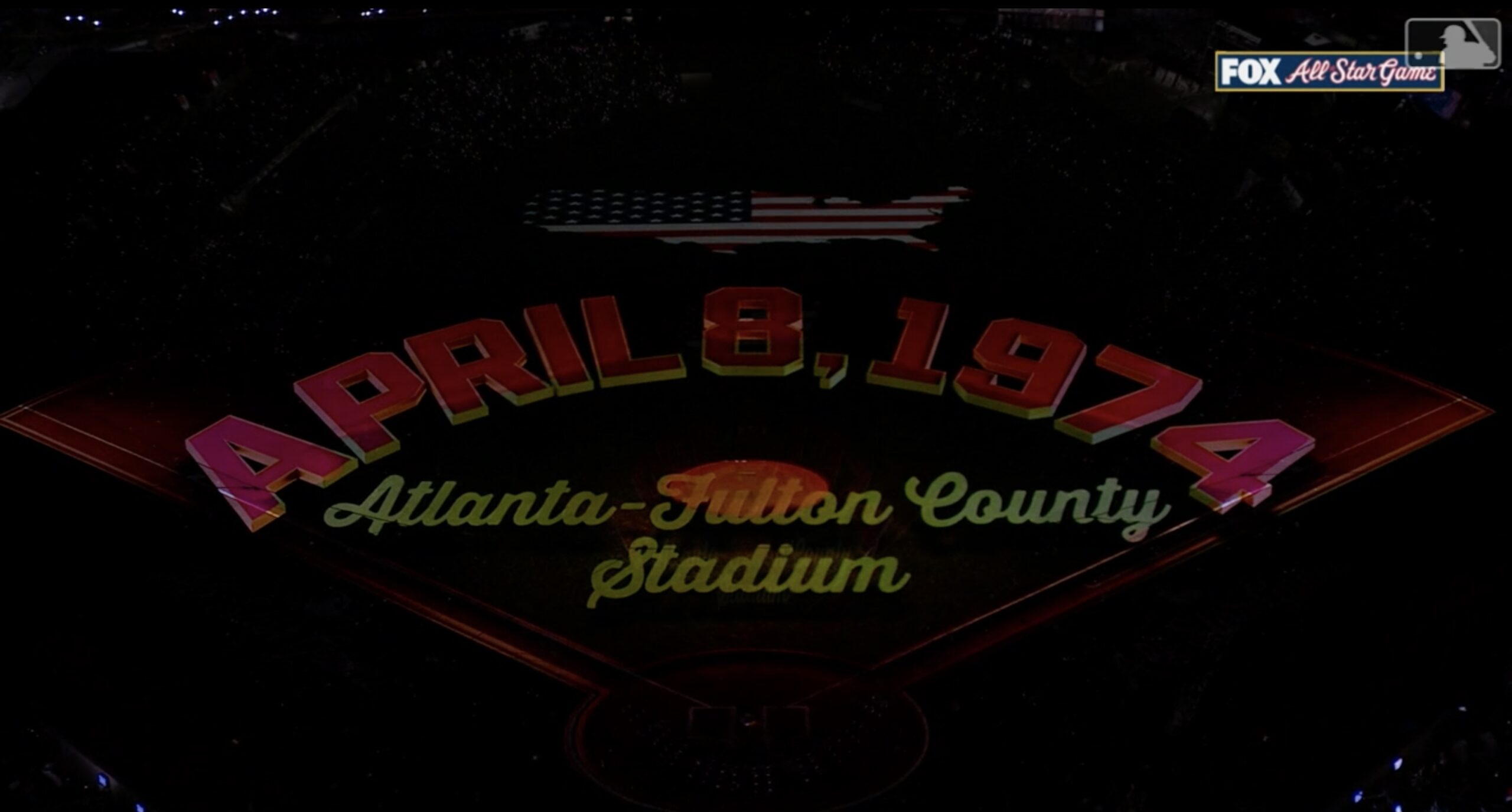
Image Engineering supplied the projection mapping used on the field at Truist Field.
The production, which ran just under three minutes, was produced by Image Engineering and required a total of 18 projectors: 12 on the infield and three double stacks in the outfield, the latter (each with two projectors) evenly split among left, center, and right field. The main scoreboard was used throughout the show primarily as a lockdown view of the entire field. A Sony 4K camera was specifically “painted” to capture the projection so that fans seated either in a low section or in the outfield could see the force-perspective 3D imaging.
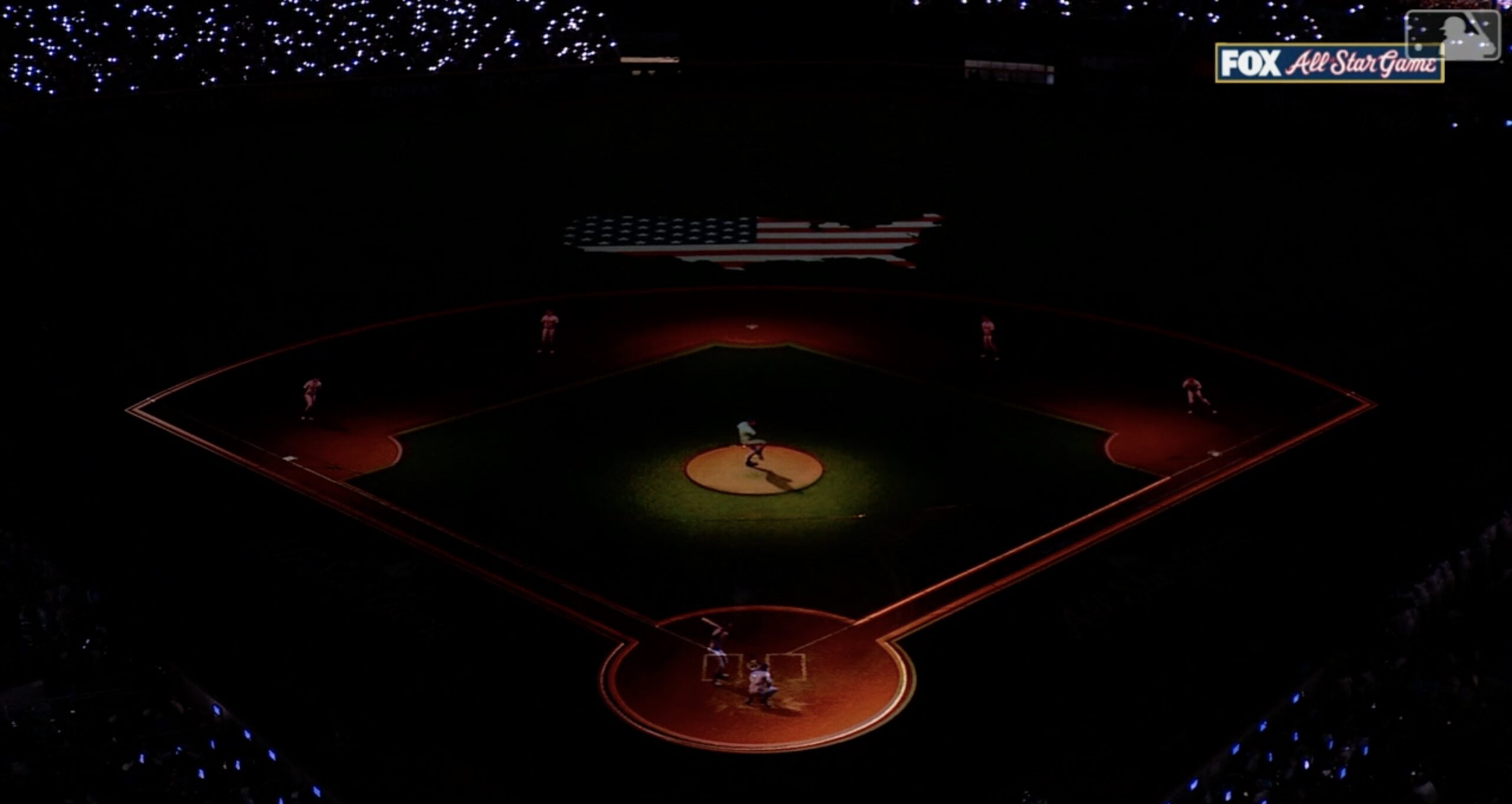
The projection re-created the scenario of the historic moment.
For Image Engineering, it was important that fans in the venue and at home have the same experience. “Everything that you saw on TV, they saw in the venue,” says Ian Bottiglieri, VP, operations, Image Engineering. “The 3D ‘baseball’ was a custom piece of 3D content we created using the same Spalding balls that were used in ’74. That was all custom 3D animation sandwiched in after [Dodger pitcher Al] Downing’s first pitch in the archival footage. We tried to tie in elements that were not only digital but also physical. It was a custom piece of pyrotechnic that was developed to create the home-run ball.”
So-called forced-perspective 3D was necessary to achieve a consistent effect for live and broadcast audiences. “If you get off axis, like left field or right field, it starts to look funny,” he explains. “That’s part of the reason we have that locked-down camera as well: so that everybody in venue could see those 3D-style effects. And it worked. The reactions have been very positive.”
Sound Tells the Story

A firework was set off to represent Aaron’s home-run ball flying through the air.
As stunning as the visuals were, the audio supporting them, provided by Stephen Arnold Music, were just as sophisticated. The audio elements took the form of music, sound design (used to enhance key sounds such as bat cracks), and archival sound clips, including the play-by-play by Dodgers’ broadcaster Vince Scully and Braves caller Milo Hamilton.
All this was delivered as both mixed stereo for the in-venue live sound and stems that could be used to fill the surround broadcast. “It’s all time-coded and synced to the entire show,” explains Whitney Arnold, president, music services, Stephen Arnold Music. “We were able to deliver [the elements] in any format they needed.”
He adds that synchronization was critical to the audio’s impact with the innovative 3D visuals, such as timing augmented low-end impact sound with the fireworks that took place when Aaron hit his historic homer.
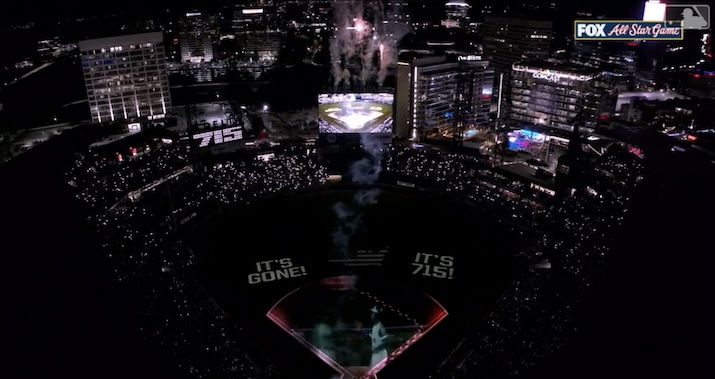
Footage from the historic day was integrated in the production.
Another challenge was getting the 51-year-old broadcast audio’s sonic quality up to par. Stephen Arnold Music Chief Audio Engineer Paul West used various plugins to clean up noise and other audio artifacts that were common in broadcast sound of the era or were developed over time in the archive. “For restoration of the historical audio, especially the dialog, we used iZotope-RX,” he explains. “Our primary DAW for all mixes is Nuendo, along with some stock Steinberg plugins for [tonal] color and sweetening; stem mastering for the project was done using Fabfilter-Pro-L2 to dial in certain frequencies for both the in-stadium and broadcast experiences.”
Because the sound had been recorded to analog tape, the translation to digital involved such issues as bitrate conversions.
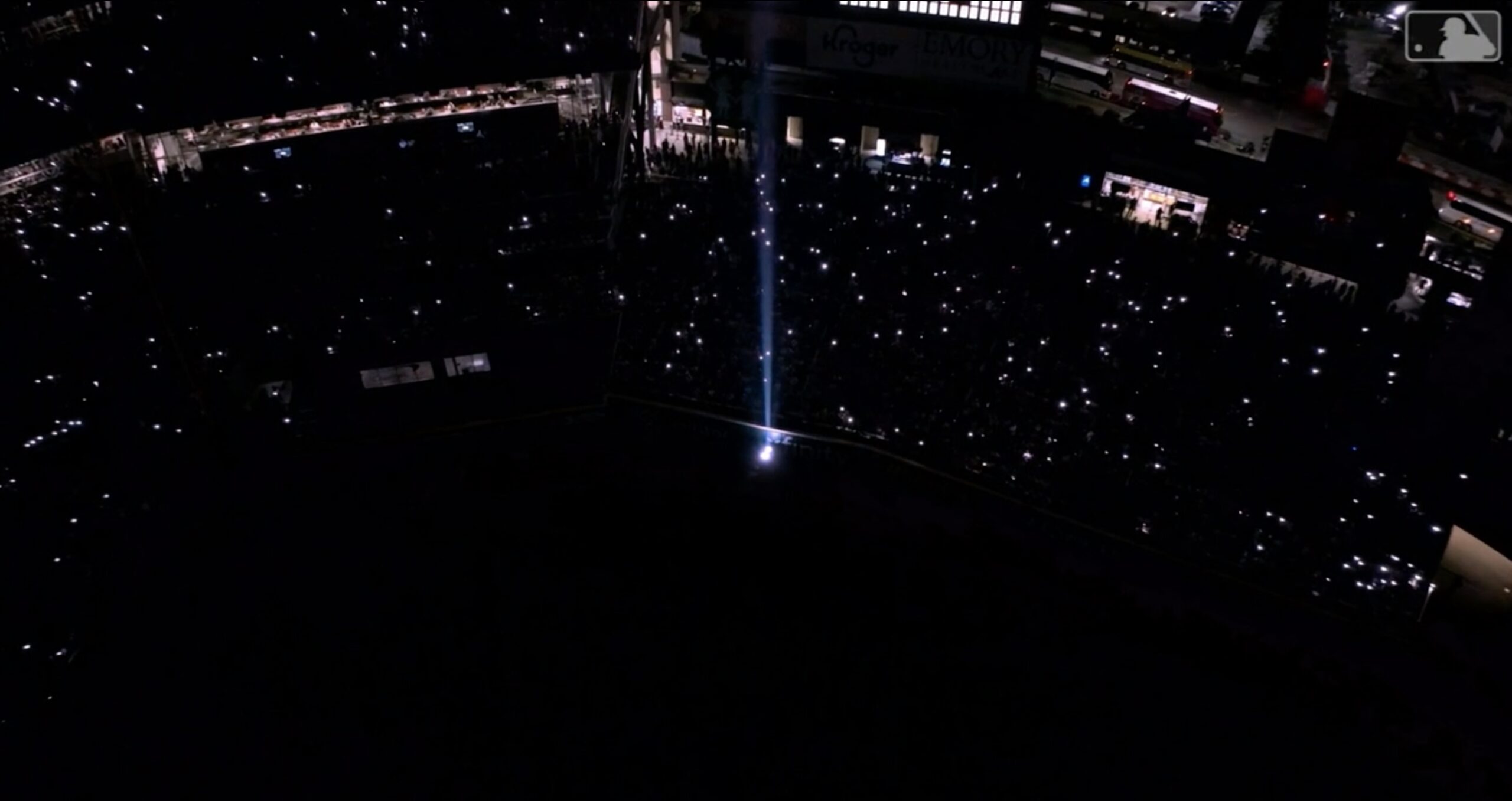
A spotlight marked the approximate location the ball landed at Atlanta–Fulton County Stadium.
“There’s also the roar of a crowd that goes through the broadcast microphones, over which we had to make sure we could still hear Vin Scully and Milo Hamilton,” notes Arnold. “We need to hear them clearly even as we don’t lessen the impact of the crowd noise. It’s a challenge.”
The entire project has a cinematic sensibility to it; in fact, he adds, the crew listened to the soundtracks and sound design of classic baseball films, including The Natural and Moneyball, to help establish the audio’s feel.
“We mood-boarded it, putting tracks behind it to find the right emotion and style,” he explains. “There’s something about baseball, you know; it’s kind of in our DNA as Americans. [We] put certain types of music behind these clips and played it back, and we were just mesmerized. Watching this with the music is so emotional.”
Aaron’s legacy was ubiquitous during the All-Star Game. The Braves moved the home-run ball and bat to the stadium’s Monument Garden for attendees to view. A statue of Aaron and a sculpture representing his record-breaking 755 career home runs already stands there — a reminder that he was an All-Star in 21 of his 23 seasons. In addition, as a tribute to him and Ruth, National League players participating in the Home Run Derby wore Aaron’s jersey number 44, and American League players sported the Bronx Bomber’s number 3. A year ago, MLB celebrated the 50th anniversary of Aaron’s homer with announcements of a new statue at Baseball’s Hall of Fame and a commemorative stamp from the U.S. Postal Service.
Stay tuned to SVG next week for our a special edition of SVG Rewind focused on the Hank Aaron 715 All-Star Game Tribute.