Banana Ballin’: Fan First Entertainment Conveys Savannah Bananas Magic via Remote Production, Out-of-the-Box Thinking
Two control rooms in Savannah, GA, are the home of production
Story Highlights
Without any hyperbole, the Savannah Bananas are the greatest story in sports over the past two years. The former collegiate summer baseball team that turned into a must-watch YouTube sensation is selling out professional baseball and football stadiums across the country, and its games air on ESPN and TNT Sports linear networks.
Success didn’t happen overnight: it took the willingness of Fan First Entertainment founder/Savannah Bananas owner Jesse Cole and President Jared Orton to take a risk. The team has become a catalyst for fun for fans young and old, and the well-oiled machine runs with remote productions from two control rooms in Savannah, GA; an onsite production van; an agile technical-services team; and the initiative to keep improving.

All Savannah Bananas games are livestreamed on Banana TV, the team’s dedicated YouTube page.
“Working for Jesse Cole is very empowering,” says Mitch Rubenstein, head, production services, Savannah Bananas. “The one thing he wants is to ‘plus up’ the experience. Every time you watch our show, there are always new things that are added.”
Birthplace of Banana Ball: ‘Fan First’ Begins With Free Streaming on YouTube
Cole believes in putting the fans above everything else. From affordable prices on tickets, food, and merchandise to a first-class show for those willing to spend money on coming to the ballpark, he understands that the team wouldn’t exist without these loyal customers. After competing in the Coastal Plain League from 2016 to 2018 and splitting time between the traditional game and “Banana Ball” — the team plays by a unique set of rules — from 2018 until 2022, the franchise decided to focus exclusively on its brand of entertainment-based baseball.

One of the two control rooms at headquarters in Savannah handled remote productions for the Bananas vs. Firefighters at Baltimore’s Oriole Park at Camden Yards Aug. 1-2.
Cole’s “fan first” ethos is reflected in the organization’s broadcasting approach: providing a completely free viewing option on YouTube. With nearly 2.5 million subscribers, this is still the primary live-distribution method for all games of the main team along with content from its three competitors: the Party Animals, the Bananas’ original and longtime opponents at 325,000 subscribers; the Firefighters, who debuted last year, with 31,000 subscribers; and the Texas Tailgaters, Banana Ball’s newest team, at a little over 18,000 subscribers. The Visitors, a Banana Ball development squad that played two games this summer, don’t have a dedicated channel.
“It seems we’re hitting a new record high [for viewership] every game,” says Rubenstein. “Hitting about a quarter of a million views per game, in the world of YouTube, is incredible.”

In a secondary control room, a crew remotely produces a game between the Party Animals and the Texas Tailgaters at CHS Field in St. Paul, MN, Aug. 1-2.
At the very beginning, all the club’s resources were dedicated to its own channels and finding ways to deliver content to Bananas fans however possible. Through the work of Savannah Bananas Head of Technology Systems Matt Webster, the transmission and distribution workflow has become a bit more sophisticated.
“Until this year,” Webster says, “the scale for the Bananas was very purpose-built by going only to YouTube. We’ve now implemented a Zixi ZEN Master–based solution to help a lot of our streaming. We’ve had to do a combination of Ku- and C-band satellite, but we’ve mostly distributed via SRT to deliver IP to a majority of our partners.”

An onsite van, commonly called the Banana Van, sends feeds to the facility in Savannah.
The uptick in complexity is a direct result of heightened interest in the team’s style of baseball. After only five games on ESPN’s family of networks, the agreement expanded significantly with a total of 12 games: seven on ESPN2, three on ESPN, and two exclusively on ESPN+ and Disney+. Over-the-air broadcasters are also getting in on the action, with The CW airing the Bananas’ game at Philadelphia’s Citizens Bank Park on July 27. True to the Bananas’ digital-centric roots, the club streamed its July 6 contest at Boston’s Fenway Park on Roku.
More recently, after the conclusion of this year’s run with ESPN, TNT Sports has opted into broadcasting the tail end of the 2025 Banana Ball World Tour from Aug. 16 to Sept. 27 in multiple MLB stadiums: the Chicago White Sox’s Rate Field, Pittsburgh Pirates’ PNC Park, San Diego Padres’ Petco Park, New York Yankees’ Yankee Stadium, Seattle Mariners’ T-Mobile Park, and Houston Astros’ Daikin Park. The Banana Ball Tour Championship Oct. 2-11 at the team’s home venue, Historic Grayson Stadium in Savannah, will also be broadcast by TNT Sports.
REMI-Powered: Savannah-Based Control Room, Banana Van Drive Each Broadcast
The immense growth of Banana Ball has necessitated a handful of changes in both production and operations. A simple plan of attack was once used to livestream games, but, with bigger crowds, a larger viewership, and Cole’s inherent bent toward innovation, a larger investment was needed to solidify the organization’s broadcast infrastructure both at the stadium and at its headquarters in Savannah.

Connectivity inside the Banana Van
At the heart of the effort is an onsite production van, commonly known as the Banana Van, which rolls up to the host venue. The vehicle houses the cameras, connectivity, and other essential equipment for producing the foundation of the broadcast. It is the conduit to the central hub of Banana Ball: two newly constructed control rooms at the team’s home base. One control room remotely produces the game featuring the Bananas and one of four opponents; with the help of a flypack located at a different venue, the other control room handles a game featuring the other three squads. Along with Zixi ZEN Master, LiveU is a critical partner for sending signals to the Savannah-based crews. Playing a part in ensuring that these systems and software are online is Savannah Bananas Head of Engineering Sean McCluskey.
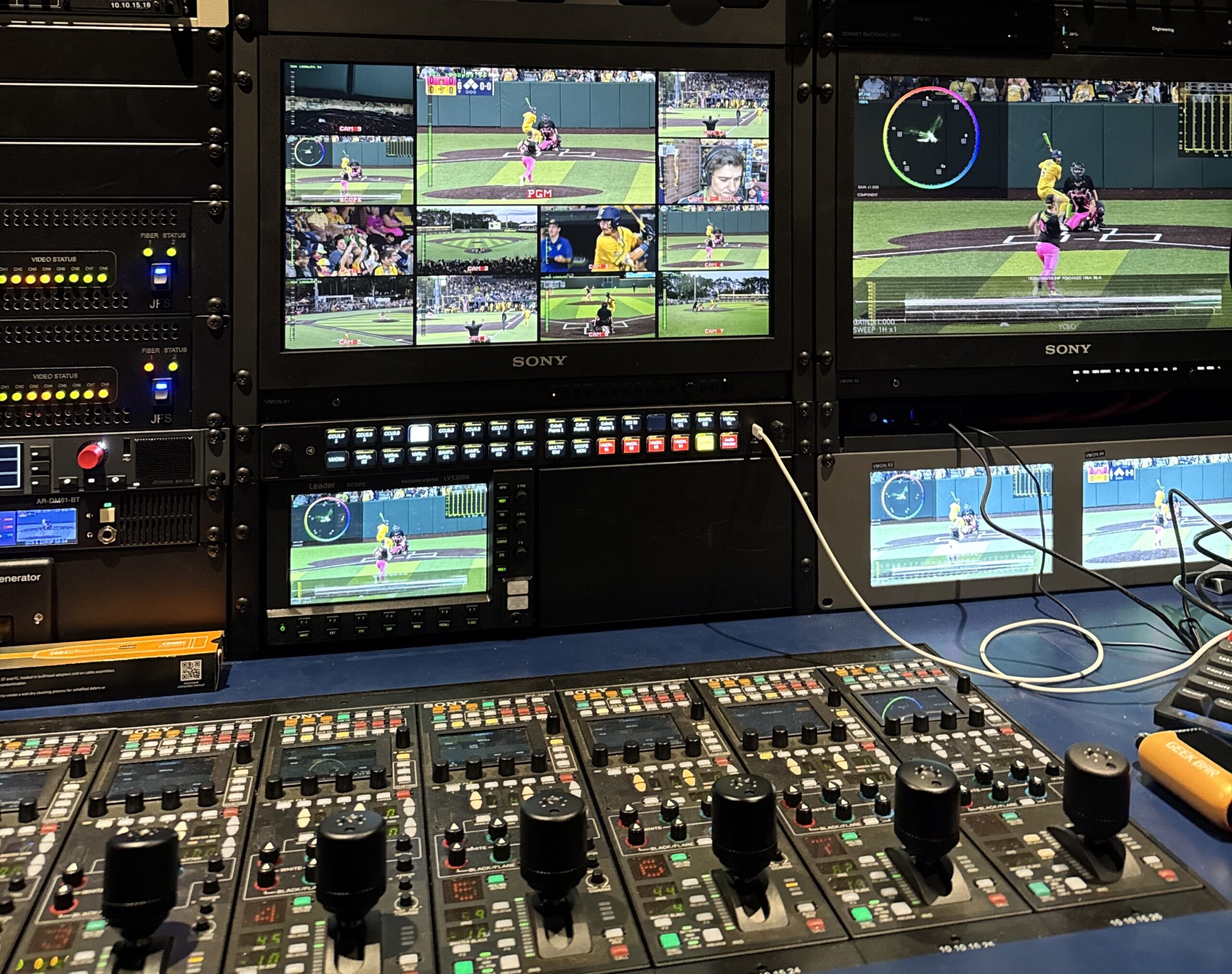
Inside the Banana Van during Bananas vs. Party Animals from Savannah’s Grayson Stadium on April 18.
The control-room upgrades were completed prior to the start of the 112-game, 41-city, eight-month-long World Tour. Rubenstein, Webster, McCluskey, along with others, were tasked with also enhancing the technologies and workflows currently in use. The newly acquired tech in the arsenal, along with a reliable production home, gives the broadcasts an extra layer of preparedness.
“Now that we’re going back to ballparks that we were in last season, it has very much been plug-and-play,” says McCluskey. “The built-out Banana Van has made the integration into some of these bigger ballparks a lot easier since it can [connect] to the venue’s infrastructure like a traditional mobile unit would.”
Logistical Layout: Packed Schedule, Simultaneous Games Are a Production Curveball
Whether sports or entertainment, any World Tour comes with challenges and areas for error. The massive scale of the Savannah Bananas’ endeavor, along with sometimes hitting multiple locations in a short period, can put a strain on the personnel handling the broadcasts. The large number of games has forced the crew to adapt along the way, including moving from a 100% internal-staff effort to relying on, and finding, local talent to work the games.

Savannah Bananas outfielder Robert Anthony Cruz, also known as Coach RAC, performs a backflip while miked up.
“We try to get as far ahead as we can because we’re trying to find crew and be super-organized,” says Rubenstein. “We treat our games the same way as any mainstream television network by making sure that we have the right infrastructure laid out by the time we get there.”
From a technological perspective, the many days of back-to-back nights or simultaneous play can put extra stress on both the technology in the field and the remote-production setup in Savannah. To fulfill Cole’s vision of putting the fans first, the behind-the-scenes crew will do whatever necessary to ensure that fans not in attendance can still watch their beloved Bananas.
“Sean has been a big driver in figuring out and making it work for these second shows, where we have only enough internet connection to get one video feed out at some of these venues,” adds Webster. “For us, it’s about how we can we make the show better for the fans by sometimes reducing our technology complexity and doing more of a traditional show.”

Savannah Bananas play-by-play announcer Biko Skalla and analyst Josh Talevski interview pitcher Dakota “Stilts” Albritton.
In live event production, a lot of broadcast elements are out of Fan First Entertainment’s control. One of these is inclement weather’s postponing a game; in the traveling show that is Bananaland, a lost day can cause problems down the line. Luckily, weather has cooperated this summer, but, from a tech standpoint, the roaming Banana Van and its gear still need to get from venue to venue with ample time to set up.
“We work closely with our events team to get the gear to each stadium on time and know certain aspects like where to load our equipment and how to power everything up,” adds McCluskey. “Having that communication and coordination with them has been paramount.”
From Majors to Minors: Stadiums in Various Sizes Add to the Challenges
Ranging from the Bananas’ largest-ever crowd of 81,000 at Clemson University’s Memorial Stadium on April 26 to their Savannah home with a capacity of 5,000, the beauty of the current World Tour is that it stops at a wide variety of stadiums. For fans, it offers many opportunities to see the spectacle in person, but, from an operational and engineering perspective, the sliding scale of size can present several roadblocks.
Larger and newer venues are generally more accommodating to broadcast needs: state-of-the-art truck compounds, updated connectivity, a sturdier tech backbone. Smaller venues — like many of the MiLB stadiums hosting Party Animals, Firefighters, and Texas Tailgaters games — aren’t so broadcast-friendly.
For example, during the first week of July, the Bananas appeared at two stadiums within the Boston Red Sox organization: Fenway Park in Boston on July 5-6 and Carilion Clinic Field at Salem Memorial Ballpark in Salem, VA, on July 11-12. The former is a major-league ballpark that underwent renovations in the offseason, including new videoboards in the outfield; the latter, home to the Single-A affiliate Salem Red Sox, has a max capacity of just over 6,000 and hasn’t had significant tech changes since its opening in 1995.
Despite the challenges, McCluskey strives to bring the same top-tier broadcasts in whatever venue the teams play in. “[Working with the Red Sox organization], the Bananas understand the interest of making sure there isn’t any dip in quality,” he notes. “When we came on during the offseason, we had a lot of fun to make all this happen.”

Savannah Bananas reporter Sam Bauman looks into the camera with a magnifying glass.
Although the fans don’t see the effort it takes to bring them the shows, the evolution has been quite noticeable for the production team. Going from cameras and camcorders suited mainly for live streaming to broadcast-grade cameras and box lenses is a huge leap with a potential learning curve, but camera operators and the entire broadcast team have been eager to learn.
“It has been extremely rewarding to be able to work with the people that were here before us and see how much they’ve embraced these changes,” says McCluskey. “Seeing them learn all of these new techniques that they didn’t know were even possible four months ago has been cool.”
New Rules, No Rules: As Banana Ball Changes, Crew Has Freedom To Experiment
If there’s anything sports fans should know about Jesse Cole, it’s that he’s always looking to implement new rules or points of contact for fans to be involved. Stealing first base? A fan catching a foul ball counting as an out? An ejection for bunting? And a complete turnaround from old-school baseball: a two-hour time limit? Only in Banana Ball.
As the rules are amended or additional ones are implemented, the production and technical crews need to adapt. Fortunately, the background of Rubenstein, Webster, and McCluskey at Ross Production Services/Ross Mobile Productions helps the team remain nimble and ready to go at a moment’s notice.
“We often did entertainment-style shows, combat sports, and esports,” notes Webster, “so we were constantly having to balance new technologies for very specific types of shows and adapting those technologies to other productions. As we pioneered a lot of the esports productions, we were keen on mixing 1080p workflows, fiber connectivity, and AR or VR insertion, but we were also familiar with adding single-sensor cameras for a more cinematic look with traditional broadcast cameras. [With] the Bananas, we’re using this experience to push their vision forward and find ways to make it work.”

Firefighters broadcast entertainer Zach Staton on the field with pitcher Mat Wolf
Unlike with any other professional sports team or league, the production has unlimited freedom to express creativity and storytelling at the highest level. Players on all four rosters are more than willing to be miked and are even comfortable performing backflips or breakdancing in the outfield. Without stringent regulations, camera operators are allowed to run on the field alongside a player making a WWE-style entrance/TikTok dance starting from beyond the centerfield wall.
Credit to the players for making themselves and their personalities available, but Cole’s and Orton’s out-of-the-box thinking has opened doors to what is possible on a broadcast. In addition to broadcast responsibilities, Fan First Entertainment plays a large role in the in-venue production of each game.
Operations are fairly standard for bigger venues with high-octane control rooms. Savannah Bananas Technical Director Jessie Hirzel, for instance, worked in the Philadelphia Phillies’ recently renovated control room and on the staff of PhanaVision for the Bananas’ trip to the City of Brotherly Love. At the smaller venues, the team’s flypack supplies video feeds for in-house crews that have production switchers without a ton of available resources.
“We’re able split our flypack into two [with feeds going to Savannah for our broadcast production and feeds going to the in-stadium control room],” says McCluskey. “We’ve done that a handful of times during this tour. It has been awesome to marry what we do on the broadcast side with what’s going on inside the stadium.”
This system has become critical for a major wrinkle of Banana Ball: fan challenges. If there’s a borderline play and a fan deems it worthy of a closer review, the umpires will honor their request, and everyone sees the replay on the in-venue videoboard. The difference between the Bananas and other professional sports leagues is that the review is done in real time for all to see. It’s yet another way for fans to feel fully immersed in the game.
“We’re not going undercover,” explains McCluskey. “Everyone is seeing the same camera angles together.”

Texas Tailgaters broadcast entertainer Brett Loftis conducts an on-field interview during pregame.
Unique rules, a higher sense of inclusion for fans in the stands, and a brand of baseball that’s attracting a new wave of fans come with a caveat: all shows of the 2025 Banana Ball World Tour have been sold out. That’s an accomplishment and testament to the Savannah Bananas, but, for Fan First Entertainment, it means working around fully occupied seats every single night. To get the right angle of certain plays, expand game coverage, or come up with an unusual camera angle, the crew doesn’t have a ton of room for maneuverability.
“Our biggest challenges have been full stadiums, especially in MiLB parks, and not being able to place a camera wherever we want to place it,” says Rubenstein. “We recently added a low-home robo in the Major League parks, and we continue to look for the best places and ways to add more cameras.”
Banana Brainstorm: Upcoming Offseason Offers Time for Improvements in 2026
There are still many games of the World Tour remaining, but attention is already turning to where the Bananas will go and who will host the games in 2026. With plans for making Banana Ball a more robust product on the diamond and on television sets and digital platforms, the crew aims to bulk up its hardware and software on the backend.
“We’ll have the time to build up our technology not only in the control room but also in our remote [setup at the stadium],” says McCluskey. “We’ve thought about it during this season, but we want to actually do it for next season. We’ve started planning those pieces now to be prepared for the offseason.”
Besides Cole and Orton, the Savannah Bananas team comprises Executive Producer Ivan Traczuk, Broadcast Producer/Director Chad Reese, Broadcast Engineers Nick Keldie and Griffin Ellis, and replay operator Keegan Woods behind the scenes and play-by-play announcer Biko Skalla, analyst Josh Talevski, and reporter Sam Bauman, Party Animals broadcast entertainer Drake Toll, Firefighters broadcast entertainer Zach Staton, and Texas Tailgaters broadcast entertainer Brett Loftis in front of the camera. They all work to ensure that Fan First Entertainment stays true to the company name: fans first, always.
“[Cole and Orton] have been here since Day 1,” notes Rubenstein. “It has exploded in the last two years. We have tremendous leadership, but we’re also a collection of creative, talented, and hardworking individuals. We’ve truly become one team because everyone has a real appreciation for what each of us is doing.”