2025 SVG Summit Audio Recap: Say What?
The Audio Production and Distribution Workshop at the SVG Summit 20 took on issues including speech intelligibility, Next-Gen Audio, and the holy grail of transducers: the digital microphone
Story Highlights
The 2025 SVG Summit was the largest yet, underscoring SVG’s own 20th anniversary, marked by steadily expanding membership and sponsor aggregation. The SVG Summit 20 itself, which covered a broad range of issues at a time when broadcast sports is expanding into streaming and experiencing evolving workflow modalities, came as one of its foundational members, NBC Sports, is about to pull off a media hat trick comprising the Olympic Winter Games, Super Bowl LX, and the NBA All-Star Game, all within a 10-day span. That’s even as major events such as the World Cup loom over the US sports landscape in 2026, as once-peripheral sports like F1 move closer to center stage, and even the Savannah Bananas — baseball’s counterpart to the Harlem Globetrotters — get ready for prime time next year.
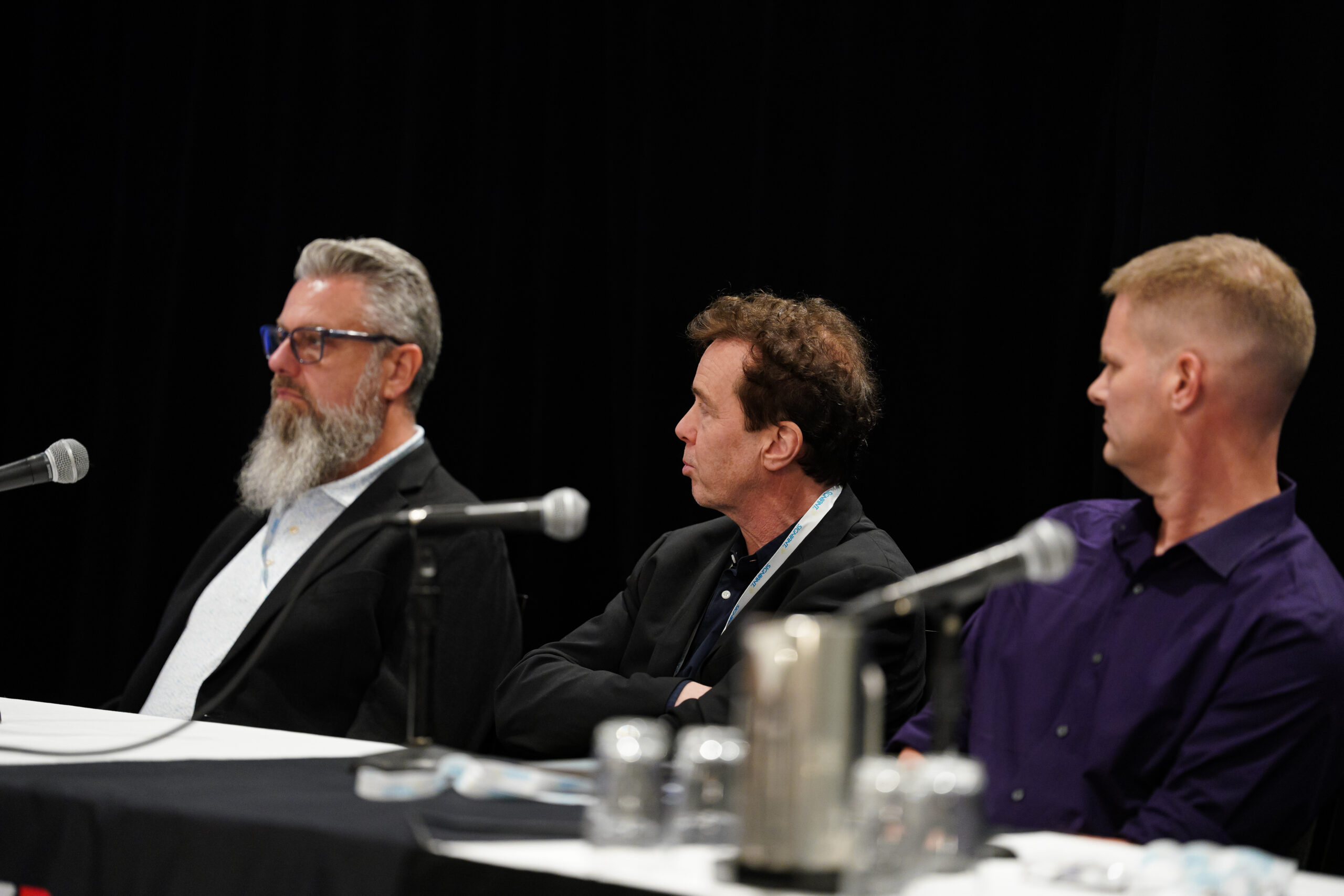
Florian Brown, Sound Supervisor, Karl Malone, NBC Sports and Olympics, Senior Director of Audio Engineering and Ceri Thomas, IMMERSV, Founder during the Perspectives on Live Audio Production and Distribution panel.
Broader production and workflow issues understandably took center stage on the Summit agenda, but there was a separate place where attendees could hear about what they hoped to hear during much of all that: the Audio Production and Distribution Workshop, which took place on Dec. 15, Day One of Summit 20. There, the agenda included panels and presentations on improving dialog intelligibility, IP-enabled microphones, a look ahead at the audio innovations planned for the 2026 Milan Cortina Olympics, and capped by an always lively conversation about, well, everything.
The Audio Production and Distribution Workshop, co-chaired by SVG Audio Director Roger Charlesworth and NBC Universal Director and Principal Audio Engineer Jim Starzynski, and co-sponsored by Audio-Technica, Dale Pro, Dolby, Calrec, Lawo, Shure, SSL, and Telos Alliance, saw many familiar faces among the 60 or so attendees in the room on the main Summit floor. While not every presenter was authorized by his or her company or organization to speak on the record about every topic, what emerged thematically is a broadcast audio sector that is steadily building out its toolkit for an imminent immersive future that will still have to contend with regulatory and other restraints.
For instance, immersive-audio capability continues to proliferate, Dolby Atmos is available on television in the US OTA broadcasts on NextGen TV (ATSC 3.0) stations, which are now available in more than 70 markets and reach around 60% of households.
As importantly, audio quality is being continuously addressed. The AES technical document TD1009.0.0.1 — Improving Dialogue Intelligibility in Media — was published literally weeks before the Summit 20 and aims to provide guidance and recommendations for improving the clarity of dialog in various media, and was the subject of discussion. It was also pointed out that ATSC A/85 RP (Recommended Practice) for TV audio loudness, mandated by the CALM Act of 2012, requiring broadcasters to control commercial volume to match programming, continues to be vetted and updated, incorporating new loudness-measurement guidelines for even better control. Audio quality remains, as one presented noted, “a work in progress.”
The demands for increasingly higher channel counts for immersive audio, alternate music, multiple language support, and discrete object elements have completely outstripped the decades-old SDI-based channel counts common in program workflows throughout production and distribution. SMPTE ST-2110 and its burgeoning array of subvariants are addressing that. The protocols continue to revolutionize broadcasting in the digital era, particularly as it adds metadata to the mix. However, it was noted that the arrival of online wagering on sports could also add pressure on that bandwidth.
At an iteration of this forum a few months ago in Detroit, we were assured that digital microphones are on their way. At Summit 20, that universe with much closer, as Voyage Audio’s Voyage Audio Spatial microphone has since been officially joined by Shure’s DCA901 Broadcast Microphone Array. Described as the first digital array microphone purpose-built for broadcast, the DCA901’s steerable lobes provide the ability to virtually and precisely aim pickup zones, eliminating crowd noise and bleed without physically repositioning microphones. This flexibility makes it possible to deliver a rich and consistent “effects mix” that keeps audiences fully immersed.
Two’s Company, Three’s A Category
The DCA901 joins Voyage Audio’s Spatial microphone and Audio-Technica BP3600 immersive-audio microphone, introduced in 2023, at a time when broadcasters are looking harder than ever at immersive effects and ambience. The Spatial mic has already made appearances at the Super Bowl (capturing the sound for the aircraft flyover) and for NHL games on Amazon Prime. A1 Jason Blood noted his use of it for pre-game ambience capture in NHL locker rooms, adding a you-are-there immediacy beyond the game itself, as well as crowd-sound capture. A1 Glenn Stilwell, who likes how steerable lobes allow him to move around the periphery of the field of play, added that array-type microphones also have an economic and ergonomic aspect, shortening the times usually allotted to pre-game deployment and after-game collection, saving he estimated in some cases, two man-hours per game.
One panelist in a discussion on the topic dubbed this new category of microphones “a workflow solution first,” as well as a sonic quality and mixing improvement. Gary Dixon, A-T’s Broadcast Business Development Director, pointed out that these microphones also add a data source, by virtue of their use of Dante and AES67 formats, a critical new channel in an increasingly data-driven production environment. The next frontier in what has quickly become its own burgeoning category in pro audio is finding ways to enhance remote control capability and add interoperability with other systems, features that will make the microphone an integral part of a digital broadcast ecosystem as opposed to simply the static endpoint it’s always been.
Snow Men And Women
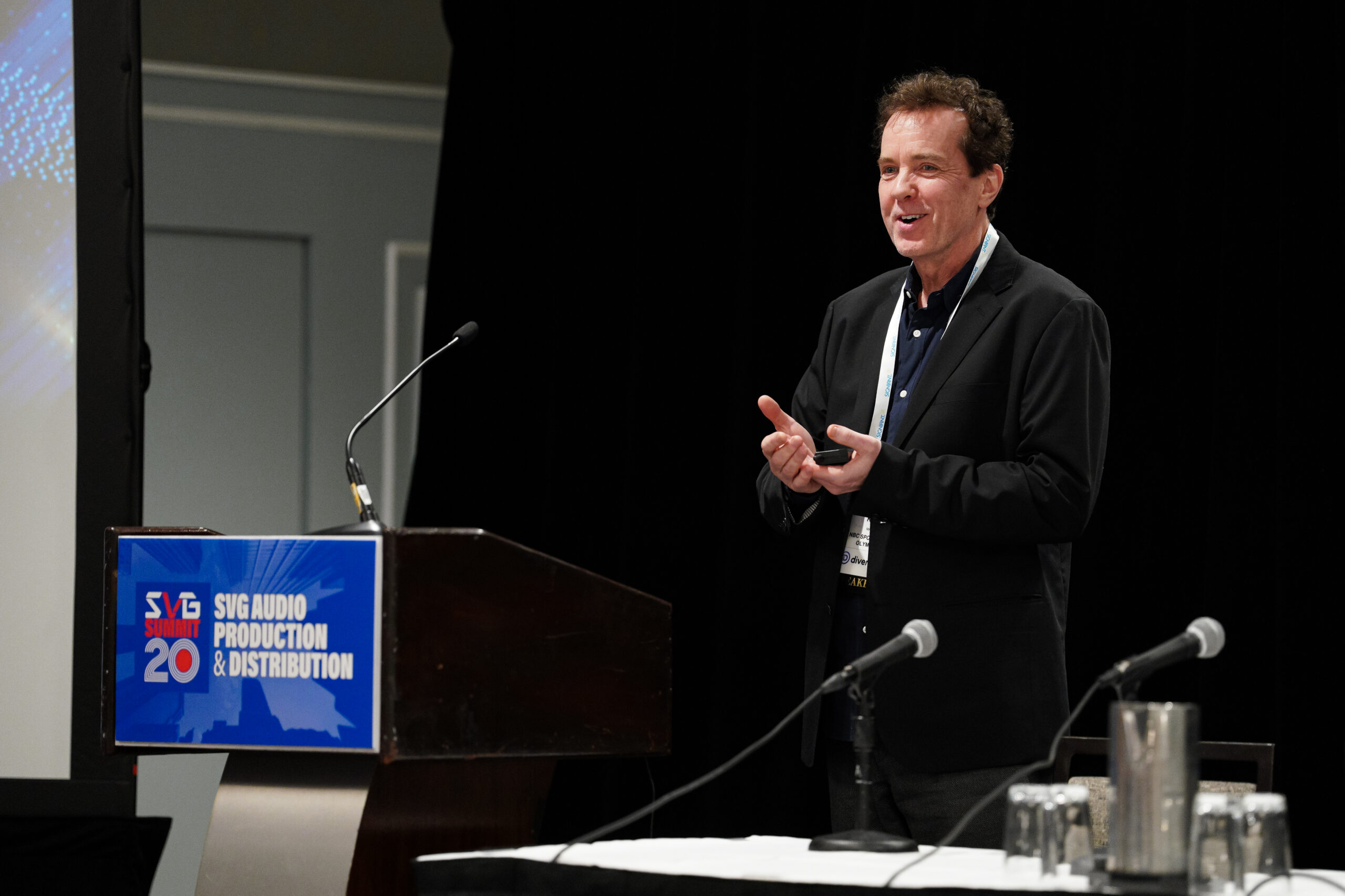
Karl Malone, NBC Sports and Olympics, Senior Director of Audio Engineering, talks Milan Cortina 2026 sound.
Audio Production and Distribution Workshop attendees were also treated to previews of the audio infrastructure for the upcoming 2026 Winter Olympics from Milan. The snowy extravaganza, whose broadcast audio will be helmed by Karl Malone, Senior Director of Audio Engineering, NBC Sports & Olympics, who laid out the complex infrastructure that will carry the coverage, from the Feb. 6 opening ceremony through 16 days of events across a large swath of northern Italy. In fact, says Malone, the scale of the Olympic campus presents the single largest challenge to the production, which will also be shown on NBC, USA, CNBC, and Peacock/Goldzone streaming networks. On the other hand, the events also offer new opportunities for immersive sound, with control rooms fitted for 5.1.4 mixing. In fact, he suggests, the unprecedented close grouping of the Olympic Winter Games, Super Bowl LX (Feb. 8), and the NBA All-Star Game (Feb. 15), all on NBC within a 10-day span presents a challenge but also an opportunity to achieve “mixing consistency across all sports.”
This Olympics will also see more athletes and coaches wearing wireless microphones and embedded in the ice for figure skating. Dante connectivity and a 64-channel MADI stream will provide as many as 10 immersive audio streams, with immersive capture by both Voyage Audio and A-T multichannel microphones. Finally, Malone emphasized all audio will be monitored for quality in a separate studio.
Invoking a very Irish sense of humor, he said, “Better to hear any problems there than read about them on Twitter.”